



Where the success of South Korea in memory chips comes from. Ispi Report
AI has transformed memory chips into a crucial strategic component, establishing South Korea and its companies Samsung and SK Hynix as leaders in the global supply chain. The ISPI report.

Chip, why Taiwanese TSMC will invest in the USA
Tsmc announces a new $100 billion investment in the USA aimed at the construction of four state-of-the-art manufacturing plants in Arizona.

Why Nvidia is tightening controls on AI chips in Asia
Nvidia, under pressure from the Trump administration, has cut more than half of its authorized Asian customers allowed to purchase its AI chips, introducing new controls that worsen the shortage of advanced processors in China.

How is the race for microchips progressing between Meta, TSMC, and SK Hynix?
Meta is focusing on a proprietary microchip to reduce dependence on Nvidia. Meanwhile, TSMC says it will not be able to fulfill all orders (revenues, meanwhile, are soaring), and SK Hynix also reports a shortage of memory chips. All the details.

Chip war, here are China’s plans and announcements. Economist report
The United States suspects that an ASML EUV machine has arrived in China, but the Dutch company denies it. In the background, the clash between Washington, Beijing, and Brussels over control of semiconductors is intensifying.

Apple also invests in Broadcom to curry favor with Trump
After the agreement with Intel, Apple announced a $30 billion investment to purchase Broadcom microchips, strictly produced in the United States. Tim Cook’s company needs to maintain good relations with the Trump administration, which had threatened tariffs on iPhones.

This is how Samsung and SK Hynix will help South Korea dominate AI.
South Korea launches a nearly $600 billion plan with Samsung and SK Hynix to massively expand memory chip production, strengthening leadership in AI and redistributing economic growth towards the southwest of the country.

Chip, what do we know about the (historical?) listing of SK Hynix in the United States?
The South Korean company SK Hynix, a leader in the AI memory chip market, plans to go public on the New York Stock Exchange, with expectations of a record-breaking deal. Here is what HBM memory is and what the company’s plans are.

Microchips, State aid authorized by Brussels. Here are the names of the companies.
The European Commission has approved state aid of 76 million euros to Germany to support QuantumDiamonds, a German company in the semiconductor supply chain. Berlin had recently received approval from Brussels for subsidies to Zeiss, Zadient, GlobalFoundries, and X-Lab (over 910 million euros in total). But Italy has also obtained something.

Everything about the agreement between Apple and Intel for microchips in the United States
Trump announced an agreement between Apple and Intel for the design and production of microchips in the United States. Although details are scarce, the deal will provide a significant boost to Intel’s revival, of which the American government is a shareholder. For Apple, the contract will help reduce dependence on Taiwan and improve relations with the White House. All the details.

After SpaceX, will Marvell be the next company to enter the “trillion-dollar club”?
According to Jensen Huang of Nvidia, Marvell will be the next company to reach a market capitalization of $1 trillion. But is that really the case? Here’s what Marvell does, why it matters, and how much it is expected to earn in the coming months.

Will Google, Nvidia, Tesla, and Apple save Intel’s microchips?
Google has ordered a large quantity of microchips from Intel, and Nvidia is also examining the manufacturing technology of the former semiconductor giant. Under Lip-Bu Tan, Intel has begun a path to recovery and is closing important contracts (including with Tesla and Apple), but doubts remain.

Will Stmicroelectronics’ plans overshadow the Italian plants?
Given the boom in artificial intelligence, Stmicroelectronics will invest in the further expansion of the Crolles plant, dedicated to silicon photonics. Although there is no direct competition with the Italian sites, the increasing importance of the data center segment for the company’s finances could push the company to focus on France.

Microchips, data centers, and a sovereign fund: what’s in the European package for technological sovereignty
The European Commission has presented a legislative package for the Union’s technological sovereignty: it includes a new Chips Act and a law for the development of artificial intelligence and cloud computing. Brussels is also opening up to a sovereign fund for advanced technologies.

Will Nvidia bury Intel with the new “superchip” for computers?
After graphics cards for video games and processors for artificial intelligence, Nvidia now aims to dominate the microchip market for computers as well. According to the company, the new Rtx Spark Superchip is set to “completely reinvent the way the PC works.” All the details.

The chip crisis brings SK Hynix and Micron into the “trillion-dollar club.”
The memory chip crisis, caused by the boom in artificial intelligence, is weighing on manufacturers of smartphones, laptops, video games, and automobiles. But it is making companies like SK Hynix and Micron, which exceed $1 trillion in market capitalization, very successful. Details and context.

All of Asml and Tata’s plans for microchips in India
Asml and Tata agree on the first 300-millimeter semiconductor factory in India. The Dutch company will supply its lithography machines and aims to expand in the country—like Apple, Google, and Microsoft—to avoid relying too much on China. All the details.

Asml, the Netherlands grumble against the United States over the new anti-China law.
The Netherlands opposes the United States’ Match Act, a law that tightens restrictions on the sale of microchip machinery to China and would consequently harm the business of the giant ASML. All the details.

What do we know about the smuggling of Nvidia chips between Supermicro, Alibaba, and Thailand?
The Thai company Obon is suspected of smuggling Super Micro Computer servers containing Nvidia microchips into China: among the buyers is reportedly Alibaba, which is on the United States “blacklist.”
Could Apple replace TSMC with Intel and Samsung?
Apple depends on TSMC for the manufacturing of processors used in iPhones and Macs. Thus, for supply chain security reasons, it has started looking for new suppliers: it has initiated contacts with Intel and Samsung, but neither seems capable of matching the Taiwanese company.

Google challenges Nvidia with new processors for artificial intelligence
Google has unveiled its new TPUs, microprocessors for artificial intelligence dedicated to the training and inference phases of language models. The Alphabet group insists on “in-house” components to reduce dependence on Nvidia chips and announces a $750 million fund to promote the spread of AI agents. All the details.

This is how Tesla is stockpiling Samsung memory chips.
Samsung Electronics has quadrupled its deliveries of GDDR6 DRAM memory chips to Tesla, which are essential for the infotainment and autonomous driving systems of the cars. All the details.

Does innovation still speak Italian?
From the decade-long substantial bet on graphene to the geopolitical challenge of chips: during the Pavia Innovation Week, the key players in research and industry discussed the future of cutting-edge innovation in Italy and Europe.

Will the “new” Intel restart from Ireland?
For 14 billion dollars, Intel is reacquiring full ownership of a factory in Ireland that it had sold only two years ago. The former American microchip giant is making a strong comeback after the cuts (and a generous public investment)?

Is China helping Iran with Smic microchips?
Smic, the most important Chinese semiconductor company, has sent machinery for microchip production to the Iranian armed forces. Officially, Beijing has not taken a stance in the Gulf war, but it could be providing support to Tehran.
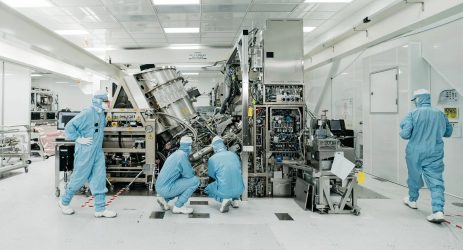
What will SK Hynix do with ASML’s microchip machinery?
Sk Hynix, a leading company in the memory chip market, will spend 8 billion dollars to acquire the most advanced machinery from Asml. The Dutch company continues to secure orders for its equipment, highly sought after by the artificial intelligence supply chain. All the details.

What is STMicroelectronics doing with microcontrollers in China?
Stmicroelectronics has begun delivering Stm32 microcontrollers entirely produced in China. The company, controlled by the Italian and French governments, claims to be the first in the world to offer a dual and equivalent supply chain, both Chinese and non-Chinese. All the details.
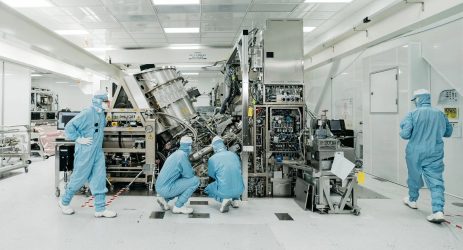
The war on Iran risks also impacting semiconductors.
The Strait of Hormuz crisis threatens not only fossil fuel markets but also the semiconductor industry, which depends on helium produced in Qatar. Taiwan—the global hub of this sector, home to TSMC—is particularly vulnerable, and the European supply chain is also exposed. All the details.

How India is moving on Hormuz, oil, and beyond
India is engaged on two fronts: on one hand, it is negotiating with Iran to ensure safe passage for tankers through the Strait of Hormuz; on the other, it is outlining an incentive plan for microchips to attract capacity from abroad. All the details.

Nexperia, the chip crisis between China and the Netherlands resumes
As the world grapples with rising oil and gas prices, the crisis between China and the Netherlands over Nexperia, the semiconductor company for the automotive industry, has reopened. All the details.

Why Nvidia gave up selling H200 chips in China
Under pressure from the governments of the United States and China, Nvidia has halted production of the H200 processors for artificial intelligence to focus on next-generation devices. Washington had authorized the sale of the H200 on the Chinese market, but the situation later became complicated, and Beijing also imposed restrictions. All the details.
