

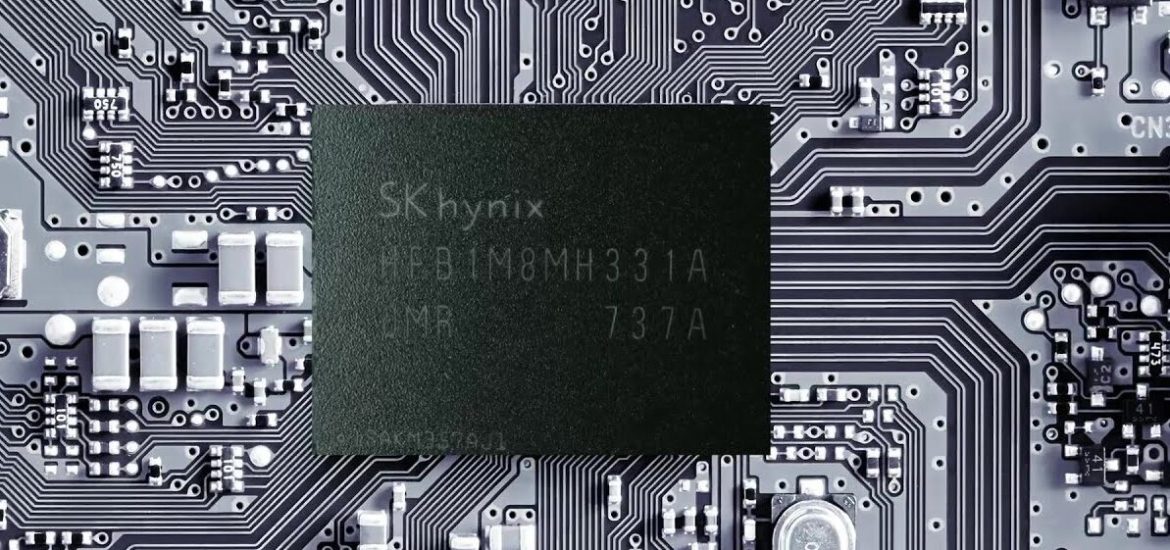

The development of artificial intelligence has caused, for many months now, a crisis in the memory chip market. These are — as the name suggests — electronic devices that allow data to be stored and exchanged with the central processing unit, the component that manages all the main activities of a computer. Since memory chips are essential for AI-dedicated systems, hyperscalers (companies like Amazon and Alphabet, which provide digital services via the cloud) are purchasing them in large quantities, reducing the available supply for other uses and driving up the price.
The shortage of memory chips is weighing on the operations and financial results of electronic device manufacturers, video game consoles, and even automobiles. But it is proving very positive for the economic and financial results of the handful of companies that produce them, to the point that South Korean SK Hynix and American Micron Technology have for the first time reached a market capitalization exceeding $1 trillion.
SK HYNIX AND MICRON IN THE “$1 TRILLION CLUB”
SK Hynix and Micron have thus fully entered the $1 trillion club, that group of companies whose market cap has surpassed $1 trillion: it includes Nvidia ($5.2 trillion), Alphabet ($4.6 trillion), Apple ($4.5 trillion), Microsoft ($3 trillion), and Amazon ($2.8 trillion), but also TSMC ($1.9 trillion), Saudi Aramco ($1.8 trillion), Tesla ($1.6 trillion), and Samsung ($1.1 trillion), another company that has benefited from the memory chip crisis.
THE RESULTS OF SK HYNIX AND MICRON
On Wednesday, SK Hynix’s stock rose by 9.3 percent — and by over 1000 percent over a twelve-month period — while Micron’s rose by 19 percent, the highest since 2011: according to UBS, moreover, the value of its shares could double within a year.
SK Hynix is the dominant company in the high-bandwidth memory (HBM) market, with a 57 percent share in the fourth quarter of 2025; it is followed by Samsung with 22 percent and Micron with 21 percent.
SK Hynix — which is also preparing for a listing on the New York Stock Exchange — said it expects a fivefold increase in its quarterly profits and believes the imbalance between HBM supply and demand will not be resolved before three years.
WHAT HBM MEMORIES ARE
Simply put, the main types of memory chips are two: NAND memories (short for Not And) and DRAM (dynamic random-access memory). NANDs are mainly used for permanent data storage in USB sticks and solid-state devices: they are slow but work even without electrical power. DRAMs, on the other hand, are fast but temporary, meaning they lose data when the computer is turned off. Essentially, NAND memories are intended for long-term data storage, while DRAMs serve to make a processor work quickly.
With the development of artificial intelligence, a new type of memory chip has emerged, which is actually a subcategory of DRAM: HBM, short for high-bandwidth memory, which allows enormous amounts of data to be transferred in very short times. Unlike “classic” DRAMs, HBMs are stacked vertically and placed very close to the processor to increase data transfer speed.
AI servers host large amounts of HBM memory but still require DRAM and NAND memory chips as well.




