

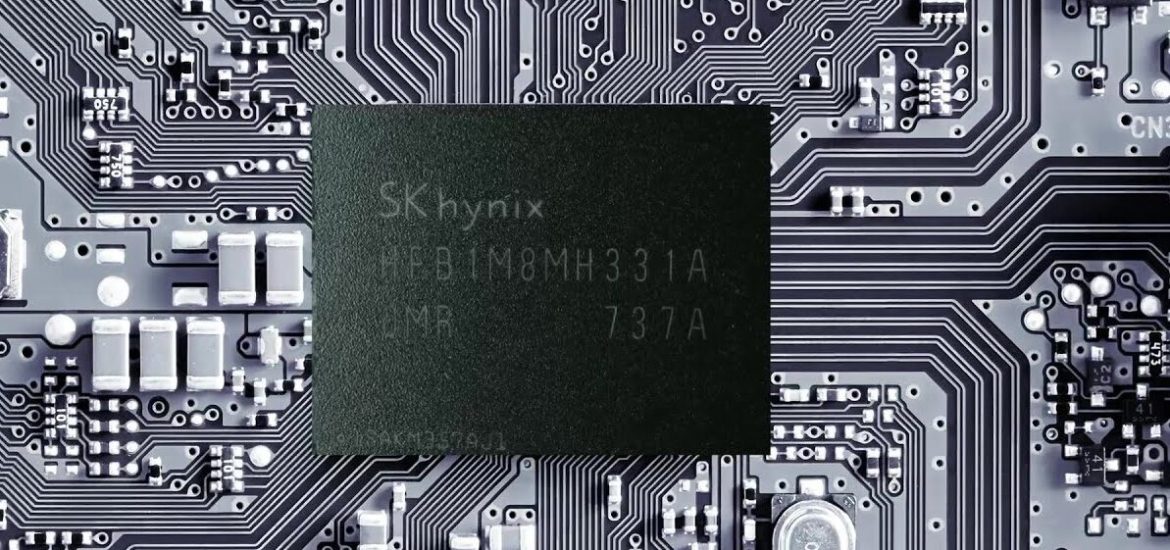

The South Korean company Sk Hynix, the world’s largest producer of a type of microchip highly demanded by the artificial intelligence sector, intends to list on the stock market in the United States as well and expects to raise over 29 billion dollars.
According to Bloomberg, the operation could prove to be one of the top five stock sales of all time, comparable to the initial public offering of the Saudi oil company Aramco in 2019, which was a record at the time. Trading on the US market is expected to begin on July 10.
WHY SK HYNIX IS IMPORTANT
Since the beginning of the year, Sk Hynix shares on the Seoul stock exchange have risen by about 300 percent, allowing the company to reach a market capitalization of 1000 billion dollars, and even surpass it.
The enthusiasm for Sk Hynix is linked to that for artificial intelligence: the South Korean company alone controls more than half – 58 percent to be precise, according to Counterpoint data – of the global HBM memory chip market in terms of revenue. In the first quarter of 2026, the shares in this market of Samsung, also South Korean, and the US-based Micron were each 21 percent.
A STEP BACK: WHAT MEMORY CHIPS AND HBMS ARE
Memory chips, or memory chips, are electronic devices that allow data to be stored and exchanged with the central processing unit, the component that manages all the main activities of a computer. Since memory chips are essential for systems dedicated to artificial intelligence, so-called hyperscalers – that is, large companies like Amazon and Alphabet, which provide digital services via the cloud – are purchasing them in large quantities, reducing the available supply for other uses and driving up the price.
Simply put, the main types of memory chips are two: NAND memories (short for Not And) and DRAM (dynamic random-access memory). NANDs are mainly used for permanent data storage in USB sticks and solid-state devices: they are slow but work without electrical power. DRAMs, on the other hand, are fast but temporary, meaning they lose data when the computer is turned off. Essentially, NAND memories are intended for long-term data storage, while DRAMs serve to make a processor work quickly.
With the development of artificial intelligence, a new type of memory chip has emerged, which is actually a subcategory of DRAM: HBM – short for high-bandwidth memory – which allows enormous amounts of data to be transferred in very short times. Unlike “classic” DRAMs, HBMs are stacked vertically and placed very close to the processor to increase data transfer speed.
AI servers host large quantities of HBM memories.
PLANS AFTER THE LISTING
Sk Hynix has outpaced the competition in the transition to HBM technology, which has allowed it to become an indispensable supplier for Nvidia, the dominant company in the AI processor market. It seems the company wants to use the proceeds from the US listing to acquire additional production capacity and to purchase extreme ultraviolet lithography machinery from ASML, the Dutch company that holds a global monopoly in the manufacture of these devices.
EUV is an extremely sophisticated process that, using very short wavelength light, allows “printing” tiny circuits on microchips. In March, Sk Hynix announced a large order of EUV machines from ASML worth nearly 8 billion dollars. In February, it revealed an investment plan of about 24 billion for the expansion of its Yongin production hub in South Korea: part of this mega-factory is expected to open in 2027.
FIRST QUARTER RESULTS OF 2026
In the first quarter of 2026, Sk Hynix reported an operating profit of 24.4 billion dollars, a record value that exceeded analysts’ expectations, which were around 23.2 billion. The company’s sales nearly tripled, surpassing 34 billion.




