

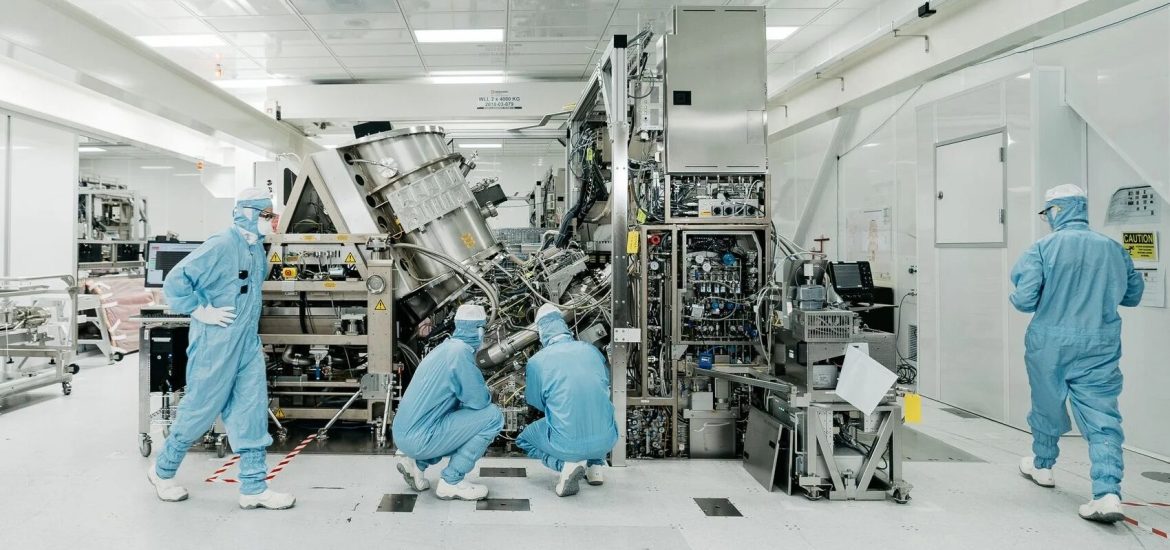

The South Korean semiconductor company Sk Hynix plans to invest nearly 8 billion dollars to purchase extreme ultraviolet lithography machinery from Asml, a Dutch company that holds a global monopoly in the production of these devices.
EUV, MEMORY CHIPS, AND ARTIFICIAL INTELLIGENCE
Extreme ultraviolet lithography (or EUV) is an extremely sophisticated process that, using a very short wavelength light, allows the “printing” of tiny circuits on microchips. Sk Hynix wants to apply it to the production of memory chips: memory chips are electronic components that – as the name suggests – allow data storage; the availability of fast and high-bandwidth memories is fundamental for the advancement of artificial intelligence systems.
WHAT THE AGREEMENT BETWEEN ASML AND SK HYNIX MEANS
The agreement between Sk Hynix and Asml will be valid until 2027 – also because a single EUV machine requires over a year of work and costs hundreds of millions of dollars – and is one of the largest of its kind, wrote Bloomberg.
For Asml, the agreement confirms its absolute centrality in the global semiconductor industry. 2025 was, for the company, the thirteenth consecutive year of sales growth; moreover, in the fourth quarter alone, it recorded orders worth 13.2 billion euros, a record and a value significantly above analysts’ expectations, whose estimates were around 6.8 billion. In 2025, Asml’s net revenues amounted to 32.7 billion, while those forecast for 2026 range between 34 and 39 billion.
As for Sk Hynix, it is a major producer of high-bandwidth memories as well as the main supplier of Nvidia, whose processors are highly demanded by artificial intelligence developers. Last month, the company announced an investment plan of about 24 billion dollars for the expansion of its production hub in Yongin, South Korea: part of this mega-factory is expected to open in 2027.
THE SHORTAGE OF MEMORY CHIPS
Meanwhile, the market continues to experience a shortage of memory chips. The main producers – besides Sk Hynix, there are also South Korean Samsung and American Micron – are indeed expanding their production capacities, but they are focusing on devices intended for data centers for artificial intelligence, which are more advanced and also more profitable. By doing so, however, they are leaving traditional sectors “uncovered,” such as automotive and consumer electronics, which use less performing memory chips.




