

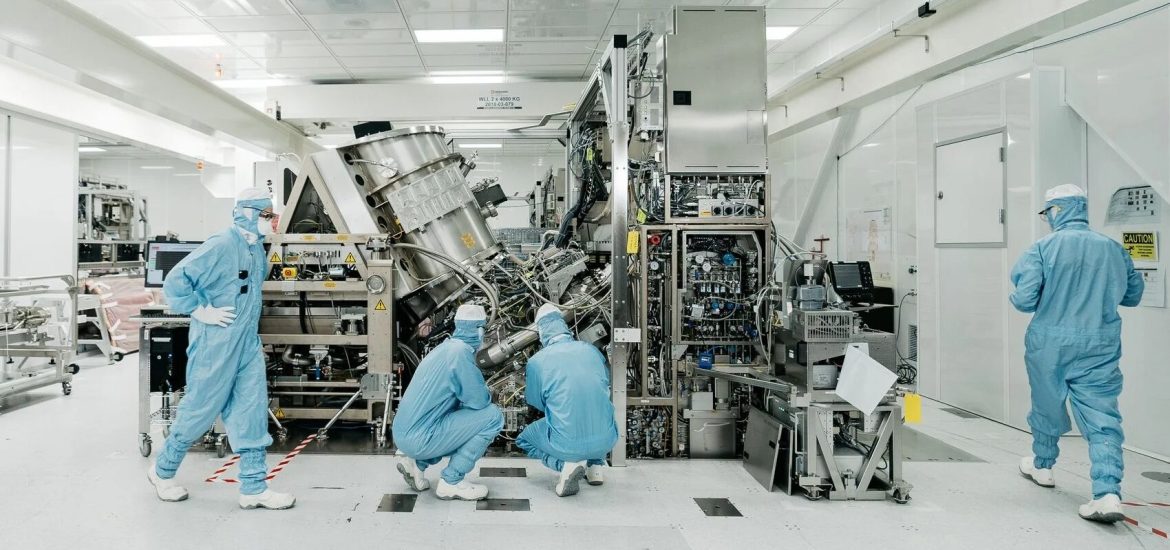

The war of the United States and Israel against Iran, which began three weeks ago, is mainly affecting the oil and natural gas markets, which depend on freedom of navigation through the Strait of Hormuz. But this waterway is not only crucial for hydrocarbon trade: large quantities of fertilizers and petrochemical products essential for many industrial sectors, such as semiconductors, also pass through the Strait of Hormuz .
HELIUM AND SULFUR FOR SEMICONDUCTORS
Semiconductor manufacturing requires – among other things – helium and sulfur. However, one-third of the world’s helium supply is processed in Qatar and is therefore directly affected by the crisis in the Persian Gulf. As for sulfur, a byproduct of hydrocarbon processing, producing countries like Iraq and Iran themselves are withholding supplies for domestic use instead of exporting them.
THE WAR’S CONSEQUENCES FOR TSMC
The rise in international fossil fuel prices on one hand, and difficulties in accessing these production inputs on the other, could make semiconductor manufacturing in Taiwan more expensive and challenging. Taiwan is the global center of this industry and home to Tsmc, the largest and most sophisticated contract microchip manufacturer: among its clients is Nvidia, the company designing the most sought-after processors for artificial intelligence; more generally, Tsmc produces 90 percent of the most advanced logic chips.
The chipmaking sector accounts for roughly one-fifth of Taiwan’s economy, but a production crisis linked to the war in the Persian Gulf could have broader consequences beyond the island’s economic fate: consider that the progress of artificial intelligence – which all U.S. Big Tech companies have confidently bet on, with investments worth hundreds of billions of dollars – depends on the availability of microchips, but semiconductors are also indispensable for many other less “cutting-edge” sectors, such as electronics and automotive.
THE HORMUZ STRAIT CRISIS SEEN FROM TAIWAN
Taiwan – and consequently Tsmc – is highly exposed to the crisis in the Strait of Hormuz because it depends heavily on liquefied gas imports and does not have abundant fuel reserves, unlike other Asian nations such as South Korea and Japan. More specifically, according to Goldman Sachs data reported by Bloomberg, Taiwan relies on imports for 97 percent of its energy needs, and 37 percent of its liquefied gas imports come from the Middle East.
If the war with Iran lasts much longer and the Strait of Hormuz remains practically inaccessible, Taiwan could face not only rising hydrocarbon prices but also a physical shortage of supplies. However, Taiwanese authorities have stated that they have secured sufficient volumes of liquefied gas for March and April, covered half of the expected demand for May, and are negotiating with American exporters for June.
Regarding helium for semiconductors, the Ministry of Economy said companies will be able to procure it from alternative suppliers in the United States and Australia. In case of limited availability, it is likely that manufacturers like Tsmc will prioritize the most sophisticated chips such as those for artificial intelligence, which guarantee high profit margins, but risk leaving more traditional sectors uncovered.
“The semiconductor sector is strategic for Taiwan,” a government official told Bloomberg: “we will ensure that energy supply to chip factories remains stable.”
EUROPE IS ALSO AT RISK
Besides Taiwan, the European semiconductor supply chain – certainly less significant internationally – is also vulnerable to the crisis in the Middle East. The European Union imports about 40 percent of the helium it consumes from Qatar, and the only producing country within the bloc is Poland, which satisfies 8 percent of the community’s demand. For now, however, European chipmakers are relatively calm because they have reserves and can source supplies from other regions.




