



Is Oracle really at risk of defaulting?
The massive investment plan in artificial intelligence is putting pressure on Oracle Group’s financial profile. Between debt, downgrades, and large data centers, here’s why the markets are increasingly focused on the tech giant.

If Google monetizes, then it is also responsible for the videos on YouTube.
The ruling of the Court of Justice of the European Union shifts the boundaries on the responsibility of platform operators and requires Google to monitor at least the content published by users with whom it has signed commercial partnerships. Agcom (which initiated the action) celebrates, while Mountain View prepares an appeal to the Council of State.

All the constraints imposed by Brussels on Google
What do the two sets of binding measures for Google under the Digital Markets Act issued by the European Commission entail and aim to achieve?
Why Google is betting on solar energy
Google will purchase the entire initial output of the massive Steel River solar project in Arkansas to offset the emissions from its data centers despite Trump’s anti-renewable policies.

The EU does not pardon Google on the massive Android fine.
The Court of Justice of the European Union rejects Google’s final appeal and confirms the €4.1 billion fine for abuse of dominant position with Android. This concludes the dispute initiated by the European Commission in 2018 regarding the highest antitrust fine ever imposed by the EU. Facts, figures, and comments.
Finally, Google has opened the Play Store to other payment methods. What changes?
The consequence of the epic battle between Epic Games and Google becomes reality and “erga omnes” (at least in the Old Continent, excluding Switzerland): Mountain View opens its digital storefront Play Store to alternative payment methods and intervenes on the commissions imposed on developers. All the news.
Amazon and Google compete for energy for artificial intelligence. WSJ report
Amazon and Google are investing billions to secure electricity for data centers, following different strategies including nuclear, renewables, geothermal, and small modular reactors. The WSJ article is taken from Liturri’s roundup.

Putting a stop to “bad” AI is practically impossible.
Containing the risks of artificial intelligence is like trying to stop a tsunami. This was demonstrated by the Financial Times and the AI safety group Alice by testing models from Google and Meta – which miserably failed, also providing instructions on how to create biological weapons, malware, and child abuse content. Facts and comments.
The British Antitrust’s ultimatum to Google
The European Digital Markets Act is being copied in London: the Antitrust authority, in its new obligations for Google, intends to equate the rights of British users with those of European internet users.

For the intelligent Siri, Apple had to ask Google for help.
The Apple Intelligence showcased in 2024 has never been seen before: Cupertino has proven to be terribly behind on the AI front. However, it is now trying to make amends by setting aside pride and relying on Google: a move that will allow Siri to update itself to be competitive in the market.

Will Google, Nvidia, Tesla, and Apple save Intel’s microchips?
Google has ordered a large quantity of microchips from Intel, and Nvidia is also examining the manufacturing technology of the former semiconductor giant. Under Lip-Bu Tan, Intel has begun a path to recovery and is closing important contracts (including with Tesla and Apple), but doubts remain.

Will the EU give an exemplary punishment, and what about Google?
Brussels is reportedly preparing a record fine of several hundred million euros against Google for alleged violations of the Digital Markets Act related to the search engine and the Play Store. Meanwhile, tensions are rising with the United States over European rules for Big Tech. All the details.

With Gemini 3.5 Flash, Google chases other AIs. And launches its smart glasses.
The Mountain View company could be the third contender in the fierce competition between Anthropic and OpenAI. It also intends to compete with Meta in the field of smart glasses: after all, the software houses of Amodei and Altman are not focusing on the hardware sector to give a physical form to their algorithms.

All of Google’s plans with SpaceX (and beyond) for data centers in space
Google is in talks with SpaceX to develop Project Suncatcher, a program focused on solar-powered orbital data centers. Musk’s company is working on a similar initiative with Anthropic. Bezos’s Blue Origin and Zuckerberg’s Meta are also looking to space.
This is how Google stopped a cyber attack developed with AI.
At the beginning of the week, Google’s Threat Intelligence Group announced that it had thwarted an attempt by hackers to use artificial intelligence models to “plan a large-scale vulnerability exploitation operation.”
This is how the EU protects consumers and keeps Apple and Google in line.
The EU Digital Markets Act forces Apple and Google to open their ecosystems, facilitating data transfer between iPhone and Android and introducing new interoperability features for third-party accessories and devices. Excerpt from the European Morning Briefing.

Here’s how to add Startmag.it to your preferred Google Sources
Google has also introduced in Italy a new feature that allows users to customize search results, giving more prominence to their preferred information sources. Add Startmag by clicking here.

Surprise praise for the lobbyist who finally speaks bluntly to major newspapers and politicians
Why did Veltroni’s predictable and at times trivial interview with AI Claude in Corriere della Sera startle Diego Ciulli from Google? The letter from Claudio Trezzano.

Here’s how Google Cloud drives Alphabet in the first quarter
Alphabet has announced its first-quarter results of the year, beating Wall Street revenue estimates thanks to the performance of Google Cloud.
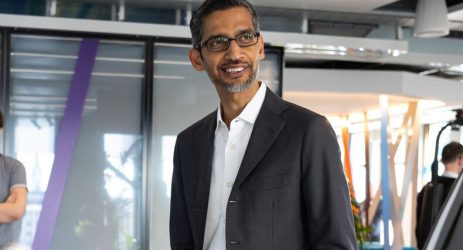
Google opens up to the Pentagon on AI, but employees shout at Pichai over military use
Google and the Pentagon have reportedly reached an agreement for “any lawful use” of Artificial Intelligence. Meanwhile, employees of the Mountain View giant have sent an open letter to the CEO asking that the government not use AI for military purposes.
What Google will do with Anthropic (and vice versa)
After Amazon’s 25 billion, Anthropic will receive up to 40 billion from Google. Amodei’s startup needs a lot of computing power; Alphabet, on the other hand, wants to fuel the demand for its processors and cloud services. All the details.

Laws to truly regulate social media can no longer wait.
From the historic conviction of Meta and Google for damages caused by social media addiction emerges the urgency for stricter regulations to curb addictions and youth-related issues and to impose responsibilities on digital companies. The intervention of Francesco Provinciali, member of the technical scientific committee of the Varenna Foundation for Childhood and Adolescence.

Google challenges Nvidia with new processors for artificial intelligence
Google has unveiled its new TPUs, microprocessors for artificial intelligence dedicated to the training and inference phases of language models. The Alphabet group insists on “in-house” components to reduce dependence on Nvidia chips and announces a $750 million fund to promote the spread of AI agents. All the details.

What is happening between the EU and Google, Meta, Snap, and Microsoft regarding the (lack of) protection of minors
Google, Meta, Snap, and Microsoft call the EU’s decision not to extend the law that helps tech companies detect online child pornography “irresponsible.” Excessive privacy obsession or indispensable protection of private life? Here’s what the data says.

Here’s how Google and Anthropic are turbocharging Broadcom
Broadcom shares are rising after the company struck a deal with Google to supply AI chips and expand its collaboration with Anthropic, the developer of Claude. The American microchip manufacturer is thus attempting to challenge Nvidia’s dominance, the global leader in AI semiconductors. All the details.

Do Big Tech companies decide what we should eat? Apparently, yes.
According to the think tank International Panel of Experts on Sustainable Food Systems, Google, Microsoft, Amazon, IBM, and Alibaba, through the use of AI and in collaboration with agrochemical companies such as Bayer, BASF, and Corteva, influence farmers on what to grow, often focusing on the most productive and profitable crops. Facts, figures, and comments.
Why Google’s Gemma 4 is different from other AI models
Google’s new artificial intelligence model, Gemma 4, combines open source, local execution, and advanced capabilities in reasoning, audio-video processing, and managing complex conversations in multiple languages. All the details.

Big Tech companies don’t care about Australia’s social media ban.
Italy is considering a ban on social media for those under 15, but Australia, the first country in the world to introduce it for under 16s, is facing a harsh reality: young people and Big Tech are finding ways to bypass it. Meanwhile, Meta is testing new business models with a premium subscription on Instagram. Facts and commentary.

Why are European TV companies attacking Google, Amazon, Apple, and Samsung?
Confindustria Radio Televisioni is among the organizations that, through the association representing the main European broadcasters, has called on the EU to subject Google, Amazon, Apple, and Samsung to the rules of the Digital Markets Act also for smart TVs and virtual assistants, denouncing the growing power of Big Tech in content distribution. All the details.

Are European TV broadcasters afraid that AI will take control of the remote?
There was a time when the housewife from Voghera, according to the stereotype, would vote based on what TV suggested to her: today, European broadcasters believe that consumers are instead guided in their daily content consumption by virtual assistants and the operating systems of their televisions. They are asking Europe to establish regulatory safeguards.

If Google’s AI changes article titles
Google has begun transforming the headlines of articles returned by its searches using AI. Without prior agreements and without journalists’ oversight afterward. Moreover, the results do not seem encouraging.

Here’s how Google will take the stage at Luiss (and beyond)
After agreements with several Italian universities, including the online institutions of the Multiversity group as well as Politecnico di Milano and Università Cattolica del Sacro Cuore, Google has signed a partnership with Luiss Guido Carli to bring artificial intelligence tools into education, with digital tutors and new learning models for students and teachers. All the details.
Moves and little tricks by Google to avoid problems with its PlayStore
Google is opening its Play Store to alternative payment methods, while simultaneously lowering commissions: the agreement reached with the combative rival Epic Games seems, in fact, to be applied “erga omnes.” However, some speculate that Tim Sweeney’s software house was appeased by an $800 million contract signed with Mountain View while the lawsuit against the Web giant was ongoing…

Gemini on trial for a suicide case
The father of a man who died by suicide claimed that Gemini had pushed the user “to leave his physical body and join the AI in the immaterial virtual world,” ordering him to barricade himself in his home and end his life. In the exchange between the victim and the chatbot, there were also preparations for a terrorist attack that was foiled at the last moment.
