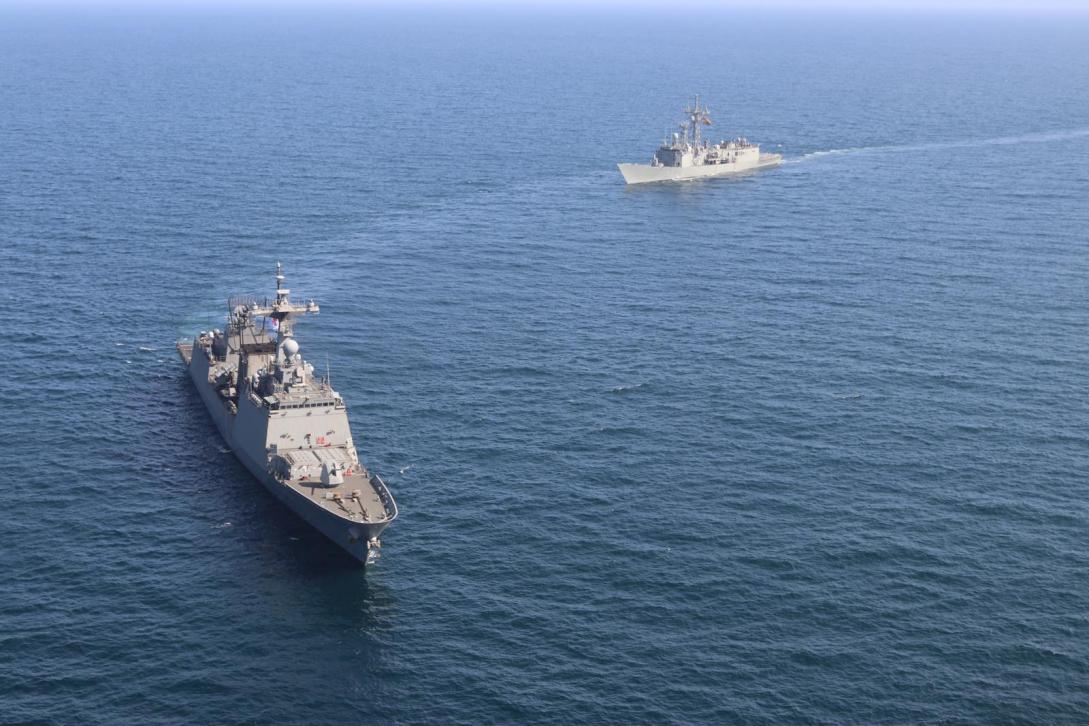
The United Arab Emirates have said they have a plan to eliminate their dependence on the Strait of Hormuz, the most important waterway in the world for fossil fuel trade (but not only) and often essential for the countries of the Persian Gulf, as it connects the latter with the Gulf of Oman, ensuring access to the Indian Ocean and thus to international markets.
THE EMIRATES WANT TO FREE THEMSELVES FROM HORMUZ, REGARDLESS OF THE USA-IRAN AGREEMENT
The Minister of Foreign Trade Thani al-Zeyoudi stated that the Emirates’ plan for emancipation from Hormuz will proceed regardless of the situation in the strait, which should be fully reopened to navigation following the agreement between the United States and Iran. However, the Emirates want to avoid being exposed to future crises, also because the war that started last February 28 has shown both Iran’s ability to control the strait and, by extension, the vulnerability of the Gulf countries.
Compared to other countries in the region, moreover, the Emirates have been able to bypass – but only partially – the Strait of Hormuz through the Fujairah pipeline: 3600 kilometers long but with limited capacity (1.5 million barrels per day), this pipeline connects the city of Habshan to the port of Fujairah, which is located on the Gulf of Oman, just beyond Hormuz. In recent months, air freight transport has also been enhanced, although it is much more expensive than shipping by sea.
THE EMIRATES’ PLAN TO DO WITHOUT THE STRAIT OF HORMUZ
The Emirati plan to do without Hormuz is based on expanding the ports of Dibba, Fujairah, and Khawr Fakkan: they are located in the eastern part of the country, facing the Gulf of Oman, thus outside the Strait of Hormuz. A new port will also be built in this area.
At the same time, the Emirates want to invest in building new pipelines, roads, and railways to strengthen connections between hydrocarbon fields and the eastern ports.
THE DOUBLING OF FUJAIRAH, AND MORE
A doubling of the Fujairah pipeline is planned so that it can transport 3 million barrels of crude oil per day, along with an additional pipeline. Minister al-Zeyoudi added that options are being evaluated to guarantee exports of petrochemical products and liquefied gas.
The costs and timelines for all these projects have not been disclosed.
THE CHALLENGES
The real problem for the Emirates, however, is not so much redirecting oil flows from the Strait of Hormuz to the eastern ports, but finding an efficient way to reroute exports of other products, such as liquefied gas and aluminum: the plants are located in the Persian Gulf area, like the large al Taweelah foundry.
And then there are imports, for which the Emirates rely heavily on ports in the Persian Gulf, such as Jebel Ali, one of the largest and most important logistics hubs in the world. Receiving imports at the eastern ports and then distributing them by truck to the major western cities, such as Dubai and Abu Dhabi, is a very costly option. Minister al-Zeyoudi assures, however, that expenses will decrease following the expansion of the railway network.
THE UNITED ARAB EMIRATES’ OIL PLANS
Since May 1, the United Arab Emirates are no longer part of OPEC, the organization of oil-exporting countries, of which they were the third largest producer. The decision – in short – was made because the Emirates wanted the freedom to sell more crude and could not tolerate the maximum production quota mechanism promoted by Saudi Arabia, which effectively leads the group.
According to estimates by the International Energy Agency, Emirati oil output could exceed 5 million barrels per day as early as 2027, marking an annual increase of 730,000 barrels per day. In this regard, the state oil company Adnoc has announced a 55 billion investment plan by 2028 to strengthen its presence along the entire fossil fuel supply chain, from upstream (exploration and extraction) to downstream (refining and sale of finished products).