



To thoroughly assess the consequences of the ongoing conflict over a medium to long-term horizon, it is necessary to consider the strategic position adopted by China regarding the energy issue. In this regard, it is useful to examine the outline of the 15th Five-Year Plan, published in March 2026. From the very first pages, it is clear that renewable sources constitute the core of China’s energy strategy. In the first table featured in the outline, some of the main objectives of the Plan are listed: among these – 20 in total – 6 relate to the ecological transition, covering various aspects of it – from air quality to energy security.
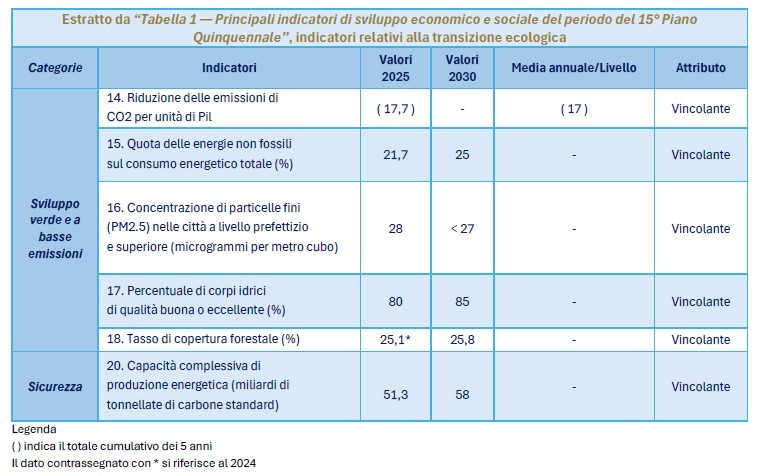
Also noteworthy is the fact that all objectives related to the “Green and Low-Emission Development” and “Security” groups are marked as “binding” goals, not merely “indicative”: this clearly illustrates the importance the current Chinese leadership attaches to the ecological transition theme. In fact, only two other objectives are indicated as “binding”: the increase in grain production capacity from 1.39 to about 1.45 billion jin (1 jin = 0.5 kg) and the rise in the average years of education of the new workforce from 11.3 to 11.7 years. Moreover, China has been making significant investments in green technologies for over a decade, and the new Plan is – in this respect – largely in continuity with the path China has taken so far. The three cornerstones of China’s strategy are:
- No contradiction between development and ecological transition At the basis of the objectives mentioned above lies a fundamental belief, namely that development – and thus growth – is not structurally at odds with reducing the environmental impact of economic activity. This belief is confirmed by data provided in February by Carbon Brief, which certifies that China’s CO2 emissions have remained stable or slightly decreased since March 2024, despite an increase in industrial production.
- Renewables as an integral part of the national industrial system China identifies the ecological transition as a component within the overall modernization of the country’s production system – a project expressed in the concept of “new quality productive forces.” In other words, China sees green technologies as an integral part of the process of climbing global value chains, which should lead the country away from the old “world factory” model and towards the global technological frontier.
- No “phase-out” of fossil fuels Despite the tremendous progress made in renewables, the Plan clearly intends to keep fossil fuels within the national energy mix. For example, in table 5, point 7, of the Plan Outline, reference is made to the construction of new gas pipelines between China and Russia, particularly the Power of Siberia II and the Far Eastern Route.
These projects are part of a strategy aimed at stability, intended to avoid or mitigate energy shocks like the one we are witnessing.
Thus, the outline of the 15th Five-Year Plan clearly shows the development direction China intends to pursue in the coming years: – continuation of climbing the global value chains; – ecological transition; – preservation of fossil fuels as a stabilization tool.
China Changes the Global Energy Landscape
In the longer term, China’s intention to become as self-sufficient as possible regarding energy supply is clear. For this reason, it has built a greentech industry unmatched worldwide, capable of drastically reducing the unit costs of these technologies. The case of solar panels is paradigmatic: from 2015 to today, the cost of transitioning to solar has drastically decreased and is now close to the level of fossil fuels; indeed, some analysts even believe that in many countries worldwide, it has become the cheapest energy source – although challenges remain, particularly regarding the transport and storage of the electricity produced.
China’s investments in the sector have enabled significant productivity increases, which have then translated into lower final prices. The result is indisputable: today, renewable sources are no longer simply a “virtuous” choice but are increasingly becoming an economically advantageous option as well.
Keeping this aspect in mind, one can clearly understand a possible consequence of the war in Iran on global demand for fossil energy sources: the search for alternative energy sources, both to protect against price volatility and to shield from the consequences of geopolitical tensions. In this context, the current crisis could represent a significant boost for the Chinese greentech sector.
Some evidence in this regard is already available: EMBER – an independent think tank focused on energy and ecological transition – reports that in March, immediately after the outbreak of the war in the Middle East, Chinese exports of solar energy production technology doubled. Finally, it is significant that demand is driven not only by advanced economies but also, increasingly, by developing countries. If consolidated, this trend would represent a significant expansion of the Chinese greentech export markets.


