



Rheinmetall is accelerating gunpowder production.
The German defense giant is expanding its Aschau am Inn site in Bavaria, turning it into one of the largest gunpowder plants in Europe and expects production to double by 2028, reaching 4,200 tons per year, reports today Cnbc.
“Without gunpowder, it is impossible to protect our citizens because, after all, gunpowder is needed for ammunition,” CEO Armin Papperger told the outlet.
The shortage of gunpowder is considered a bottleneck for increasing ammunition production for armies and an obstacle for Europe in ensuring defense sovereignty. However, Papperger told Cnbc that the shortage of nitrocellulose, also known as fulmicoton, used in ammunition propellants, is no longer a problem for Rheinmetall, as the company has secured its own supply and built reserves, with stocks sufficient for the next four years, following the shortage of this ammunition ingredient and the rise in gunpowder prices that emerged after the Russian invasion of Ukraine.
But cotton linters, a by-product and primary ingredient necessary for nitrocellulose production, are one of the most delicate links in the European defense supply chain, historically dependent on China.
Already in 2024, the Financial Times reported that European defense companies warned that dependence on Chinese cotton used in gunpowder for ammunition threatened their ability to expand production, a move necessary to support the Ukrainian armed forces, which were already under pressure at the time.
All the details.
RHEINMETALL’S STRATEGY
“NATO is not ready for combat without this site here in Aschau,” Rheinmetall CEO Papperger said yesterday during the groundbreaking ceremony for the plant expansion, reports the German outlet Ntv. Instead of 1,700 tons of artillery gunpowder, production will increase to 4,200 tons per year and, from 300,000 propellant modules used to fire shells, production will reach one million. Papperger estimated the investment in the site at about 500 million euros. The new plant will start production in 12 to 13 months. The site is managed by the subsidiary Nitrochemie: in 1994, the giant acquired a stake in the then WNC Nitrochemie, a JV with the Swiss state company RUAG.
Not only that, in April 2025, Rheinmetall initiated the acquisition of Hagedorn-NC, a German industrial nitrocellulose producer, intending to steer military-grade propellant production as part of its ammunition sector expansion strategy.
The expansion of Rheinmetall’s Bavarian plant follows last year’s expansion of its ammunition facility and comes at a time when gunpowder prices have skyrocketed after the war in Ukraine depleted stocks, notes Cnbc.
The group has also invested millions in gunpowder production plants in Spain and Switzerland, the American outlet recalls, emphasizing that Rheinmetall is one of the world’s largest ammunition producers and one of the few covering the entire value chain, from gunpowder to the casing. “In every sector where gunpowder is needed… here we produce for all these products,” Papperger assured. The CEO also stated that Rheinmetall’s order backlog should exceed 100 billion euros by the end of the year.
THE GUNPOWDER ISSUE FOR THE DEFENSE INDUSTRY
The availability of gunpowder is considered one of the main constraints on increasing ammunition production for European armed forces. The scarcity of this component is indeed cited as one of the factors limiting the defense industry’s capacity to increase production volumes and represents an obstacle to Europe’s goals of greater strategic autonomy.
According to the German manager, Rheinmetall has overcome one of the main supply chain problems: the availability of nitrocellulose. The company has secured its own supply and built reserves sufficient for the next four years.
EUROPEAN DEPENDENCE ON COTTON LINTERS
Yet, Papperger himself stated two years ago to the Financial Times that Europe depends on China for “over 70%” of its cotton linters, the raw material traditionally used to produce military-grade nitrocellulose.
“There is a risk [that China could suspend linter supplies for geopolitical reasons]. And that is why we buy as much as possible to stock our reserves,” the Rheinmetall chief explained.
According to the International Trade Centre, China accounts for nearly half of the cotton cellulose traded globally. Among the largest importers of this material are Germany, Sweden, and Belgium.
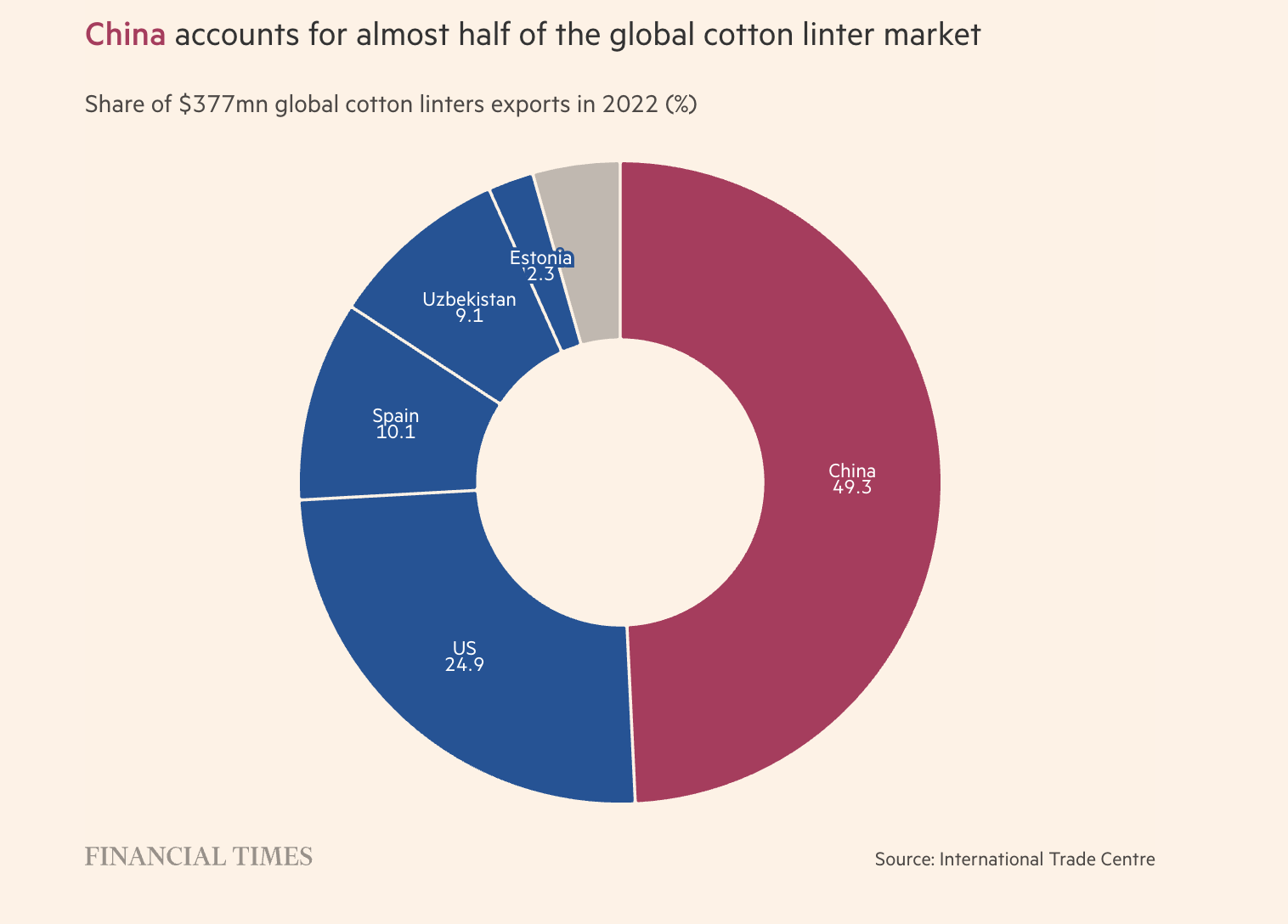
The Ft also reported that several defense companies warned it would be difficult to quickly increase explosives production while depending on Chinese sources and that there is a risk China could limit exports of the material if relations deteriorate. To the British financial daily, the Swedish defense company Saab explained that “[dependence on China] could pose a greater risk in the future as we and the industry increase production capacity in Europe.” Saab CEO Micael Johansson also told the Financial Times that nitrocellulose is an example of how defense companies will have to build new supply chains in a “multipolar world” where “there will not only be the Western rules-based order.”
WHAT ARE THE ALTERNATIVES TO CHINA?
Also in 2024 Papperger stated to the Ft that the company had stockpiled enough linters for three years after the Russian invasion of Ukraine, and that deliveries continued “every month from China.” “But the point is that Europe should be independent in the long term,” the Rheinmetall chief reiterated.
To the British financial daily, military analyst Christian Mölling, director of the Berlin think tank Edina, explained that nitrocellulose is a “low-cost chemical product” and that production of one of its key ingredients has long been outsourced to countries like China.
As noted earlier this year on Defence Matters, dependence on cotton linters represents a critical issue because these raw materials cannot be quickly replaced. Although alternatives such as wood-derived cellulose are under study, their adoption requires lengthy qualification and certification processes to ensure their use in ammunition. The picture is further complicated by stricter controls introduced by Beijing on dual-use material exports, which have pushed defense companies to strengthen the security of their supply chains.




