


European rearmament will benefit the coffers of the American defense industry.
This is what a recent report by the Conseil d’analyse économique (Cae), a think tank linked to the Paris government, has put in black and white, noting that over half of European arms imports come from Washington, while industrial fragmentation and technological delay limit the strategic autonomy of the Union.
In a report published on Wednesday, the Cae analyzes the implications of European rearmament and details the structural obstacles to the continent’s defense. Despite a projected increase in defense budgets to 3.5% of GDP by 2035, the document highlights three main challenges: industrial dependence on the United States, fragmentation of the European defense market, and technological lag. These elements, according to the report, risk limiting the economic efficiency of the military strengthening process.
The Cae report also emphasizes that American arms imports increased between 2020 and 2024. Furthermore, 53% of European arms imports come from the United States. Without real integration of the defense market, strategic autonomy will remain a mirage, comments the French daily La Tribune.
All the details.
THE ECONOMIC KNOTS TIED TO EUROPEAN REARMAMENT
According to the French think tank’s study, the effort of European rearmament, expected to be a long-term endeavor, raises important economic questions. First, it raises the issue of European strategic and industrial autonomy, since about one-third of arms purchases come from non-EU countries. It then highlights the challenge of catching up technologically with the United States and China in key sectors such as artificial intelligence, semiconductors, quantum technologies, space, and sensor and electronic warfare systems. Thirdly, the issue of European integration emerges, as the fragmentation of national markets entails additional costs, limits equipment interoperability, and hinders innovation efforts.
THE LEAP IN MILITARY SPENDING
The war in Ukraine and the deterioration of the strategic context have radically changed European military budgets. European countries aim for 3.5% of GDP for military spending by 2035. This increase, comparable to that recorded during the Cold War, represents, according to the report’s authors, “a cost, a challenge, and a strategic opportunity at the same time.”
In particular, since 2022, European states have initiated a significant increase in their military budgets. Rearmament is mainly based on increased equipment purchases, the report highlights. The share of funding for equipment in the total budget has risen from less than 20% in 2018 to 33% in 2025, according to EDA data. The European military equipment market is therefore expected to grow from 47 billion euros in 2014 to 256 billion euros by 2035.
TIED TO US IMPORTS
Despite the increase in resources, European rearmament remains strongly linked to US capabilities.
Europe continues to rely on the United States for key functions such as intelligence, logistics, military planning, and nuclear protection. According to the report, European states have invested insufficiently in upstream research and development and have thus accumulated a delay in mastering digital technologies and artificial intelligence. To address the emergency, they are splitting their rearmament efforts between orders from the national industry and the United States, without sufficiently considering the European dimension.
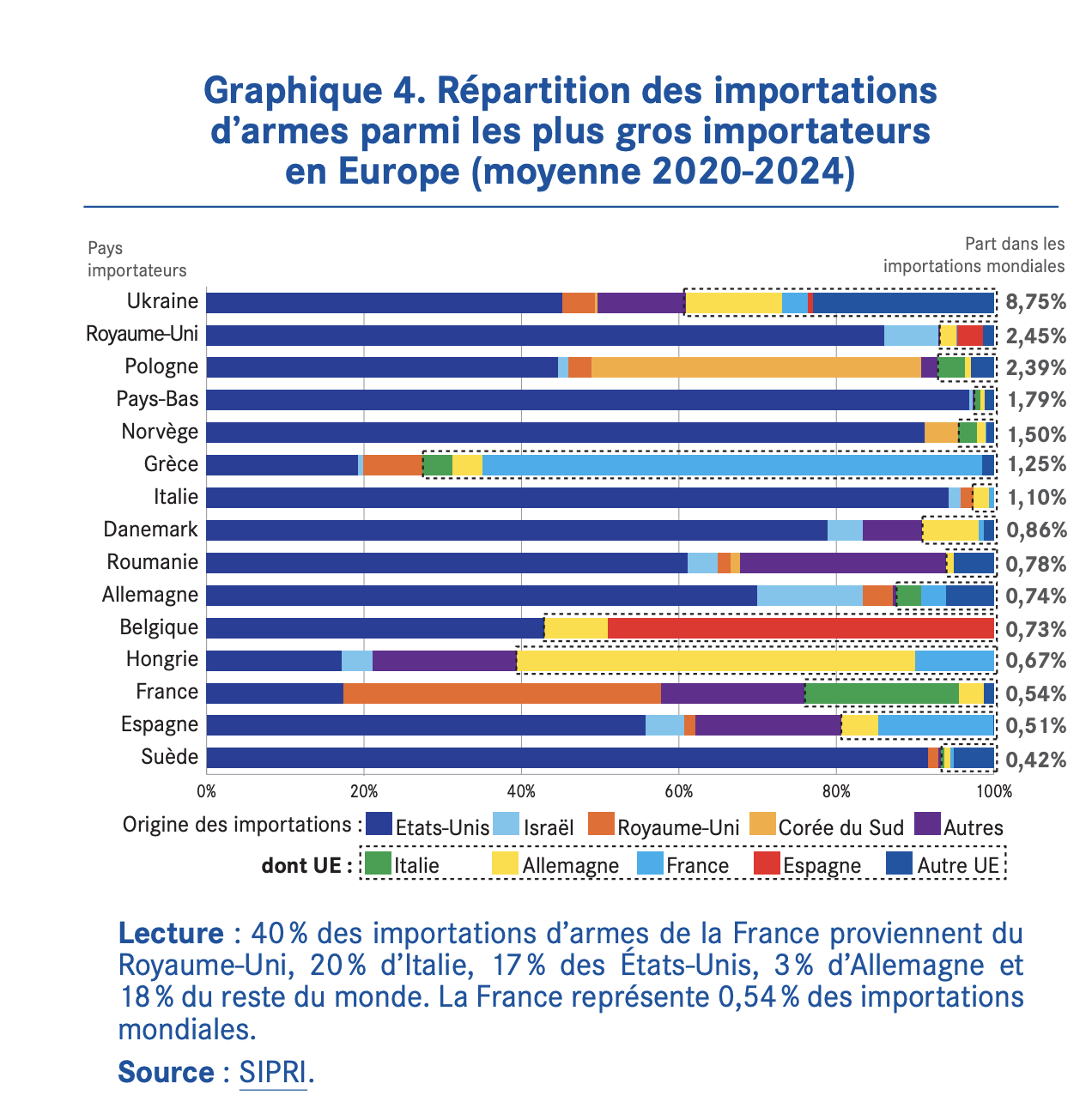
Europe imports one-third of its equipment. Specifically, the report also highlights how American arms imports increased between 2020 and 2024.
These imports mainly come from the United States: according to Sipri, the US share of total European imports (including intra-EU imports) rose from 41% between 2015 and 2019 to nearly 53% between 2020 and 2024. Intra-European trade in military equipment remains low.
DEPENDENCE THAT PENALIZES THE SUPPLY CHAIN
Furthermore, Europe’s economic dependence is more pronounced than military equipment imports alone suggest, warns the French think tank’s report. Upstream in the value chains, the EU depends on external supplies for 97% of the 27 raw materials identified as critical. Additionally, the Cae highlights that Europe controls only less than 10% of global semiconductor production.
A TOO FRAGMENTED EUROPEAN MARKET
Finally, the fragmentation of the European market represents a further critical element. The Conseil d’analyse économique report notes that EU countries use 98 main weapon systems, compared to the 18 in the United States’ arsenal. This dispersion limits economies of scale and standardization.
According to the Cae, without real integration of the defense market, European strategic autonomy risks remaining an unattainable goal.




