As an immediate reaction to the attack, from 10:45 the Iranian authorities proceeded to close the national airspace. The kinetic response followed shortly between 11:44 and 11:56, when the IDF, which had already activated sirens throughout Israeli territory at 10:13 and formally declared a state of emergency at 10:26, reported the arrival of a first salvo of missiles, followed by several others in the subsequent hours, which however did not follow a structured pattern. These, in fact, despite initially being primarily directed against Israel and a plurality of U.S. military bases in the Middle East, with the progressive depletion of Tehran’s longer-range arsenals, particularly with the exhaustion of MRBMs and SRBMs, increasingly focused on a widespread campaign against even symbolic targets, without considering the use of saturating tactics. From this perspective, it seems that Tehran had carefully planned a scenario of existential threat to the Islamic Republic, leveraging the experience gained from the 12-Day War. In this sense, it would have arranged rotations, command redundancies, and decentralized automatic reprisals to preserve operational capability in case of severe disruptions to the command chain. Indeed, the disruption of the Iranian C2 structure by Israel, although not complete, since the President of the Republic, Masoud Pezeshkian, and other prominent figures such as the Secretary of the Supreme National Security Council (SNSC), Ali Larijani, survived, undoubtedly compromised the coordinated response capabilities of the Iranian military forces. Nevertheless, it is noteworthy that the Iranian institutional apparatus has so far proven capable of resisting the Israeli-U.S. decapitation attempt by implementing contingency plans specifically developed to ensure the overall control of the war effort.
Overall, the plausible intent of Iran’s total war response is to lead to a regionalization of the conflict capable of generating sufficient instability, from an economic-financial perspective with global repercussions, sufficient to force especially, but not only, the Arab countries of the quadrant to leverage for a cessation of hostilities. In this light, attacks have also been carried out against a significant number of countries in the region, whose affected civilian areas have proven far more vulnerable than U.S. military installations and Israeli national territory.
During the first phase of the Iranian retaliation, among the primary targets hit using a variety of missile vectors and OWA UAVs were, in addition to Israel itself, numerous U.S. military bases, including the Al Udeid Air Base in Qatar (12:28), the headquarters of the U.S. Fifth Fleet in the Juffair area in Bahrain (12:32), the Ali Al-Salem Air Base in Kuwait (12:43), the Al-Dhafra Air Base in the United Arab Emirates (12:43), and the Prince Sultan Air Base in Saudi Arabia (13:13). From 14:03 onwards, further numerous waves of Iranian missiles and drones followed, hitting not only Israel, where several damages were also caused by interceptor debris, but also Qatar (Doha), the United Arab Emirates (Dubai and various areas around Abu Dhabi), Kuwait (Kuwait City), Bahrain (Manama), and Oman (Duqm). On Monday, several OWA UAVs were also shot down near the British Akrotiri Air Base close to Limassol, Cyprus. In general, on Sunday morning (09:30), Israel declared that in the first 24 hours of the conflict Iran launched a total of about 150 ballistic missiles against its territory, a number slightly lower than that recorded on the first night of the 12-Day War.
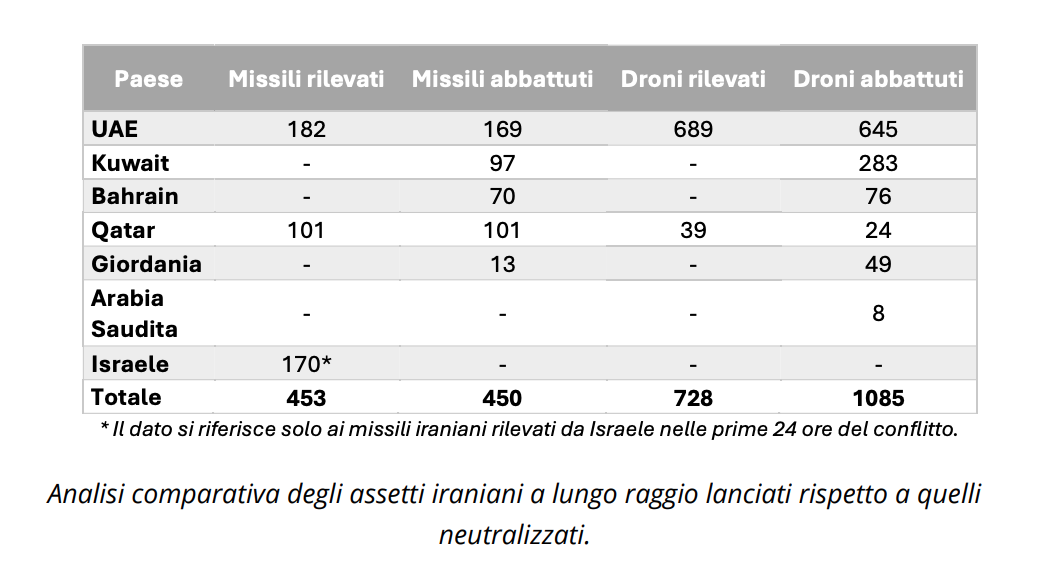
At the same time, the regional escalation of the conflict by Iran also made it necessary for the Gulf States to intervene directly to guarantee the defense of their airspace. In this regard, the official bulletins published by the Ministries of Defense of the various countries in the region have allowed the extraction of two significant data points: the actual extent of Iranian long-range attacks and the effectiveness of the air defense architectures of the attacked States. From their analysis, however, the emerging picture is significantly fragmented due to the heterogeneity of what has been made public by the various countries. In this respect, the gap between detected and shot-down assets stands out, favoring the latter both in the case of missiles and drones. For this reason, it is plausible that the total number of detected vectors is actually higher than officially declared. Overall, however, despite the incompleteness of the data, the scale of the attacks carried out by Iran in the region emerges distinctly, which included several hundred missiles, predominantly ballistic, and more than a thousand OWA UAVs.
Simultaneously, Iran’s reactions were strongly connected also to what during the Pentagon press conference by Secretary of War Pete Hegseth on Monday morning was defined as one of the key pieces, along with missile and nuclear targets, of the Southern Front managed by the United States, namely Iranian naval capabilities, particularly regarding their potential use to close the Strait of Hormuz. This, in fact, was hinted at by the IRGC already at 18:50 on Saturday, when numerous very high frequency (VHF) transmissions were sent communicating the prohibition for any ship to cross the Strait. However, in the hours following the announcement, naval traffic in the area continued, highlighting Iran’s difficulties in practically implementing its declarations.
In this context, the U.S. attempt to prevent possible Iranian mining operations of the Strait of Hormuz through targeting several naval bases of the Artesh and IRGC in the Persian Gulf and Arabian Sea, particularly those of Konarak and Bandar Abbas, takes on importance. In this context, the sinking of an Iranian Moudge-class corvette (known as Jamaran in the West), the IRIS Shahid Bagheri carrier, the IRIS Makran forward base ship, several Bayandor-class corvettes, and three Iranian Alvand-class frigates, among the largest and most sophisticated ships of the Iranian Navy, which has overall been heavily disrupted even in its C2 centers, was confirmed. In this context, although a true closure of the Strait was not recorded, it is emphasized how the indiscriminate targeting campaign conducted by Iran has nonetheless led to serious consequences for maritime traffic in the area. In fact, by midnight Sunday, at least 5 civilian tankers were hit by Iranian drones or missiles in the Strait and Persian Gulf area, particularly the Skylight (flag of Palau), Ocean Electra (flag of India), MKD Vyom (flag of the Marshall Islands), Hercules Star (flag of Spain), and Stena Imperative (flag of the United States). The damage to the energy sector was further aggravated by the closure of several refineries, including the Saudi Ras Tanura and QatarEnergy’s offshore LNG production plants, hit by Iranian attacks. To conclude, the tensions related to the situation in the Strait of Hormuz area also include the Houthi declaration concerning the closure of the Bab el-Mandeb Strait, although no concrete actions have followed so far.
In parallel, beyond the probable attempt to militarily enforce the blockade of the Strait of Hormuz, there is also the risk of targeted irregular warfare actions, including explosive attacks, violent riots, and cyberattacks, against broadly Israeli-U.S. targets, even outside the region. The attempted assaults on Baghdad’s Green Zone and the U.S. Consulate in Karachi could represent an early warning sign of such a threat. A scenario further confirmed by the U.S. decision to generally raise the alert status (FPCON – Force Protection Condition) for its military bases to Charlie level, the second highest on the scale and corresponding to an imminent but nonspecific risk situation. At the same time, it is reported that the U.S. Embassies in Kuwait City (Kuwait) and Riyadh (Saudi Arabia) were also hit as part of the broad-spectrum Iranian attacks.