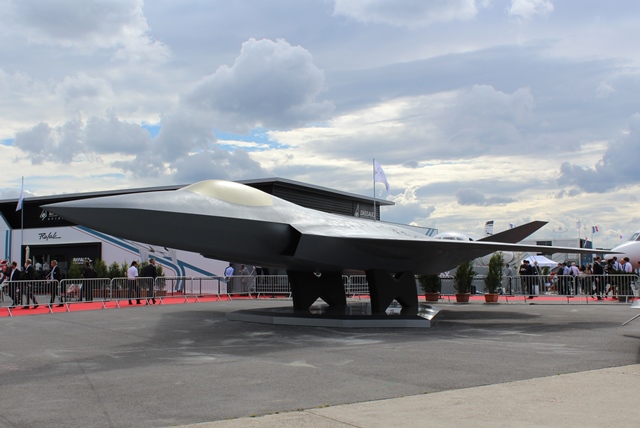

Defunct or not, there is no peace for the Fcas (Future Combat Air System) project, the program to develop the sixth-generation fighter born from the collaboration between Germany, France, and Spain.
Launched in 2017, the Fcas program – estimated to be worth over 100 billion euros – is designed to replace the French Rafale and the German and Spanish Eurofighters starting from 2040. Fcas has been the subject of a long dispute between the companies involved: the French Dassault and the defense division of the Franco-German Airbus based in Germany.
The work is divided into several pillars, and the controversy concerns the leadership of the main part of the project, that of the fighters, between Airbus and Dassault Aviation.
Last month, Airbus CEO Guillaume Faury, denied that relations with Dassault had completely broken down, but seemed to turn the page on Fcas in its current form, raising the possibility of two distinct fighters publicly for the first time.
And to date, the persistent political, operational, and industrial divisions seem to have definitively compromised the initiative. For the head of the French Dassault, the project is “dead” if Airbus, which represents the interests of Germany and Spain in the project, refuses to cooperate.
Commenting on Dassault’s 2025 financial results, president and CEO Éric Trappier said he had taken note of what he described as Airbus’s refusal to cooperate with the company, accusing it of blocking progress and not accepting the French company’s leadership on the jet, reports Reuters.
All the details.
DASSAULT’S STING
“If Airbus maintains its position of not wanting to cooperate with Dassault, the matter is closed,” Trappier said at a press conference. He added that the project was in “real difficulty,” stating: “What appears irreconcilable is that Airbus does not want to cooperate with Dassault.”
The Dassault chief explained that he had proposed changes to the rules for the flight demonstration phase that would have clarified Dassault’s leadership on the main fighter, including suppliers, while granting Airbus control over its own areas of responsibility.
Repeatedly questioned about the fate of the Franco-German project during a briefing on the results, Trappier defended France’s track record in producing high-performance fighters like the Rafale and accused Airbus of wanting a cumbersome partnership like that of the Eurofighter, notes Reuters.
“I said from the beginning that I want clear leadership and not just on paper,” Trappier said, referring to the crewed fighter component.
IN RESPONSE TO AIRBUS
The remarks from the French Rafale manufacturer come just over a week after those from the German counterpart in the Fcas project.
The Fcas program is at “a difficult crossroads,” Guillaume Faury said at the Airbus annual results presentation press conference held Thursday in Toulouse, France.
Airbus CEO Faury recalled that the company has invested “a lot of time and energy” in the Fcas program. “We believe that if a system with two fighters could be realized, it could be an opportunity to have other partners with us,” he added. “But it is up to our customers to decide with whom to join forces, if that will be the case. I repeat, we are not at that point yet.”
At the moment, Airbus has declined to comment on Trappier’s recent statements about Fcas. When asked last month if communication lines with Dassault were broken, CEO Guillaume Faury said: “The bridges are not cut and this should not be turned into a personal matter. It is not. What is certain is that we are struggling to find a way out,” recalls the Ft.
REGARDING COLLABORATION WITH OTHER COUNTRIES
Meanwhile, with uncertainty looming over the Fcas project, the prospect of collaborating with other countries is emerging for both companies.
For his part, Trappier said Dassault was open to collaborating with other countries if Fcas with Germany were to crumble, but that any decision on partners would be made by the French government.
French President Emmanuel Macron, in particular, has tried to keep the project afloat, reiterating last month the need for Europe for Fcas, agreed with former German Chancellor Angela Merkel.
AFTER THE GERMAN CHANCELLOR’S POSITION
Also last month, the industrial dispute between France and Germany erupted when German Chancellor Friedrich Merz stated on the Machtwechsel podcast that collaboration to build a nuclear-capable fighter with France “is not what we currently need in the German army.”
“The French need a nuclear-capable aircraft in the next generation of combat aircraft; we do not need it in the German Bundeswehr at this time,” Merz said on Machtwechsel. “Now the question arises: do we have the strength and will to build two aircraft for these two different objective requirement profiles, or just one?”
“France wants to build only one aircraft and wants to practically align it with the specifications it needs. But that is not what we need,” explained the German chancellor, reiterating that “This is not a political dispute, but a real problem in the requirement profile. If we cannot solve it, we will not be able to maintain the project.”
As highlighted by the Financial Times, it is time for Berlin, Paris, and Madrid to decide whether to move to the next phase as planned or to scale down Fcas by removing the common jet element.