

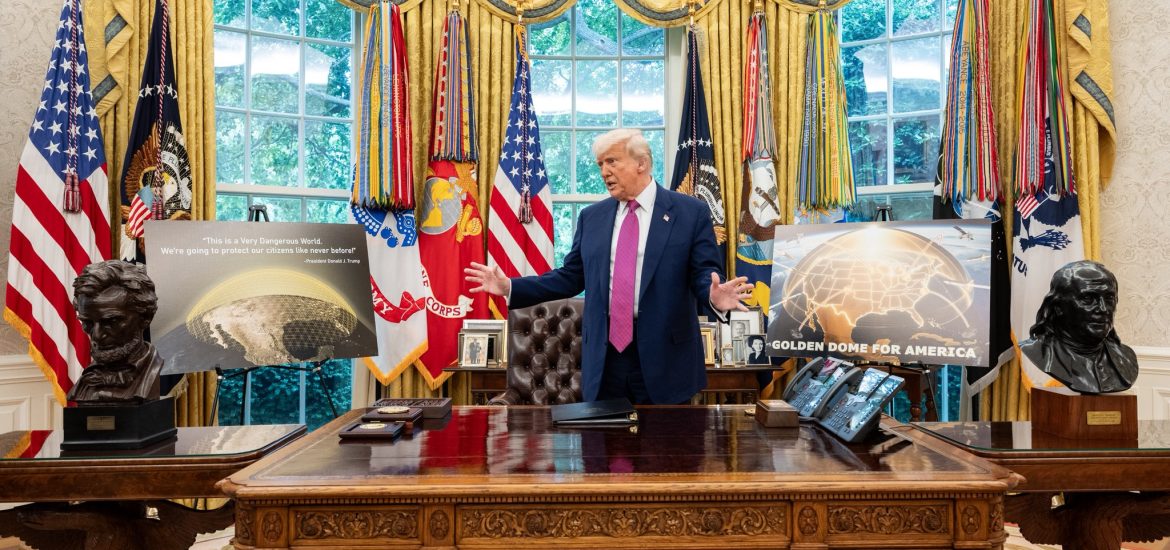

“Promise made, promise kept”: it is with these words that US President Donald Trump unveils plans for the 175 billion dollar missile shield “Golden Dome.”
On Pete Hegseth’s first day as Secretary of Defense and just days after his return to the White House in January, on January 27 President Trump signed an executive order to introduce a new missile defense system, initially named American Iron Dome. Inspired by Israel’s Iron Dome air defense system, Trump wrote in the executive order that the new American missile defense system must be capable of addressing “The threat of attacks with ballistic, hypersonic, and cruise missiles, and other advanced aerial attacks,” because “it remains the most catastrophic threat the United States faces.”
Yesterday President Trump presented the “Golden Dome” project to begin construction of the new and sophisticated missile defense shield capable of intercepting threats from space, estimating a cost of about 175 billion dollars and operational readiness within three years.
All the details.
INITIAL FUNDING
Speaking Tuesday in the Oval Office, Trump stated that the Golden Dome program will require an initial investment of 25 billion dollars, with a total cost of 175 billion dollars over time.
The initial sum of 25 billion dollars was allocated from the “One Big Beautiful Bill” (tax bill proposal), which has not yet been approved.
In fact, the government has estimated that the project will end up costing much more over the decades. This month, the Congressional Budget Office estimated that Golden Dome could cost up to 831 billion dollars over two decades.
LED BY THE SPACE FORCE GENERAL
Also yesterday, the US president announced that the Space Force general, currently deputy chief of space operations, Michael Guetlein will oversee the project.
WHAT THE GOLDEN DOME WILL BE LIKE
The “Golden Dome” project echoes the failed “Star Wars” program of President Ronald Reagan, criticized for being overly ambitious and for diverting funds from other national priorities.
What’s different today? “The technology wasn’t there. Now it is,” explained Pentagon chief Hegseth. “And you are following through on your words saying we will protect the homeland from cruise missiles, ballistic missiles, hypersonic missiles, drones, whether conventional or nuclear.” Trump stated that the system will be composed of “next-generation” technologies for land, sea, and space, including space sensors and interceptors.
The Golden Dome “will protect our homeland,” Trump explained, adding that Canada has expressed its willingness to be part of it.
INSPIRED BY THE ISRAELI IRON DOME
As already mentioned, the system is partly inspired by the Israeli Iron Dome. The latter is the short-range missile defense system that has an interception rate of about 90%, according to the Israeli military. However, the Iron Dome selectively protects populated areas in a country the size of New Jersey.
Trump’s Golden Dome would be much larger and designed to combat a wider range of threats, including hypersonic weapons capable of moving at speeds greater than sound and fractional orbital bombardment systems – also called Fobs – capable of launching warheads from space, notes the Bbc.
The shield would also include a wide range of surveillance satellites and a separate fleet of attack satellites that would shoot down offensive missiles immediately after launch.
“They will all be shot down,” Trump declared. “The success rate is very close to 100%.”
US officials had previously stated that Golden Dome will aim to enable the United States to stop missiles at various stages of their deployment, even before launch and while still in flight.
THE TIMELINE ACCORDING TO TRUMP
“This Golden Dome project will integrate with our current defense capabilities and should be fully operational before the end of my term,” Trump said. “So we will get it done in about three years. Once completed, Golden Dome will be able to intercept missiles even if launched from other parts of the world and even if launched from space,” Trump added.
WIDESPREAD SKEPTICISM
It is not yet clear how complete the system will be. It is also uncertain whether such an ambitious program could divert funds from other vital programs. The Air Force, for example, is replacing 400 of its intercontinental ballistic missiles built in the 1970s with new ones.
Analysts have expressed doubts about the plausibility – and the immense costs – of replicating Israel’s air defense capabilities on a continental scale. Trump, however, remains optimistic, notes Axios.
Planning, construction, management, and maintenance of Golden Dome, as well as its funding, will require intense coordination among the Pentagon, Congress, current and future presidents, defense contractors, and troops, the outlet added.
EXPERTS’ COMMENT
According to missile defense expert Tom Karako, the current US system mainly focuses on the capability to shoot down intercontinental ballistic missiles from rogue states like North Korea. But the United States needs better protection against other threats such as drones, cruise missiles, and hypersonic weapons, he added.
“The truth is we are pretty vulnerable,” said Karako, director of the Missile Defense Project and senior fellow for Defense and Security at the Center for Strategic and International Studies.
AMERICAN DEFENSE COMPANIES READY TO DO THEIR PART
Finally, American defense companies are already competing for the contract to build the shield, submitting proposals directly to Secretary of Defense Pete Hegseth since Trump signed the executive order in January.
Participants at the press conference named L3Harris Technologies, Lockheed Martin, and RTX Corp as potential contractors for the massive project, reports Reuters. L3 has invested 150 million dollars in building its new facility in Fort Wayne, Indiana, where it produces Hypersonic and Ballistic Tracking Space Sensor satellites, part of a Pentagon project to improve detection and tracking of hypersonic weapons with space sensors that could be adapted for Golden Dome, the outlet adds.
Lockheed Martin’s chief operating officer Frank St. John had told Axios that the project “will require the best from every tech company.” Meanwhile, Reuters had also revealed that Anduril Industries, Palantir Technologies, and SpaceX were collaborating on the Golden Dome initiative.




