Brussels is accelerating on defense.
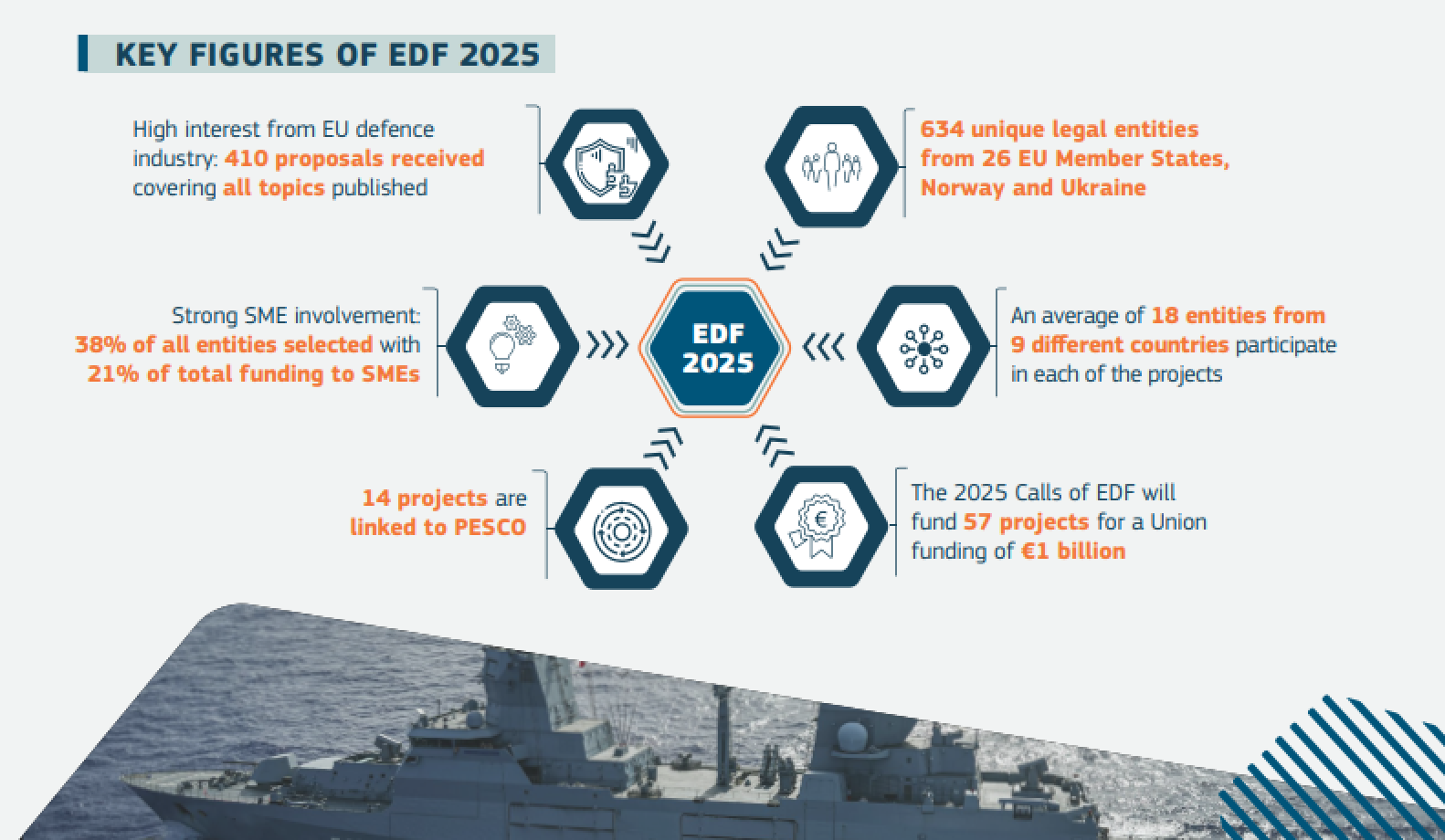
On April 15, the European Commission announced the results of the 2025 calls for proposals under the European Defence Fund (Edf), totaling 1.07 billion euros of EU funding to support 57 joint European research and development projects in the defense sector.
Of these, 9 are led by Italy.
These are the Salubris, Anemos, Asimov, Aether, D-Storm, Dart, Abyssa, Sequilite, and Sound2 programs.
All the details.
WHAT IS THE EUROPEAN DEFENCE FUND (EDF)
The European Defence Fund (Edf) is the EU’s main instrument supporting cooperation in research and development in the defense sector, with a budget of 7.3 billion euros for the 2021-2027 period. It promotes collaboration among companies of all sizes and research institutes throughout the EU and Norway. The fifth Edf call attracted a record number of 410 proposals, a 37% increase compared to last year, the European executive’s note specifies.
In particular, the 1.07 billion euros now allocated by the European executive will support the objectives in the Defence Readiness Roadmap 2030. Specifically, the focus will be on the four ‘flagship’ programs established by the EU: the European Defence Initiative against drones, the Oriental Flank Watch, the European air shield, and the European space shield.
PROJECTS SELECTED UNDER EDF 2025
The 57 projects selected under EDF 2025 cover a wide range of critical sectors, including artificial intelligence (AI), cyber defense, drones, and anti-drone systems. More than 15 projects will support the four European flagship initiatives for preparedness.
SME FOCUS
Among the objectives of the European Defence Fund is also the attraction of new talents and support for start-ups and small and medium-sized enterprises. In this context, the Commission announced that some projects will activate “internal calls” to finance new ideas, with contributions up to 60,000 euros per company. “More than 21% of total funding will go to SMEs, thus allowing entities without previous experience in the defense sector to enter the market,” reads the statement released by Brussels.
STRENGTHENING COOPERATION WITH KYIV
Furthermore, the European Commission highlighted the EU’s strengthening of cooperation with the Ukrainian defense industry, supported by the EU Defence Innovation Hub in Kyiv. This partnership aims to better integrate Ukraine into the European industrial base. A key initiative, the Stratus Project, will develop an AI-based cyber defense system for drone swarms. It includes a Ukrainian subcontractor, ensuring that the project benefits from direct battlefield experience, the note indicates.
9 ITALIAN-LED PROJECTS, INCLUDING AETHER
Subsequently, also with EDF 2025, our country is a protagonist in several projects, 9 out of 57. Such as the Aether project, coordinated by the Italian company Avio, which will develop propulsion and thermal management systems to support the drone defense initiative. Or the Asimov project, coordinated by Leonardo, which aims to create the first European on-orbit servicing system (OOS) dual-use system, enabling autonomous, safe, and sovereign operations across all orbital regimes (LEO, MEO, GEO).
There is also the D-Storm project led by Mbda, which will develop long-range munitions and interoperable, affordable, and mass-producible unmanned combat aerial systems, adapted to modern saturation warfare and European strategic needs. The project will define modular and “plug and play” system architectures combining low-cost hardware with advanced software to maximize operational effectiveness while minimizing unit and logistical costs, according to the fact sheet published by the Commission. The Italian company Fincantieri is at the helm of the Abyssa project, which will promote the development of autonomous, resilient, and high-performance underwater systems capable of operating beyond 6000 meters depth.
NEXT STEPS
Finally, following the selection of successful proposals, the Commission will begin preparing the grant agreement with the consortia, aiming to sign the agreements by the end of the year.