

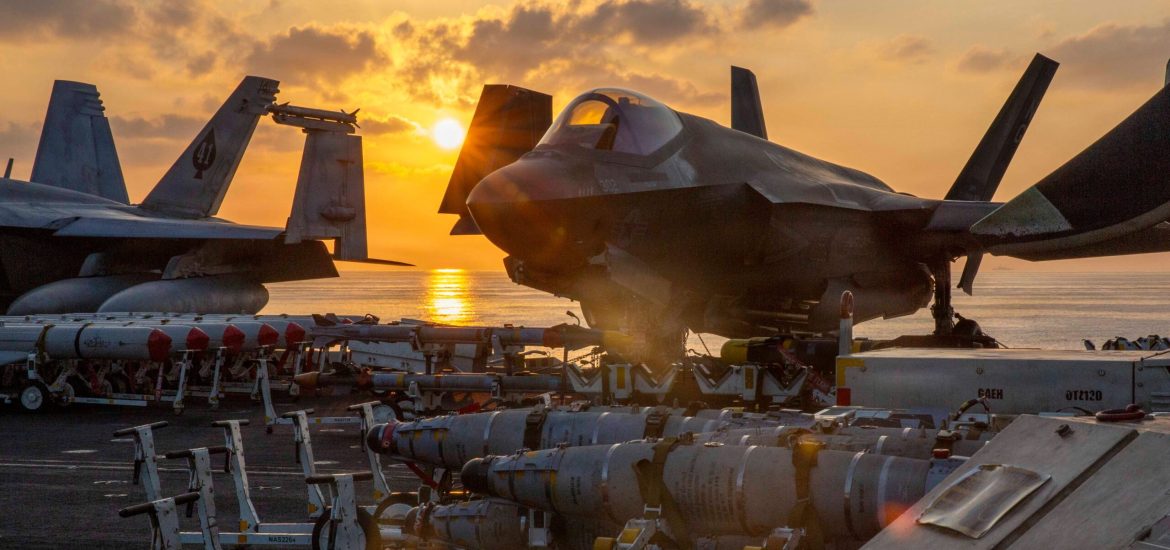

On the morning of Saturday, February 28, 2026, starting at 10:12 Tehran time (07:42 CET), the Israeli Air Force (IAF) and U.S. forces deployed in the Area of Responsibility (AoR) of the U.S. Central Command (USCENTCOM) launched a coordinated military action against the Islamic Republic of Iran, which quickly took the form of a massive air campaign and long-range strikes.
The campaign, the result of long planning and conducted in full synchronization, was divided into an Israeli Operation, officially named Roaring Lion and announced by the Israeli Defence Forces (IDF) at 10:57, and a U.S. action, dubbed Operation Epic Fury and communicated by the Pentagon at 12:09. Although operating in close collaboration, the two countries pursued distinct sets of objectives from the outset: the United States focused its activities on degrading Iranian military capabilities and the military-industrial complex, with particular reference to the missile segment, nuclear facilities, naval infrastructure, and air defense systems; Israel, on the other hand, declared its aim to remove the existential threat posed by Tehran, focusing on political and military leadership, missile sites in western Iran, and command and control (C2) structures.
In this context, the first wave of attacks conducted by the IAF on Saturday morning consisted of strikes aimed at dismantling the Iranian security-military apparatus and neutralizing its highest institutional leaders. The initial attack, claimed as the largest in IAF history, involved the deployment of approximately 200 aircraft, mostly F-35I Adir and F-16I Sufa multirole fighters, the latter equipped with air-launched ballistic missiles (ALBM), several booster remnants of which were found in western Iraq, and supported by KC-707 Re’em tankers for in-flight refueling over Syria, striking up to 500 distinct targets almost simultaneously, in conjunction with U.S. BGM-109 Tomahawk cruise missiles. The ALBMs, in particular, had already been used by Israel in previous Operations Days of Repentance (October 2024), Rising Lion (June 2025), and Summit of Fire (September 2025) to neutralize air defense systems and hit high-value targets (HVT) deep in enemy territory without exposing crewed aircraft.
Nevertheless, it is considered plausible that during the operation the F-35I Adir assets, due to their stealth characteristics, were employed from the outset in stand-in mode in conjunction with stand-off attacks. Overall, the observation of activities conducted by Israel aligns with lessons learned from past operations, particularly during the 12-Day War, where similar stand-off strikes with ALBMs were recorded in the implementation of a suppression and destruction campaign of enemy air defenses (SEAD/DEAD) aimed at creating a safe corridor for crewed aircraft to operate in stand-in mode. Specifically, this was precisely replicated by the IAF during Operation Roaring Lion, where from day one an attempt was made to open such an air corridor towards and above Tehran, an objective officially declared achieved on Sunday evening, thus reducing reliance on stand-off munitions and enabling large-scale bombing campaigns against Iranian institutional targets.
Tehran was therefore immediately a priority target for the IAF, which from 10:12 struck first University Street and the Jomhuori area, then the compound of Supreme Leader Ali Khamenei, the Ministry of Defense, the Ministry of Intelligence, the headquarters of the Atomic Energy Organization of Iran, and the Parchin military complex. The first confirmations regarding high-profile individuals neutralized came late afternoon, when the names of Defense Minister Aziz Nasirzadeh, Chief of Staff of the Armed Forces Seyed Abdolrahim Mousavi, Supreme Leader’s Personal Representative on the Defense Council Ali Shamkhani, and Commander of the Islamic Revolutionary Guard Corps (IRGC) Mohammad Pakpour were reported. As for the Supreme Leader, following initial reports placing him in a safe shelter, from 15:37 his status began to appear uncertain due to the extent of damage to his compound, which was hit by about 30 munitions.
Subsequently, during the evening, news of his probable elimination was disseminated by Israeli (23:10) and U.S. (23:45 and 00:35) sources, then definitively confirmed by Iranian authorities on the morning of Sunday, March 1. Overall, the start of Saturday’s attacks in broad daylight, rather than the traditionally preferred nighttime hours, was plausibly determined by the availability of real-time intelligence on the Supreme Leader’s location, a highly time-sensitive opportunity that necessitated advancing the operational window.
In parallel, the degradation of Iranian military and military-industrial capabilities involved both U.S. forces, specifically the U.S. Air Force (USAF) and U.S. Navy, and, in a later phase, the IAF, which also conducted strikes against Hezbollah in Iqlim al-Tuffah, Lebanon, and against Kataib Hezbollah in Baghdad to dismantle their C2 structures. While initial Israeli attacks focused on the Tehran area to decapitate Iranian institutional leadership, U.S. targets were more widely distributed across the country, in at least 24 of 32 provinces, including numerous cities such as Kermanshah, Lorestan, Tabriz, Isfahan, Karaj, Ilam, and Urmia.
In this first phase, many attacks aimed to degrade and destroy what remained of Iranian air defenses to subsequently allow crewed aircraft to operate safely in enemy airspace. In this context, the breadth of the target list, at least 130 geographic objectives distributed nationwide, required consistent and continuous use of intelligence, surveillance, target acquisition, and reconnaissance (ISTAR) assets, especially for locating, identifying, and dynamically tracking mobile ballistic missile launchers to prevent their operational deployment and concurrently support allied air defense architectures. Alongside SEAD/DEAD activities, several production and logistics sites related to the missile and drone sector, ammunition depots, C2 nodes, and installations connected to the Iranian military-industrial supply chain were also struck.
Among the targets were several fortified underground facilities linked to the IRGC’s ballistic missile capabilities, one of which was hit as early as 14:15 in eastern Iran. In this regard, a particularly significant moment occurred approaching the first night of operations. While U.S. tanker movements near Gibraltar had been detected since 22:06, at 00:00 a peak of activity was observed around Lajes Air Base in the Azores, from which five KC-46 Pegasus tankers reportedly took off within minutes. These signals suggested the imminent deployment of B-2 Spirit strategic bombers, equipped with advanced stealth capabilities and capable of carrying significant conventional payloads, including penetrating ordnance suitable against underground structures. Subsequently, at 19:36 on Sunday, night strikes were confirmed involving four such aircraft that took off from Whiteman Air Force Base, Missouri, hitting several deeply buried mountain facilities using a total of 64 GBU-31(V)3/B Joint Direct Attack Munition (JDAM) 900-kilogram high-penetration bombs. Their use is notable in place of the GBU-57A/B Massive Ordnance Penetrator (MOP) bombs employed in the previous Operation Midnight Hammer in June 2025, a choice driven by their lighter weight and thus higher transportable quantity, factors aligned with the high number and dispersion of targets to be hit during a single sortie. A similar strike, in terms of operational methods, was recorded during the night between Sunday and Monday.
On the morning of March 2, USCENTCOM announced the deployment of three B-1B Lancer strategic bombers that took off from Ellsworth Air Force Base, South Dakota, to degrade Iranian ballistic missile capabilities by destroying assets and industry elements in the sector. Although the type of munitions used is unknown, it is noteworthy that the B-1B has the largest payload of any active U.S. bomber. This, combined with the fact that it is not classified as a stealth aircraft, suggests a transition from penetration bombing characterizing the SEAD/DEAD phase to high-volume fire bombing following the neutralization of enemy defenses. In this context, the United Kingdom’s announcement on Sunday evening of making several military bases available to the United States for attack operations against Iran is significant. Among these, Diego Garcia in the Indian Ocean and Fairford in the UK stand out as potentially useful forward operating points for U.S. strategic bombers, enabling more systematic use in the conflict without resorting to ultra-long-range sorties.
In this context, during the second day of operations, the USAF and U.S. Navy maintained a relatively lower sortie rate compared to their Israeli counterpart, with attacks still focused primarily on achieving air supremacy through thorough SEAD/DEAD activities, while continuing the destruction of Iranian military sites and the military-industrial complex, all while the IAF remained engaged in neutralizing Iranian medium-range ballistic missile (MRBM) launchers in support of air defense activities. Regarding SEAD/DEAD activities, it is noteworthy that Israeli-U.S. strikes systematically continue to neutralize remaining Tehran aircraft while still grounded, including F-4 Phantom, F-5 Tiger, and MIG-29 Fulcrum assets.
During the night between Sunday and Monday, at 00:20, USCENTCOM released an updated operational report covering the first two days of the campaign, claiming the neutralization of about 1,000 targets. Overall, currently and likely for the next two to three days, USAF, U.S. Navy, and IAF operations will follow a daily cadence alternating massive sorties with tactical pauses, aiming to ensure logistical and maintenance sustainability and allow constant assessment of the ground situation. Operationally, the main limiting factor for the overall campaign duration is the availability of air-to-surface and surface-to-air munitions. Nonetheless, it is reported that U.S. armed forces have leveraged the conflict to deploy several newly designed assets for long-range strike missions in combat for the first time.
Among these is primarily the new short-range ballistic missile (SRBM) Precision Strike Missile (PrSM), which entered operational service only about two years ago and represents the latest evolution of the U.S. Army’s long-range precision strike capability. Its use marked the operational debut of a munition designed to progressively replace the MGM-140 Army Tactical Missile System (ATACMS), expanding range, precision, and employment flexibility from M142 High Mobility Artillery Rocket System (HIMARS) and M270 Multiple Launch Rocket System (MLRS) ground platforms. Another asset tested in the field for the first time is the long-range attack drones (OWA-UAV – One-Way Attack Unmanned Aerial Vehicle) Low-cost Unmanned Combat Attack System (LUCAS), inspired by Iranian Shahed-136s and launched from the ground by Task Force Scorpion Strike, incorporated only since December 2025 within USCENTCOM.
Concluding the overview of the Israeli-U.S. offensive, another factor accompanying operations from the initial phases, generating particularly impactful effects, has been the use of cyberattacks against the Islamic Republic. Initially, around 11:22, several Iranian information sites, including the state news agency, were targeted. Subsequently, the action expanded both in scope and intensity, leading to a rapid shutdown of Internet connectivity in the country: starting around 11:58, by 12:17 disconnection had affected the entire Iranian territory, contributing to quickly and effectively disrupting Iranian C2 architectures.




