



The National Space Policy Strategic Document (Dspsn) sets a course. Now it must become an execution machine: industrial capital, private equity, exploration manufacturing, homogeneous districts, results-based procurement, and measurable responsibilities.
In the space sector, having a vision is not enough. You have to know how to execute it.
This is, today, the political and industrial threshold facing Italy. Not the ability to participate in major international programs: that exists. Not the quality of technical skills: that exists too. Not the presence of a recognized scientific, manufacturing, and engineering tradition: it is already a consolidated asset. The real question is another, more severe one: is the country able to transform this sum of excellences into an organized industrial platform?
The National Space Policy Strategic Document has an obvious merit. It puts space back at the center of sovereignty, security, competitiveness, and growth. It does so within a correct framework, because space is no longer a side sector. It is critical infrastructure. It is industrial policy. It is market. It is defense. It is economic diplomacy. It is the ability to protect data, communications, supply chains, territories, infrastructures, and national interests.
But a strategy, to be credible, must go beyond the language of intentions. It must say who does what; with what resources; within what timeframes; with what indicators; with what corrective powers. It must move from vision to execution. Otherwise, it remains a well-written document but does not become a development engine.
The first issue is capital. And here it is necessary to avoid a misunderstanding that often crosses the Space Economy debate: you cannot talk only about startups and venture capital. Startups are fundamental. They bring speed, risk, creativity, technological cross-pollination. They are an indispensable part of the ecosystem. But a national space policy cannot stop at the early stage. Orbital leadership is not built by incubating only new companies. It is also built by growing mature companies, consolidating excellent SMEs, financing scale-ups, supporting acquisitions, factories, clean rooms, test facilities, patents, certifications, and international presence.
Venture capital ignites the spark. Private equity can build the industrial machine. It is a decisive distinction. Space needs growth capital, consolidation funds, structured debt, guarantees, hybrid instruments, multi-year procurement. It needs investors capable of understanding complex technologies, long cycles, future margins, and intangible assets. If Italy finances the birth of companies but neglects their growth, it will produce good ideas destined to be bought elsewhere. If instead it builds a complete financial scale, it can retain know-how, increase the average size of companies, and bring out national and European champions.
The Dspsn opens this door when it calls for innovative financial instruments, mixed funds, private equity, and subsidized financing. But this step must be moved from the margin to the center. Private equity is not a technical note. It is an industrial policy lever. It can aggregate fragmented companies, strengthen family governance, support M&A operations, accompany exports, make supply chains more robust, and transform small excellences into productive platforms.
The second issue is exploration manufacturing. Here Italy does not start from a blank page. The Thales Alenia Space site in Turin represents a strategic asset: a stronghold of European and global space manufacturing in pressurized infrastructures, habitable modules, orbital logistics, and architectures related to inhabited space. Turin is not just an industrial memory. It is a national lever.
When the Dspsn talks about human and robotic exploration, orbital logistics, commercial stations, low orbit activities, modules, life support systems, health in space, advanced materials, and digital twins, it is not describing a futuristic chapter. It is entering a field in which Italy already has credibility. And credibility, in space, must be nurtured before it is consumed.
Defending the Turin asset does not mean locking it into a territorial logic. It means strengthening it within a national exploration roadmap. It means connecting it to robotics, materials, avionics, software, sensors, biomedicine, cybersecurity, universities, ITS, specialized SMEs, and supply networks. Space exploration is not just science. It is sophisticated manufacturing. And it is precisely this manufacturing that must be protected because it contains skilled labor, patents, tacit knowledge, international reputation, and negotiating capacity.
The third issue is clustering. The DSPSN calls for districts, technological clusters, European hubs, and public-private partnerships. It is the right direction, but it must be made more demanding. Clusters must be homogeneous, comparable, and dialoguing. A space geography made of territories speaking different languages, measuring different indicators, adopting different governance, and competing for visibility rather than specialization is not acceptable.
A national district scheme is needed. Each territory must enhance its vocation, but within a common framework: regional stakeholders in the control room; universities and research centers; large companies; SMEs; business networks; finance; ITS; administrations; foundations; innovation entities. Under this architecture, specialized industrial networks must operate: components, data, software, materials, downstream, cybersecurity, orbital logistics, exploration, Earth observation.
The district must not be a showcase. It must be an operational platform. And it must communicate with other districts. The Italian risk is well known: building brilliant but isolated territorial excellences, each jealous of its own perimeter, each convinced it can represent the entire supply chain. Space does not allow provincialism. Turin must dialogue with Lazio, Abruzzo, Lombardy, Campania, Puglia, Tuscany, Emilia-Romagna. North and South must enter multi-regional alliances. Each territory must not want to be everything. It must know what it brings to the national platform.
Homogeneous clustering also serves capital. Private equity does not invest in confused narratives. It invests where it sees governance, pipeline, aggregable companies, contracts, patents, margins, managers, export, public demand. A well-built district makes opportunities readable. A well-designed business network allows an SME not to remain alone. A multi-regional alliance allows Italy to present itself in Europe as an industrial system, not as a sum of bell towers.
The fourth issue is downstream. Space is not only satellite, launcher, module, or mission. It is also data that becomes service. Agriculture, environment, civil protection, insurance, energy, mobility, cultural heritage, security: these are the markets where the Space Economy stops being a promise and becomes productivity. But data does not become a market by itself. Standards, use cases, pricing models, users, contracts, demand formation are needed.
The public administration can be the first smart customer. Not just a funder. Not just a contracting authority. A customer. It must buy results: faster monitoring, predictive maintenance, early warning, territory control, resource management efficiency, infrastructure security. Public procurement can create a market if it is multi-year, measurable, outcome-oriented. If it remains just procedure, it preserves the status quo.
Above all is governance. An interministerial space strategy is inevitable. But multiplying actors does not automatically produce effectiveness. Budget owners, mission boards, responsibilities, milestones, KPIs, arbitration powers are needed. Matrices full of involved actors show participation; they do not always show accountability. And in space, administrative slowness is not neutral. It is loss of position.
For this reason, the Dspsn should be read as a map of processes to be executed, not as a catalog of objectives. The difference is substantial: each chapter must translate into operational responsibilities.
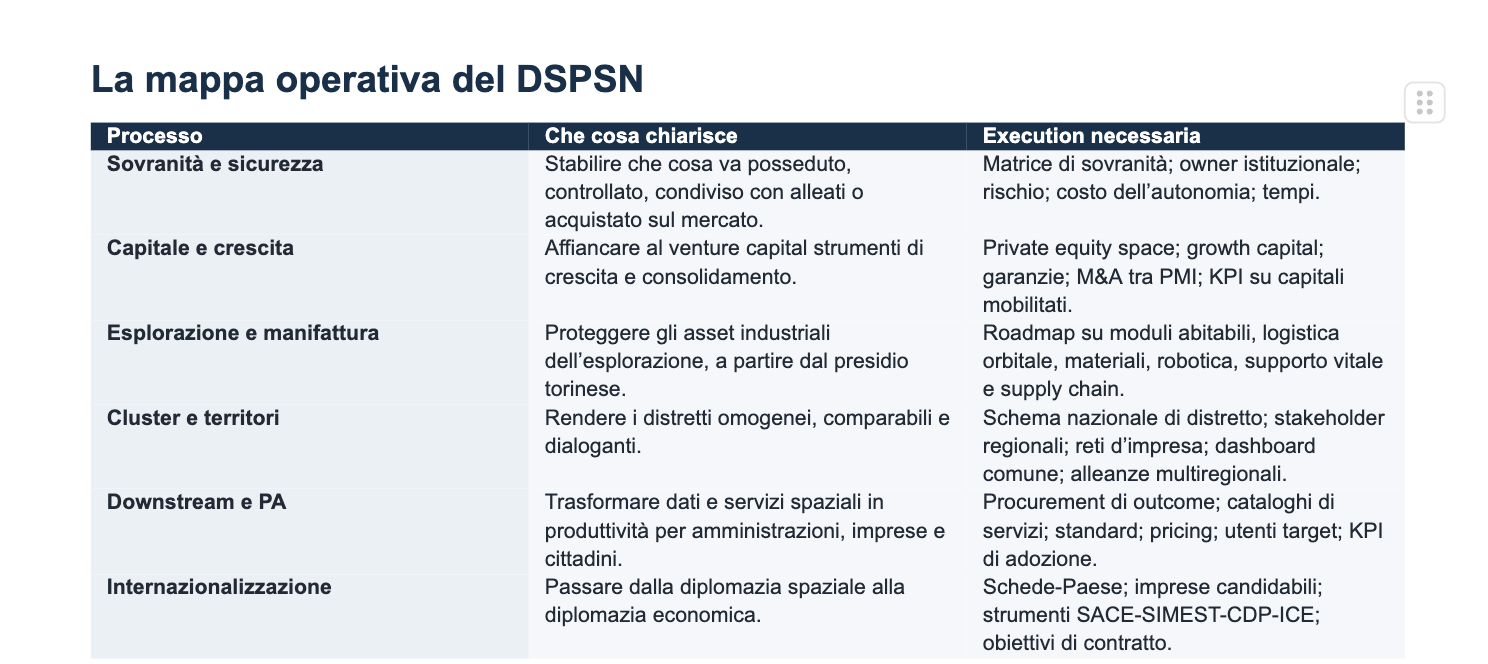
This map separates words from processes. “Sovereignty” becomes a control matrix. “Capital” becomes a supply chain of financial instruments. “Cluster” becomes comparable territorial governance. “Exploration” becomes a manufacturing stronghold. “Internationalization” becomes contracts. This is where a strategy shows its seriousness: in the ability to transform solemn nouns into operational verbs.
A national dashboard is also needed. Space revenues of Italian companies. Export. Margins. Mobilized private capital. Private equity operations. M&A. Patents. Skilled employment. Services purchased by the PA. ESA and EU contracts. SME size growth. Value of intangible assets. What is not measured is not governed. And what is not governed, in space competition, is governed by others.
The same multi-regional ambition must become concrete. If one territory oversees exploration manufacturing, another sensors, another downstream, another electronics, another observation services, the strategy must build stable bridges between these vocations. Not conferences. Not occasional tables. But joint programs, business networks, integrated procurement, common European projects, dedicated finance, and export objectives.
Finally, a portfolio logic is needed. Not everything can be equally prioritized. Earth observation, telecommunications, navigation, launchers, exploration, orbital logistics, cyber, training, diplomacy: these are relevant areas, but not all can receive the same intensity of capital, attention, and urgency. Some must be scaled. Others monetized. Others validated. Others still rethought. Industrial policy is not a list of ambitions. It is the discipline of priorities.
Italy has a rare window. It has skills, companies, territories, universities, research centers, a space manufacturing sector that in some segments is already a global asset. But the time of declarations must give way to the time of organization. Defend Turin as an exploration asset. Bring private equity alongside venture capital. Build homogeneous and dialoguing districts. Make the PA a smart customer. Measure intangibles. Choose priorities. These are not technical details. They are the substance of a mature strategy.
The conclusion is clear. Every process evoked by the Dspsn needs a precise execution plan. It is not enough to indicate the objective; it is necessary to establish who takes charge of it. It is not enough to call for capital; it is necessary to define instruments, tickets, targets, and governance. It is not enough to talk about clusters; it is necessary to build districts with common rules and operational business networks. It is not enough to mention exploration; it is necessary to protect the manufacturing assets that make it possible. It is not enough to invoke internationalization; it is necessary to generate pipelines, contracts, and measurable returns.
Flying high today means replacing the rhetoric of excellence with the discipline of execution. Space will reward countries capable of being visionary and strict, ambitious and measurable, national and multi-regional, technological and financial. Italy can be among them. But it must stop thinking of itself as an archipelago of skills and start behaving like an industrial platform. It is not enough to have stars to point to. A course is needed. And, above all, the ability to follow it.


