

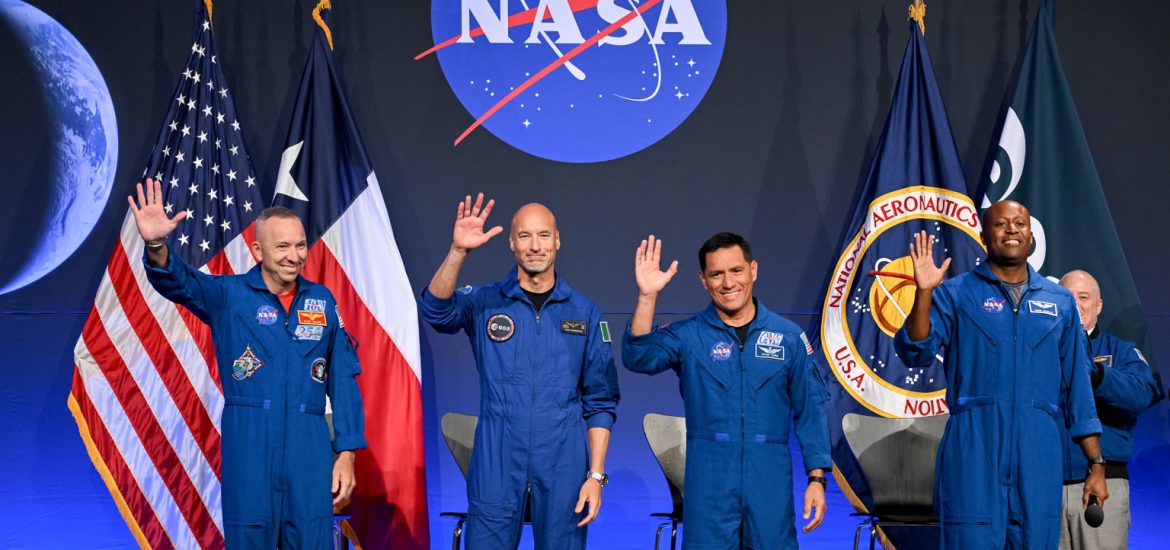

Parmitano returns to space.
Nasa has chosen the European Space Agency (Esa) astronaut Luca Parmitano as pilot of the Artemis III mission, the experimental flight that Nasa plans to carry out in mid-2027 to test future lunar landing modules developed by Blue Origin and SpaceX in Earth orbit.
The mission, lasting about two weeks, represents a key step in the Artemis program: the astronauts will not reach the Moon, but will verify in flight the technologies and procedures that will be used in future lunar landing missions. Artemis II will follow about a year later, which in April carried four astronauts into lunar orbit testing the Space Launch System (Sls) rocket and the Orion capsule. The goal of the U.S. space agency is now to use Artemis III to qualify the technologies and aim for the lunar landing with Artemis IV.
And flying as test pilot on the Artemis III mission will be the Italian Parmitano: “Test pilot by training, with two space missions, commander of the International Space Station – he has seen space flight from every important angle,” said Josef Aschbacher, Esa Director General, yesterday.
All the details.
NASA CHOOSES THE ARTEMIS III CREW
On June 9, Nasa announced the four astronauts selected for Artemis III. Leading the mission will be Randy Bresnik, a veteran of the Space Shuttle and the International Space Station. The role of pilot was assigned to the Italian Luca Parmitano of the European Space Agency (Esa), already a protagonist of two long-duration missions on the ISS in 2013 and between 2019 and 2020.
The crew is completed by Frank Rubio, a Nasa astronaut who holds the record for the longest U.S. spaceflight with 371 consecutive days spent in space between 2022 and 2023, and Andre Douglas, on his first space mission. Bob Hines will be the backup astronaut and will participate in training along with the rest of the crew.
FROM FIRST LUNAR LANDING MISSION TO TEST FLIGHT
The four astronauts will take part in what Nasa officials have called one of the most complex crewed missions ever undertaken. The flight will require a coordinated series of launches, rendezvous maneuvers, and dockings between different spacecraft.
Initially conceived as the mission that would return U.S. astronauts to the lunar surface for the first time since Apollo 17 in 1972, Artemis III is now a test flight, as decided by Nasa last February. The model is that of Apollo 9 mission, to validate the systems necessary for the lunar landing before attempting a new descent to the Moon.
And it is precisely the Apollo 9 mission, “my favorite,” that astronaut Parmitano referred to today in a press conference with Italian journalists organized by Esa.
HOW THE FLIGHT WILL PROCEED
As already mentioned, the crew will not head toward the Moon. Instead, they will fly in orbit around the Earth for a journey of about two weeks, in order to test the landing modules, which will then be used to bring humans back to the lunar surface as early as 2028.
According to the plan outlined by Nasa, Blue Origin will first launch a prototype of the Blue Moon Mark 2 lunar lander, designed to remain in low Earth orbit for up to 90 days.
Subsequently, the crew will take off aboard the Orion capsule, the same used during the Artemis II mission, launched by the Sls rocket. Orion will reach the Blue Moon lander and remain docked for about two days. During this phase, the astronauts will enter the vehicle and also test a version of the Artemis lunar spacesuit developed by Axiom Space.
TESTS WITH BLUE ORIGIN AND SPACEX LANDERS
Once activities with Blue Moon are completed, Orion will separate from the Blue Origin vehicle and reach Starship, the lunar lander developed by SpaceX. The crew will spend about a day aboard the vehicle to verify its systems and operational procedures.
The availability of reliable landing modules is considered essential for the success of the Artemis program, which aims to create a permanent human presence on the Moon and use the experience gained as a basis for future missions to Mars.
During the crew presentation, representatives from Blue Origin and SpaceX outlined the progress of their respective programs. “We are confident that New Glenn will be ready for Artemis III,” said Jeremy Parsons, Nasa official responsible for the Moon-Mars program, referring to the explosion of Blue Origin’s New Glenn rocket, necessary to propel the company’s lander into space.
SpaceX instead announced its intention to perform an in-orbit refueling demonstration of Starship by the end of the year, a capability considered essential for future deep space missions. The company also confirmed that it is building at Starbase, Texas, the cabin intended for astronauts participating in future lunar missions.
THE LUNAR RACE (AGAINST BEIJING)
Many challenges packed into a single mission, while time is running out. Because if this mission represents a fundamental step of the Artemis program, China continues to pursue the goal of conducting its own crewed lunar landing by 2030.
And it was precisely to Esa astronaut Luca Parmitano that Startmag asked today, during the press conference organized by Esa, how much the desire of the United States to maintain space leadership over China is weighing on the choices and timing of the Artemis program.
“It weighs 100%,” Parmitano replied. The Italian astronaut emphasized that “we, as the European Space Agency, as allies of the United States, want to be together with them in this moment of exploration.”
“We want to be alongside those who lead and indeed it will be so,” Parmitano added, recalling his role in the mission: “I will be the pilot alongside the commander and we will share responsibilities broadly.”
According to the Esa astronaut, “Europe wants to be alongside the United States in this phase of lunar exploration precisely to bring our values as Europeans, together with the American ones.” Parmitano then highlighted how “Nasa serves the American administration, their geopolitical will to demonstrate technological predominance,” while “we as the European Space Agency bring our values of collaboration and cooperation, openness, bridging. Whether it is a technological bridge or an ideological bridge, we want to be a connecting point for humanity.”
“In this sense, I believe that our participation is, from a technological point of view, with the European service module, but also with our personnel and our ability to generate very high professionalism, we are succeeding and I hope this mission will be the demonstration of that,” concluded the Italian astronaut Parmitano.




