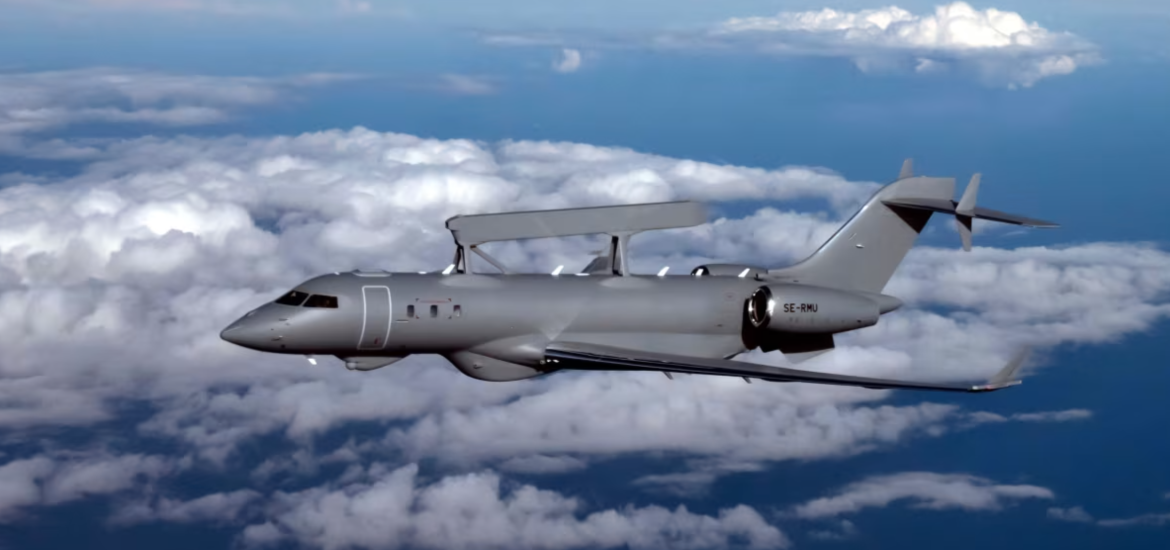

Canadian Prime Minister Mark Carney has announced the purchase of a fleet of Saab GlobalEye surveillance aircraft for the Royal Canadian Air Force, a concrete step in the strategy to reduce dependence on the United States in military procurement.
Based on the Canadian-made Bombardier Global 6500 executive jet, the GlobalEye prevailed over two American competitors, including a Boeing model.
The deal, exceeding 5 billion Canadian dollars, will create jobs for thousands of Canadians and strengthen control over the Arctic, while Ottawa continues to evaluate the future of its fighter jet fleet.
THE ANNOUNCEMENT FROM OTTAWA
Yesterday, opening the CANSEC defense industry exhibition in Ottawa, Carney made the decision official.
As the New York Times writes, echoing a concept he has expressed for months, the Prime Minister stated that “the days when 70% of every dollar spent on defense went to the US are over.” This comes after Canada fulfilled its promise to bring defense spending to the NATO target of 2% of GDP.
According to military sources, Ottawa aims for six aircraft for both national and international operations. The Swedish proposal beat the Boeing E-7 Wedgetail, penalized by delays and cost increases, and the L3Harris Aeris X.
Equipped with advanced sensors and state-of-the-art radar, the system is primarily intended for monitoring the Arctic, a vast territory over which Canada now intends to assume full responsibility after decades of close cooperation with Washington.
SWEDISH TECHNOLOGY ON A CANADIAN PLATFORM
The GlobalEye is the result of a union between Swedish expertise and the Canadian aerospace industry: it is built on the Bombardier Global 6500 platform, a luxury jet produced in Canada.
As reported by the Associated Press, the GlobalEye integrates Saab radars and sensors capable of detecting objects over 650 kilometers away, both in the air and on land or sea surfaces, offering real-time situational awareness and the ability to guide fighters to targets.
“With a suite of advanced sensors and mission systems, the GlobalEye will be a key asset for the Canadian Armed Forces to detect and deter threats in the Arctic,” Carney said, words echoed by the CBC.
ECONOMIC BENEFITS AND LOCAL PRODUCTION
One of the strengths of the agreement is the tangible return for the Canadian economy.
Carney announced that about 3,000 Canadian workers will be involved in the project and that one-third of the fleet will be produced locally.
“This is an example of Canada’s defense and industrial strategy in action,” the Prime Minister said according to the New York Times. “It builds strategic autonomy, creates jobs, and strengthens Canada’s position as a global leader.”
Saab has already started collaborations with Canadian suppliers and plans investments in research and development in the country. The Guardian highlights how this choice strengthens ties with Sweden, a new NATO ally, and more generally with Nordic countries for Arctic security.
From Stockholm came praise from Swedish Prime Minister Ulf Kristersson: “The GlobalEye is already creating jobs in Canada and collaborating with the local supply chain. This decision ties our two nations even closer,” he wrote on social media.
THE CHALLENGING CONTEXT WITH WASHINGTON
The move comes at a time of heightened tensions with the United States. Tariffs imposed by the Trump administration, annexation threats, and the recent suspension of the Permanent Joint Board on Defense have contributed to creating the climate that brought Carney to power with a more assertive stance.
As noted by the Associated Press, the behaviors of the Trump administration “infuriated Canadians” and fostered a climate of sharp confrontation with the US.
THE STILL OPEN DECISION ON US FIGHTERS
The purchase of the GlobalEye comes as Ottawa reviews the order for 88 American F-35 fighters.
Carney has requested an assessment to verify the possibility of reducing the purchase of jets produced by Lockheed Martin and integrating the Saab Gripen, which promises production and maintenance in Canada. The Prime Minister clarified that the two processes are proceeding separately, but analysts and industry see a common thread.
Philippe Lagasse, from Carleton University in Ottawa, cited by Reuters, considers the GlobalEye a significant test of the new policy. However, he expects Canada to ultimately keep most of the F-35s, avoiding fleet fragmentation.
Saab remains in the running for the fighters as well.