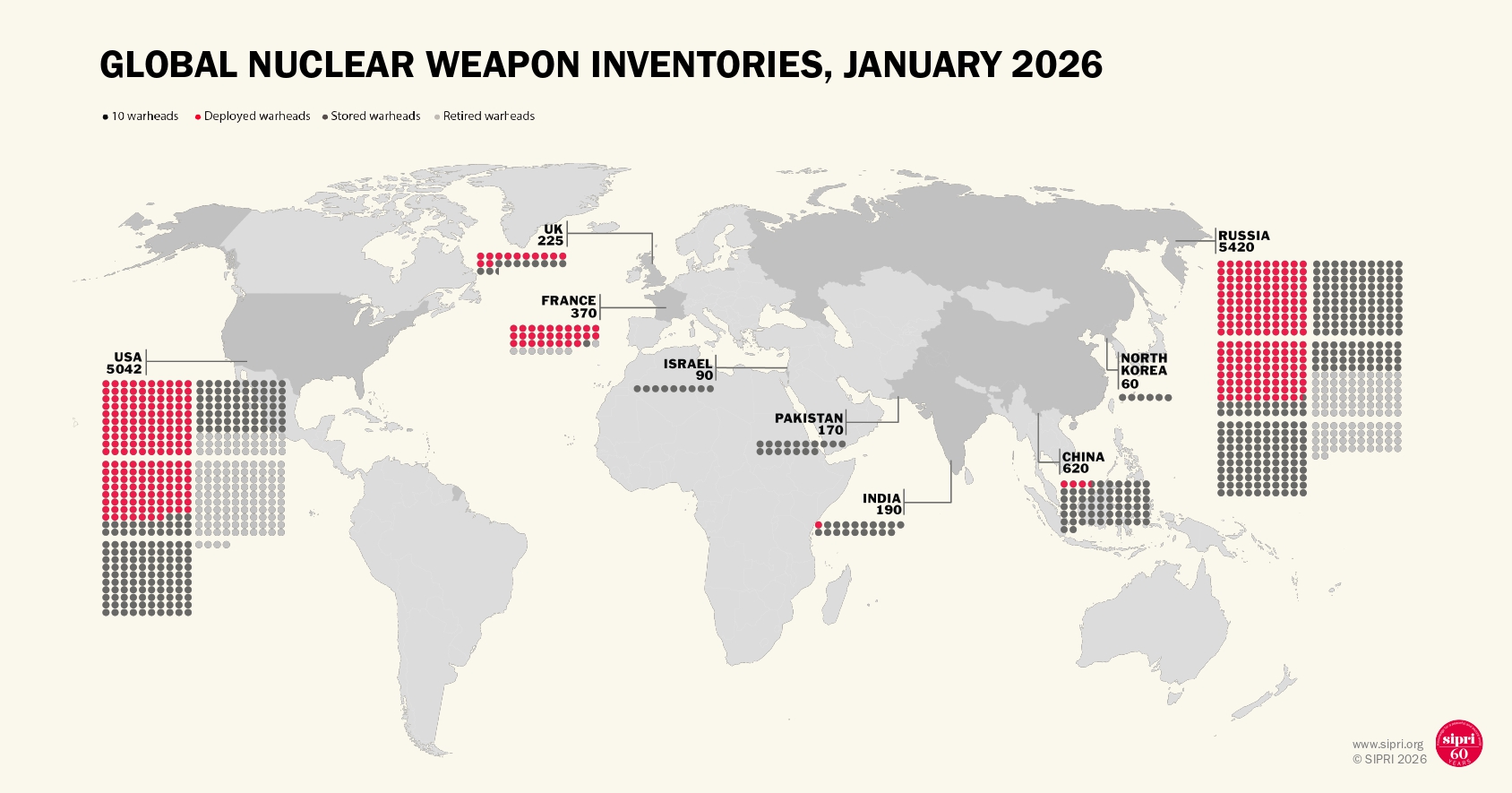
With the global arms race, governments are increasingly relying on nuclear deterrence.
The nine nuclear-armed nations – United States, Russia, United Kingdom, France, China, India, Pakistan, North Korea, and Israel – continue to update their nuclear arsenals throughout 2025.
This emerges from the annual report on strategic arsenals published today by the Stockholm International Peace Research Institute (Sipri).
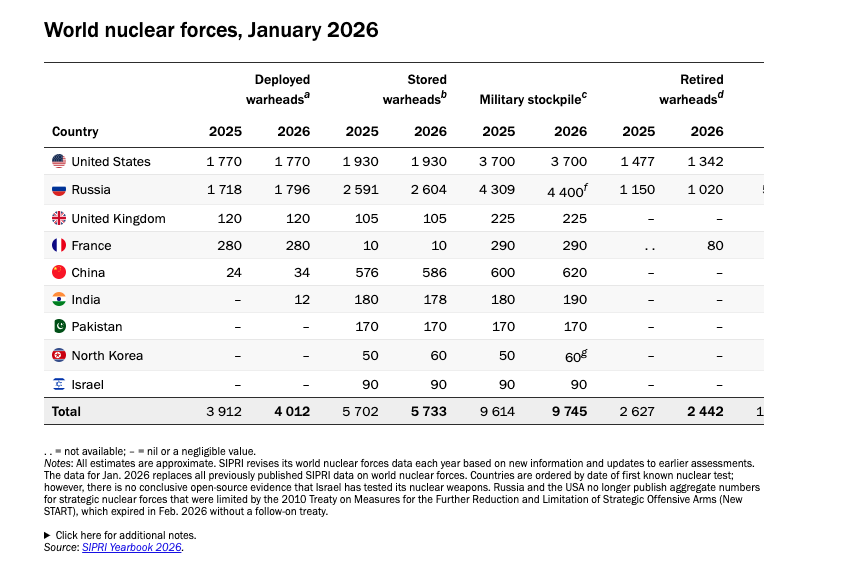
Of the global total of about 12,187 nuclear warheads in January 2026, approximately 9,745 were in military stockpiles for potential use, notes the Swedish think tank. In particular, it is estimated that 4,012 of these warheads were deployed with missiles and aircraft, while the remainder were in centralized storage. Between 2,100 and 2,200 of the deployed warheads were maintained at high operational alert status for ballistic missiles.
Russia and the United States together possess about 83% of all stored nuclear warheads (i.e., usable warheads). However, China remains the fastest-growing nuclear power: the Beijing government intends to credibly deter other countries from a possible nuclear attack.
According to the Stockholm institute, the trend that characterized the post-Cold War period could soon reverse: so far, the dismantling of old warheads by the United States and Russia compensated for the production of new weapons, but now this is gradually changing.
All the details.
TREND REVERSAL
Since the end of the Cold War, the gradual dismantling of retired nuclear warheads by Russia and the United States has generally exceeded the deployment of new warheads, resulting in an overall year-on-year decrease in the global nuclear arsenal. This trend is likely to reverse in the coming years, as the pace of dismantlement slows while the deployment of new nuclear weapons accelerates, explains Sipri.
“Evidence that nuclear-armed states are shelving, and even abandoning, their disarmament commitments, instead choosing to flaunt their nuclear power, is steadily increasing,” commented Hans M. Kristensen, Associate Senior Fellow of the Sipri Weapons of Mass Destruction Program and Director of the Nuclear Information Project at the Federation of American Scientists (FAS). “By resorting to nuclear solutions, states create new risks and fuel the arms race.”
THE CHINESE CHASE
Among all, China is modernizing its nuclear forces faster than any other country. According to Sipri estimates, Beijing possesses about 620 nuclear warheads, compared to 600 in 2025.
On September 3rd, the People’s Republic of China celebrated the 80th Anniversary of the end of World War II with a military parade through Tiananmen Square, where it showcased for the first time a complete nuclear triad, that is, deployable weapons from land, sea, and air.
According to the Swedish think tank’s report, China has deployed hundreds of nuclear-capable missiles in three large silo fields in the northern part of the country. Work is underway to build another 30 silos in three mountainous regions to the east. “Depending on how it chooses to structure its forces, China could potentially possess at least the same number of intercontinental ballistic missiles (ICBMs) as Russia or the United States by the end of the decade,” the report states.
Nonetheless, the number of nuclear warheads remains far lower than those held by Russia and the United States, which continue extensive modernization programs despite technical and financial difficulties.
WHAT’S HAPPENING IN THE OLD CONTINENT
Moving to Europe, there is also growing interest in nuclear deterrence on the Old Continent. As Sipri recalls, only the United Kingdom and France possess nuclear weapons. Specifically, France has 290 nuclear warheads, which can be launched from both nuclear submarines and Rafale fighter jets.
The Paris government has offered to extend discussions on nuclear deterrence to European partners, as they are reassessing their security arrangements due to uncertainty about the long-term reliability of the U.S. nuclear umbrella.
NUCLEAR RISKS INCREASE WORLDWIDE
Finally, Sipri also warns that the expiration of the New START treaty has increased uncertainty about the future limits on strategic arsenals.
“Authoritative voices, including some world leaders, advocate the use of nuclear weapons as a guarantee against an attack by a hostile state. But making national defense and security strategies dependent – or more dependent – on nuclear weapons could significantly increase nuclear risks,” observed Sipri director Karim Haggag.
“The dangers associated with nuclear weapons are increasing due to advances in weapons technology, the collapse of nuclear arms control, and intensifying geopolitical tensions, among a range of other factors.” At the same time, global events – not least the outbreak of conflict between India and Pakistan, both nuclear-armed – are challenging the logic of nuclear deterrence.