

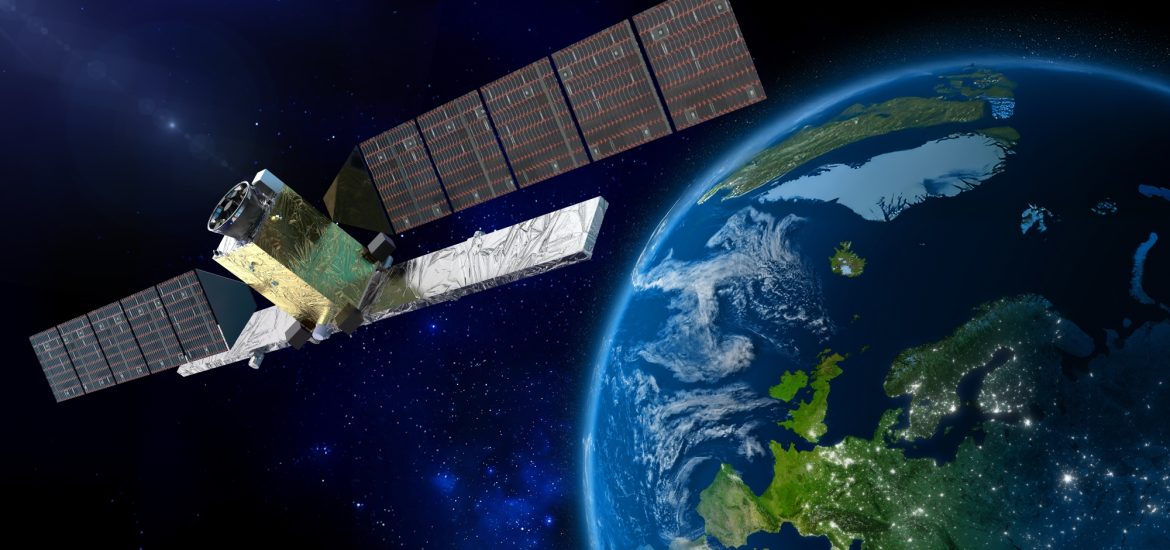

Thales Alenia Space consolidates European leadership in Earth observation.
At the Berlin International Aerospace Exhibition (ILA), the joint venture between Thales (67%) and Leonardo (33%) announced the signing of a contract with the European Space Agency (ESA) for the development of two new generation Sentinel-1 radar observation satellites. The contract – previewed to Startmag by Ornella Bombaci, director of the Competence Center Engineering at Thales Alenia Space during the webinar “From Space to Earth: data and technologies at the service of the planet” (Watch the live stream here) – signed yesterday represents the first tranche of an agreement worth a total of 700 million euros.
Thanks to this contract, Thales Alenia Space will contribute to 11 of the 12 Copernicus missions, “the most sophisticated environmental monitoring program in the world,” declared the CEO of the Franco-Italian company, Hervé Derrey.
Sentinel-1NG is part of Copernicus, the Earth observation component of the EU space program, managed by the European Commission and co-financed by the EU and ESA, which is responsible for the development and launch of the Sentinel satellites, manages most of the missions, and ensures data availability. The mission also enjoys support from the Italian Space Agency (ASI).
All the details.
SENTINEL-1 NG
Following the success of the Sentinel-1 mission, operational for over 12 years, these new generation satellites will ensure the long-term continuity of Earth RAD observation capabilities while offering improved performance.
THE OBJECTIVES
Specifically, Sentinel-1 NG will provide observation data for environmental protection, climate monitoring, natural disaster assessment, and many other socially relevant applications. The satellites will meet the needs expressed by Copernicus services for Climate Change, Land and Sea Monitoring, and those involved in Emergency Management and Security.
Among the numerous applications planned for this mission are maritime surveillance, monitoring of oceans, ice, and land, particularly regarding soil moisture, vegetation cover, forest types, and crop types and conditions. The satellites will offer day and night monitoring regardless of weather conditions.
THE ROLE OF THALES ALENIA SPACE
Thus, Sentinel-1 Next Generation will be led by Thales Alenia Space as the main industrial contractor with Airbus Defence and Space as the main industrial partner responsible for the C-band SAR instrument.
In particular, the main program contract management is entrusted to Thales Alenia Space in Italy, and the company’s teams in Belgium will provide the Power Conditioning and Distribution Unit (PCDU) as well as the photovoltaic assembly for the solar panels (PVA). Thales Alenia Space in Switzerland will supply the cameras for monitoring the SAR antenna apertures and solar panels. The teams in Spain will deliver the Remote Terminal Unit (RTU) and the band transponder (SBT). Thales Alenia Space in France will be responsible for controlling the position of the solar panel wings (SADA). Leonardo will provide the Star Trackers.
“Thales Alenia Space will leverage its proven experience in Earth observation radar programs to contribute to this new and challenging mission,” commented Giampiero Di Paolo, CEO of Thales Alenia Space Italy. “Sentinel-1 Next Generation will offer superior radar imaging capabilities compared to the first generation of Sentinel-1, thus expanding coverage both in Europe and globally, while reducing the intervals between successive radar images,” concluded Di Paolo.




