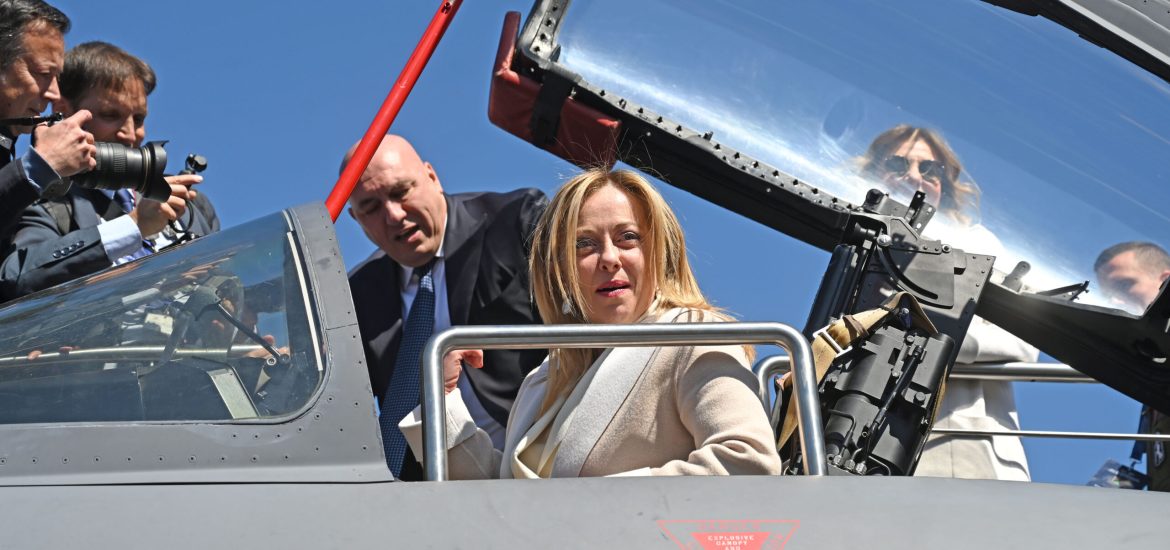

The F-35 program, the most expensive military program ever undertaken, costs Italy much more than expected.
This emerges from the “Resolution of the European and International Affairs Control Section No. 5/2026” of the Court of Auditors on Italy’s participation in the Joint Strike Fighter F-35 Lightning II Program, updating a previous 2017 investigation.
Produced by the American Lockheed Martin, the F-35 Lightning II is a fifth-generation multirole fighter aircraft (capable of performing all missions of the aeronautical doctrine), with pronounced stealth characteristics (low observability by radar systems) and net-centric features (interconnection of all communication, information, and data exchange systems available).
Italy joined the project “from the beginning,” becoming a level 2 partner of the F-35 Joint Strike Fighter program with the commitment to purchase 115 F-35s (reduced to 90 in 2012 from the initial 131 and now restored to the original number with the Defense DPP for the 2024-2026 three-year period).
“Delays recorded in certain phases of the project development, especially in the initial phase (System development and demonstration phase), lasting over 11 years (from the expected 2012 to the actual 2023), have led to a significant increase in economic burdens also borne by Italy,” reports the auditing authority.
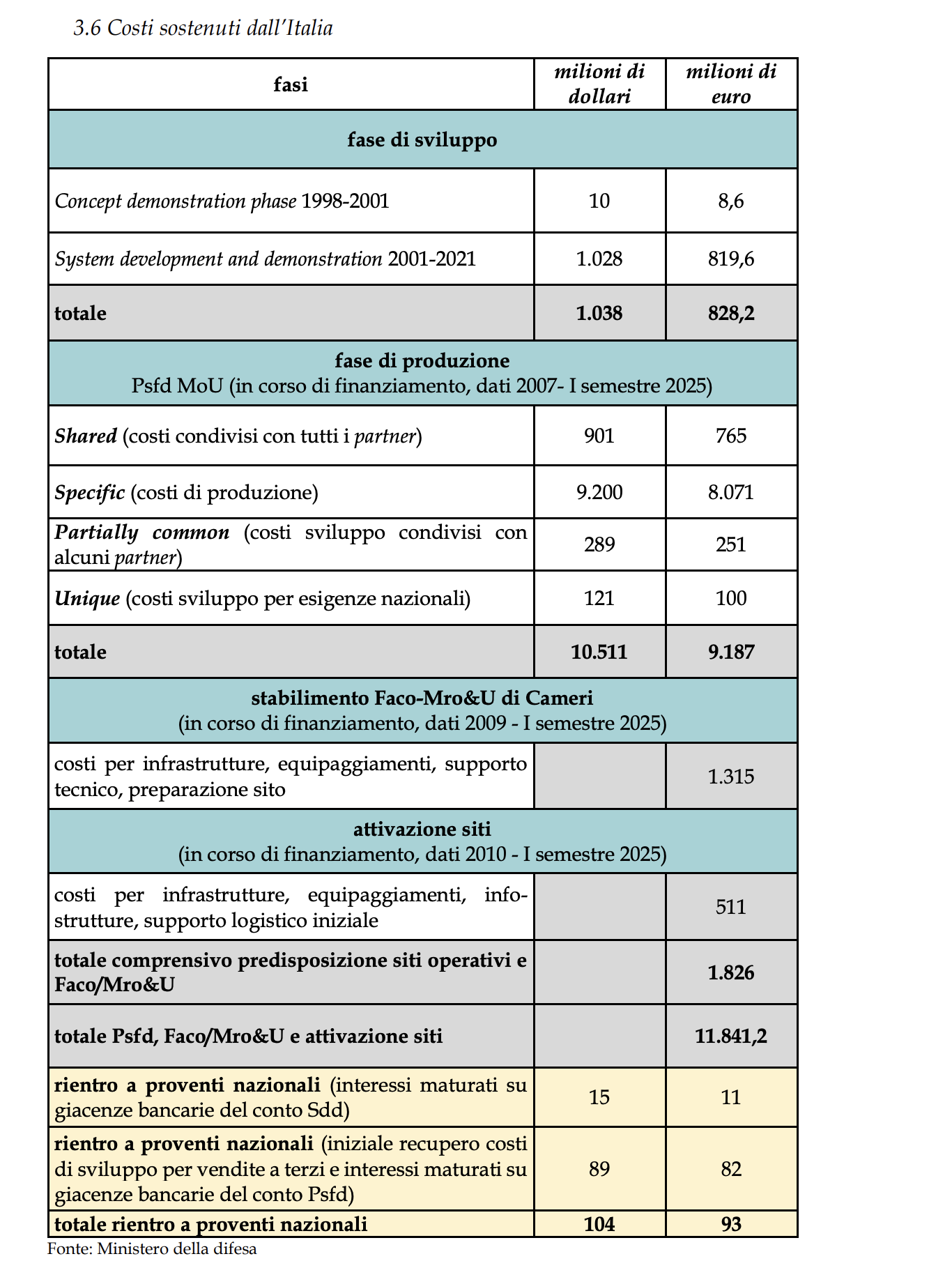
Monitoring by the Court of Auditors reveals that, over twenty-seven years – from 1998 to 2025 – Italy has allocated as much as 11 billion 840 million euros to the F-35 program, tripling the initial forecasts.
Moreover, our country boasts benefits but limited control and technological return. “In fact, since Italy is merely a partner in the program, it does not have the ability to influence its decision-making dynamics, especially in terms of actual sharing of developed technologies and associated costs,” the Court of Auditors specifies.
But the new Global Combat Air Program (Gcap) is also born to overcome these limitations.
All the details.
DELAYS AND CRITICAL ISSUES OF THE PROGRAM
First of all, the Court of Auditors certified the delay in the development phase of the F-35 program: it lasted over 11 years longer than expected. “Testing activities should have concluded in 2012; however, due to technical requirements, the deadline was extended to 2018. Furthermore, in the absence of validation for the use of certain weapons in flight and due to the pandemic, simulator tests ended in September 2023. The memorandum deadline set for 2016 was extended to 2021, although the conclusion of testing activities occurred in 2023,” the Court of Auditors reported.
Therefore, participation in this phase entailed costs of 1,028 million dollars.
Full production was also delayed from 2015 to 2024, “with an economic-financial impact, causing a cost increase that affected the lead country as well as the partners.” The Court highlights that these delays directly impacted Italy as well.
INCREASE IN COSTS BORNE BY ITALY
Total costs have significantly increased (up to tripling) compared to initial estimates.
“Between the end of 2006 and the beginning of 2007, the nations that had participated in previous phases signed the Production sustainment and follow-on development (Psdf) memorandum, a 45-year agreement ending in 2051,” the Court of Auditors reconstructed, emphasizing that “The signing entailed for Italy an economic commitment related to the program’s non-recurring shared costs of 903.2 million dollars.”
IMPACT OF TURKEY’S EXIT FROM THE PROGRAM IN 2019
Moreover, Ankara’s exit from the F-35 program also had a direct impact on costs for the other partners.
“In 2019, following the purchase of the Russian-made S-400 missile system, the US unilaterally decided to suspend Turkey from the program. Consequently, in 2021, the partners notified their withdrawal from the Psdf, signing another agreement in September 2021, the New Psdf memorandum, which, besides excluding Turkey, introduced a new cap for the program’s non-recurring shared costs, with Italy’s commitment amounting to 2,233.7 million dollars for the 2021-2051 period.”
ITALY’S EXPENDITURE, TRIPLED COMPARED TO THE INITIAL PROJECT ESTIMATE
Therefore, the United States’ decision to exclude Turkey from the program increased shared costs, raising Italy’s contribution to about 2.8 billion dollars, with further possible increases up to over 3.2 billion. Overall, the “shared” costs have more than tripled compared to initial estimates.
The 2014 reduction in the number of aircraft purchased (from 131 to 90) lowered future costs but not those already incurred, also causing negative effects on industry and employment, the Court of Auditors notes. The subsequent decision to increase to 115 aircraft mitigates these effects but entails new spending increases.
In general, costs continue to rise due to technological and inflationary factors, while Italy has little control over decisions and cost dynamics, dominated by the United States.
“Due to the need to introduce new technologies and considering inflation trends, a further increase in shared costs has been estimated that would exceed the financial limit most recently set contractually between the US and the partners, amounting to 17.22 billion dollars. The direct impact for Italy would be 440.27 million, reaching the maximum contribution expected of 3.276.12 billion,” certifies the Court of Auditors.
As of June 2025, Italy has spent 11.84 billion euros on the F-35 program (for development and production phases, for the trivalent Cameri plant, and for site activation). This represents a tripling of costs compared to the initial project estimate.
INDUSTRIAL RETURNS
Italy has capitalized on its participation in the program by weaving a network of governmental and industrial collaborations with US counterparts, resulting in the establishment at Cameri of a trivalent hub consisting of three plants: Wing Factory (for wing assembly production), Faco (for final aircraft assembly), and Mro&U (for maintenance and upgrading of aircraft).
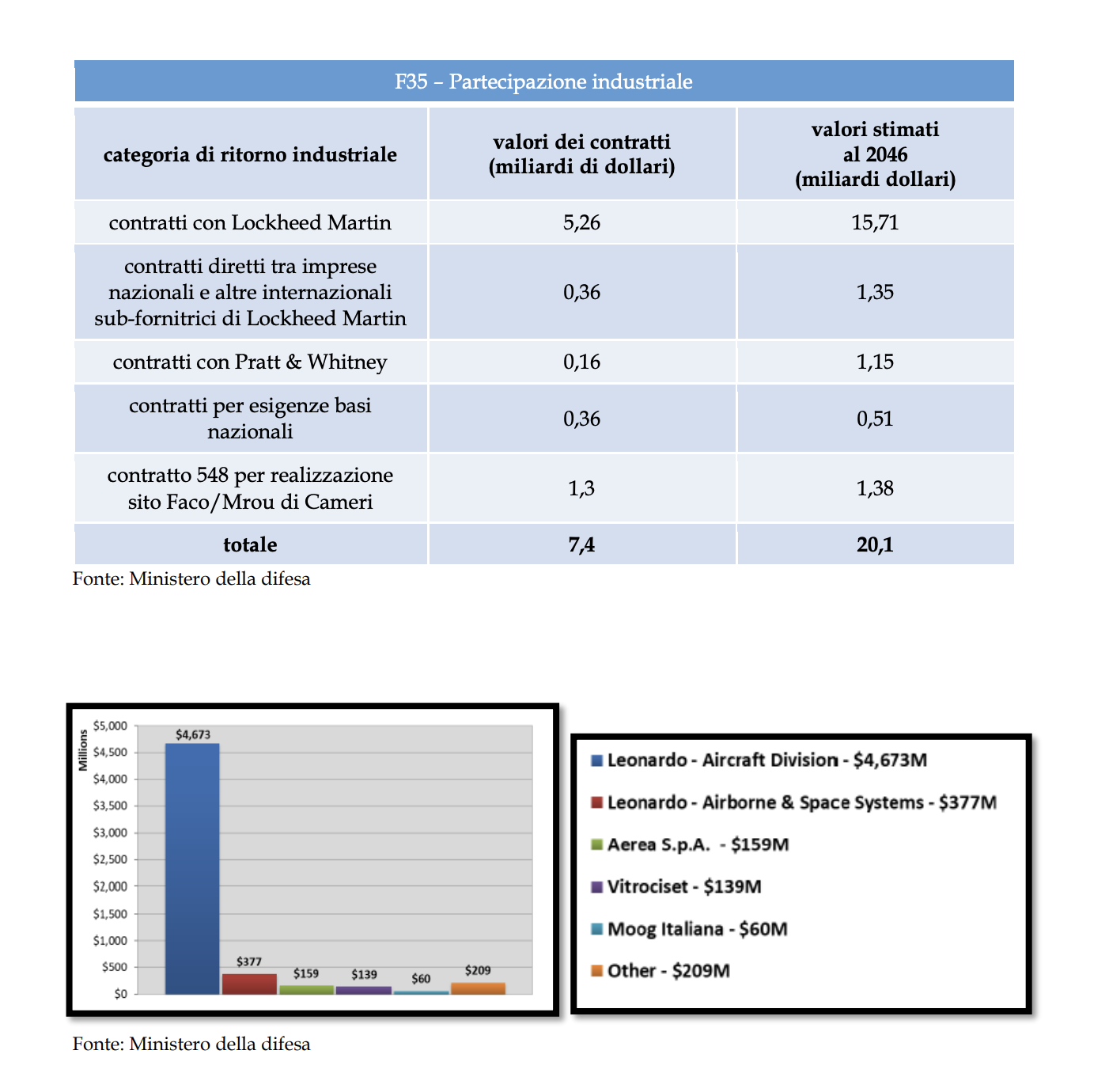
The industrial return consists of: – industrial participation plans (Ipp) of Lm and P&W; – activities carried out under national contracts, for example for the construction of infrastructure supporting the activation of F35 sites or for the implementation of national requirements; – activities performed for works and services supporting the activation and maintenance of the Faco/Wing Assembly/Mro&U plant in Cameri; – activities carried out by national industries under direct contractual relationships that do not involve Lm and P&W and/or the Ministry of Defense. The analysis of economic returns is limited to the calculation of direct industrial returns, i.e., first-level production or service supplies by Italian companies; 126 companies are involved, of which 58 are active with at least one executing contract.
National industrial participation has reached a contractual volume of 7.4 billion dollars, with an annual increase of 9.52% (647 million). The estimated value of opportunities by 2046 is 20.1 billion, with a semi-annual increase of 2.7% (530 million dollars) and an annual increase of 3.1% (608 million). However, the amount of contracts realized (7.4 billion) is 2.25 billion (23%) less than what was forecast by the first half of 2025 (9.62 billion). This discrepancy is largely due to the initial downsizing of the national fleet to 90 aircraft, notes the Court of Auditors.
THE CAMERI HUB
Furthermore, the program foresees the adaptation and/or construction of infrastructure necessary for the aircraft, equipment, and support of the F-35 fleet being acquired. The expenditure so far sustained is 510.78 million euros, of which 52.18 million in 2025 (first half).
Conversely, the establishment of the trivalent Cameri Hub took place through contract no. 548 of June 18, 2010. As of the first half of 2025, expenditure amounts to 1,314.64 million euros and includes interventions related to the evolution of the Mro&U site from a national maintenance facility to a regional one.
In this regard, it should be remembered that the structure managed by Leonardo in Cameri is the only final assembly and checkout site for F-35s in Europe. It is a tri-functional site (wing production, aircraft assembly – Final Assembly and Check out, and MRO&U) where maintenance, repair, overhaul, and upgrading activities for F-35s in the Euro-Mediterranean region are carried out. The facility is responsible for assembling the F-35A/B of the Italian Air Force and Italian Navy, as well as aircraft for the Dutch air forces.
However, regarding the technological return connected to the Hub, “its marginality relative to the program as a whole is noted, considering that wing assembly production, aircraft assembly, and maintenance pertain more to mechanical-avionic skills than to technological advancement typical of this avionics sector (radar, sensors, etc.),” the Court of Auditors points out.
EMPLOYMENT IMPACT
Following the aforementioned reduction in Italy’s acquisition plan from 131 to 90 aircraft in 2014, employment volume estimates ranged between 3,500 and 6,400 jobs. Today, based on the program’s maturity level, the update is provided through data processed by Leonardo and other involved companies. The benefit as of December 31, 2024, is 3,861 units: 2,304 within Leonardo; 1,000 in companies supplying Lockheed Martin and/or Pratt & Whitney; 557 in the preparation of operational sites.
RELATIONSHIP WITH GCAP
Subsequently, the Court of Auditors in its report highlights that Italy participates in the F-35 program as a partner under US leadership, with limited decision-making weight.
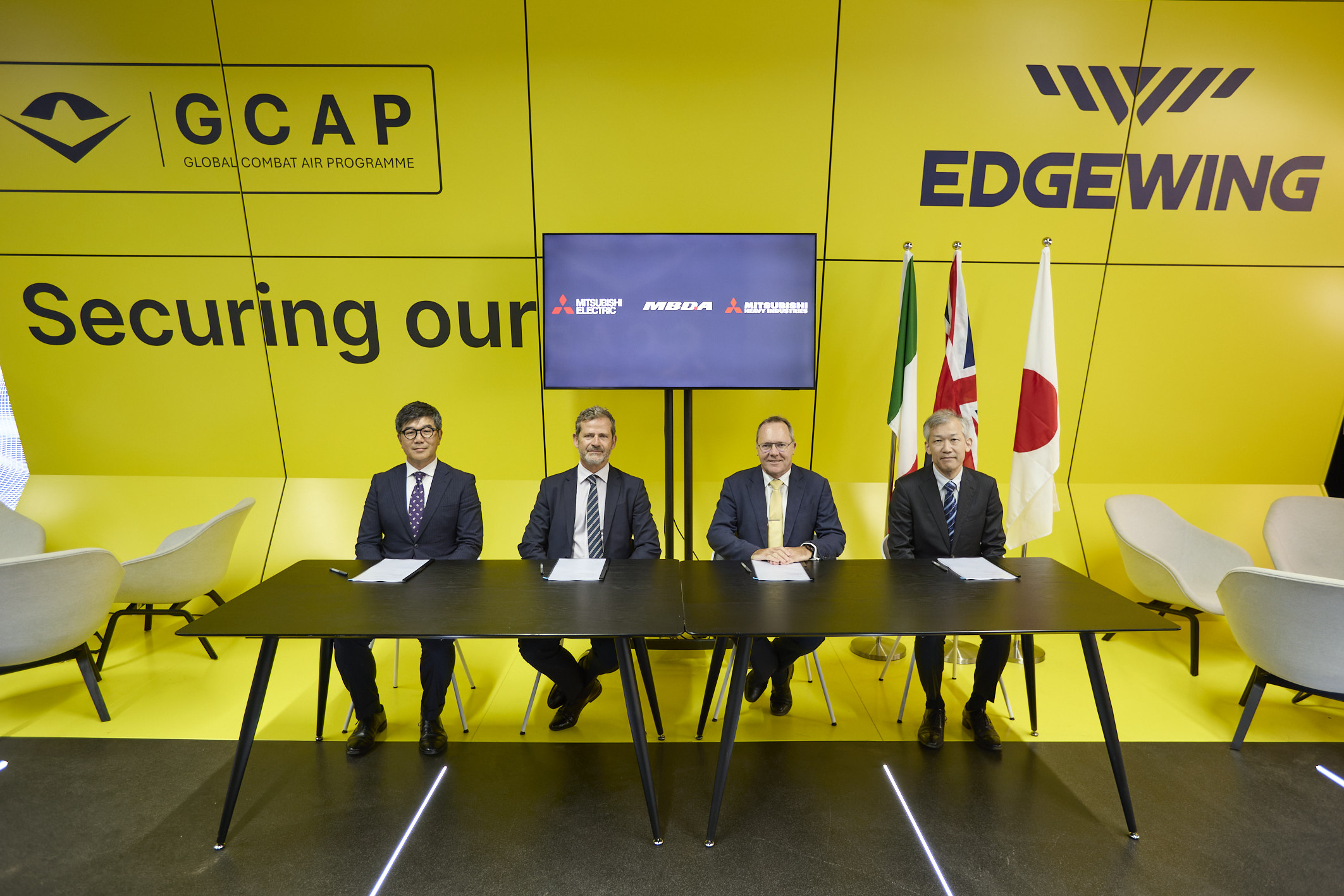
Conversely, the recent adherence to the Gcap program – a joint project between the United Kingdom, Italy, and Japan for the development of the sixth-generation combat system with entry into service planned for 2035 – “aims, for now only programmatically, to overcome such criticalities, with Italy in an equal partnership position with the other participating countries,” the Court of Auditors’ report emphasizes.
The principle of equal partnership involves sharing technologies, skills, and greater transparency.
GCAP aims to strengthen national industrial and technological know-how, ensuring access to advanced technology development and maintaining strategic capabilities in the aeronautical sector. The two programs are also complementary and integrated into an industrial ecosystem that fosters synergies, investments, and technological development for the future generation of aircraft.
According to the Ministry of Defense, Gcap was created to respond to emerging challenges in future post-2035 operational scenarios. It is intended to gradually replace the Eurofighter aircraft, integrating the F35 component. Also, according to the Ministry, F-35 and Gcap constitute the backbone of the Italian Air Force’s frontline combat capability, the auditing authority further emphasizes.
THE COURT OF AUDITORS’ CONCLUSION
Finally, the Court of Auditors concludes by recalling that the F-35 program has accumulated significant delays (development completed in 2023 instead of 2012; full production in 2024 instead of 2015), causing a significant increase in costs. Turkey’s exclusion further increased shared costs, raising Italy’s contribution to about 2.8 billion dollars, with possible increases up to over 3.2 billion, more than tripling initial estimates.
The reduction in the number of aircraft (from 131 to 90) decreased industrial and employment benefits without proportionally reducing already incurred costs; the subsequent increase to 115 aircraft mitigates these effects but entails new spending.
Overall, due to inflation and technological updates, costs continue to rise for this program in which Italy has little control over decisions, dominated by Washington.
In conclusion, up to 2025, Italian expenditure on the F-35 is about 11.84 billion euros, more than tripled compared to the initial estimate, with a significant impact on public defense spending.