


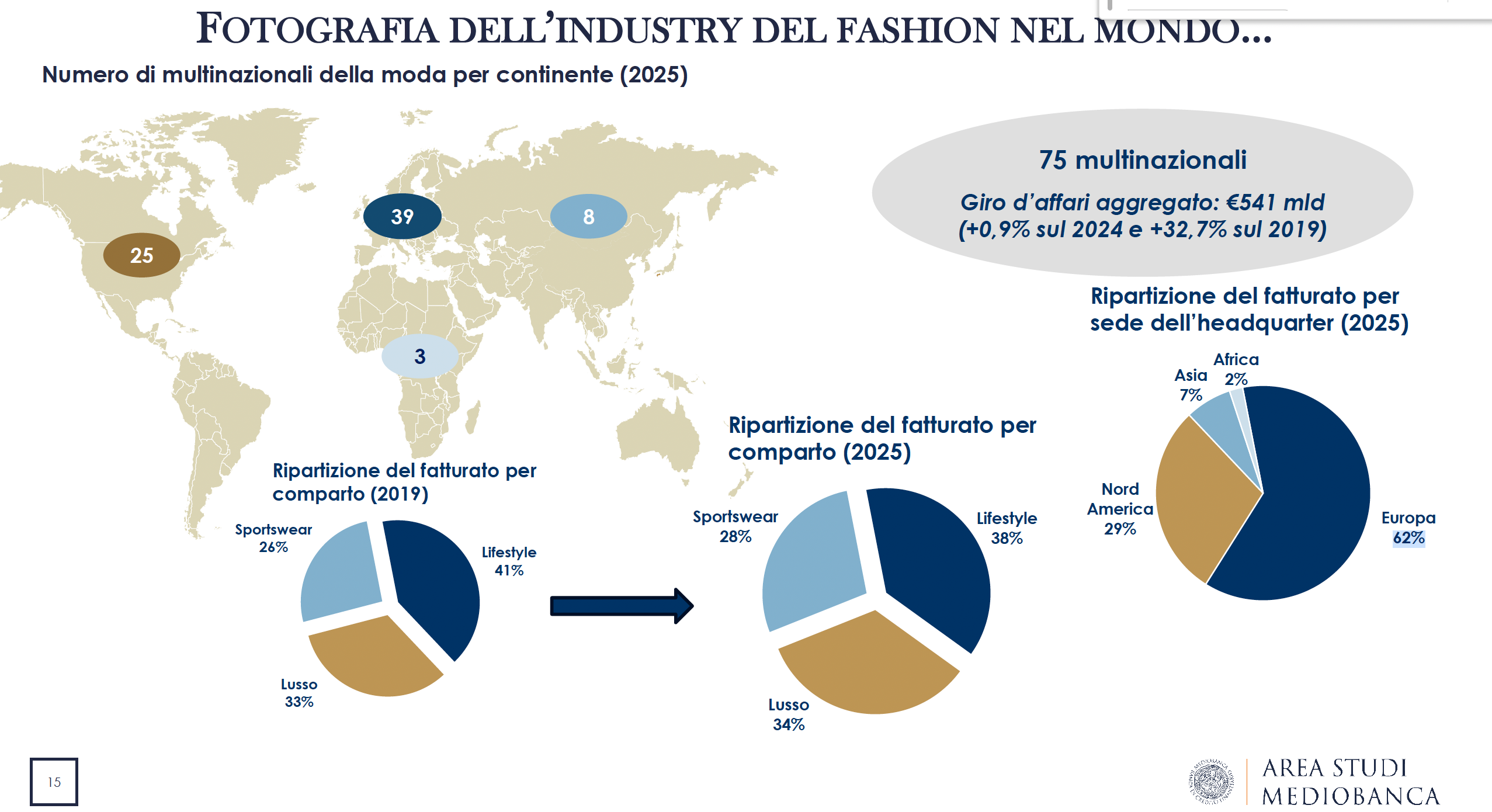
Global fashion is slowing down, but not retreating. After the powerful rebound following the pandemic, 2025 marks a boundary line: growth does not disappear, but changes pace. The numbers say it clearly. According to the Mediobanca study on the global fashion system, which analyzes 75 large multinationals with revenues exceeding one billion euros, the total turnover reaches 541 billion, an increase of just 0.9% compared to 2024, but still 32.7% higher than pre-pandemic levels.
The scope of the analysis is selective and tells a lot about the report’s purpose. Mediobanca looks at the major global fashion groups in the strict sense, divided among luxury, lifestyle, and sportswear, excluding both adjacent sectors such as jewelry and eyewear, as well as Asian third-party manufacturers and multi-brand retailers. Also excluded are players difficult to compare like Shein, characterized by ultra-fast fashion digital models and less data transparency compared to large listed groups, and unlisted groups lacking complete data. Included, however, are the names that truly define the sector’s balance: LVMH, Inditex, Nike, Adidas, H&M, Fast Retailing.
Snapshot of the global fashion industry
Source: Mediobanca Research Area
AFTER THE BOOM, REALITY
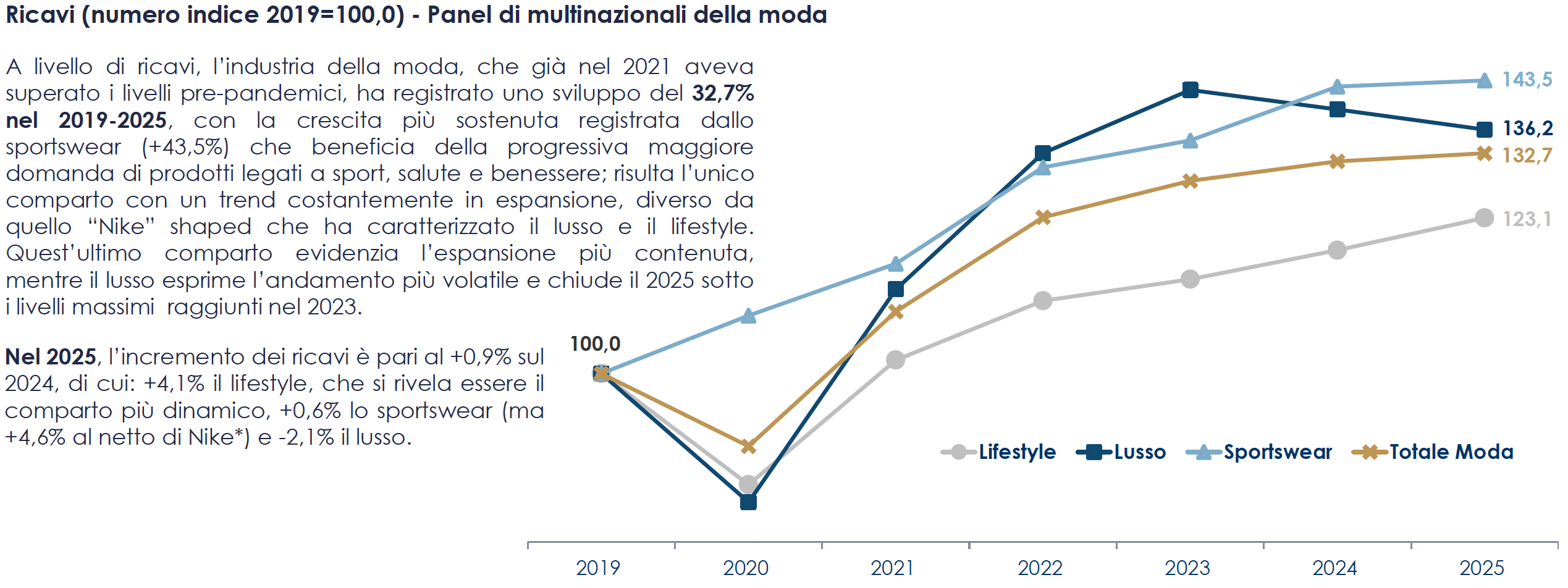
The post-Covid biennium gave the impression of a permanently expanding sector. The major luxury groups, from LVMH to Hermès, reached record levels, while players like Zara (Inditex) and Nike benefited from transversal and global demand. Between 2019 and 2025, moreover, the fashion system grew overall by 32.7%, recovering and largely surpassing pre-pandemic levels.
But that cycle has ended. Already in 2024 growth began to slow, reaching just +0.9% in 2025, a figure that clearly marks the phase change. It is less a crisis than a normalization.
The slowdown is also visible in the dynamics of individual sectors. Luxury, after driving the post-pandemic recovery, records a contraction of 2.1% in 2025, while sportswear grows just 0.6% and lifestyle confirms itself as the most dynamic segment in the short term with +4.1%. Different signals, but converging in the same direction: demand is no longer uniform.
Consumers are becoming more selective again, less willing to spend impulsively. Clothing and footwear are more exposed to the macroeconomic context, while some luxury categories – such as iconic bags and accessories – maintain greater resilience.
PRICE IS NO LONGER ENOUGH
For several years, the price lever worked almost without friction. Major luxury brands systematically raised price lists, supporting revenues and margins. Hermès, which in 2025 records an operating profitability of 41.1%, or Moncler, at 29.2%, are clear examples of this dynamic. At the same time, groups like LVMH – the global leader with 80.8 billion euros in turnover – have built much of recent growth also on the ability to defend and raise prices.
That model today shows its limits. According to the Mediobanca study, the extensive use of the price lever has generated progressive disenchantment, especially among aspirational customers. Part of the demand has withdrawn, putting volumes under pressure.
The numbers confirm the phase change. In 2025 the luxury sector records a 2.1% contraction compared to the previous year, after years of sustained growth, while the lifestyle segment grows by 4.1%, capturing demand more sensitive to price. A sign that willingness to pay is no longer unlimited.
The phenomenon also emerges among individual players. While major luxury groups maintain high profitability levels, signs of slowdown emerge precisely in segments more exposed to aspirational clientele. Conversely, accessible and premium operators, such as Inditex (39.9 billion in revenues) or H&M (21.1 billion), show greater resilience on the volume front.
The point is not so much lowering prices, but making them credible. The market demands coherence between price and perceived value. It is no coincidence that groups like Prada, which rose to 5.7 billion in revenues and is strongly recovering compared to 2019, are increasingly focusing on positioning and distinctiveness.
MARGINS UNDER PRESSURE
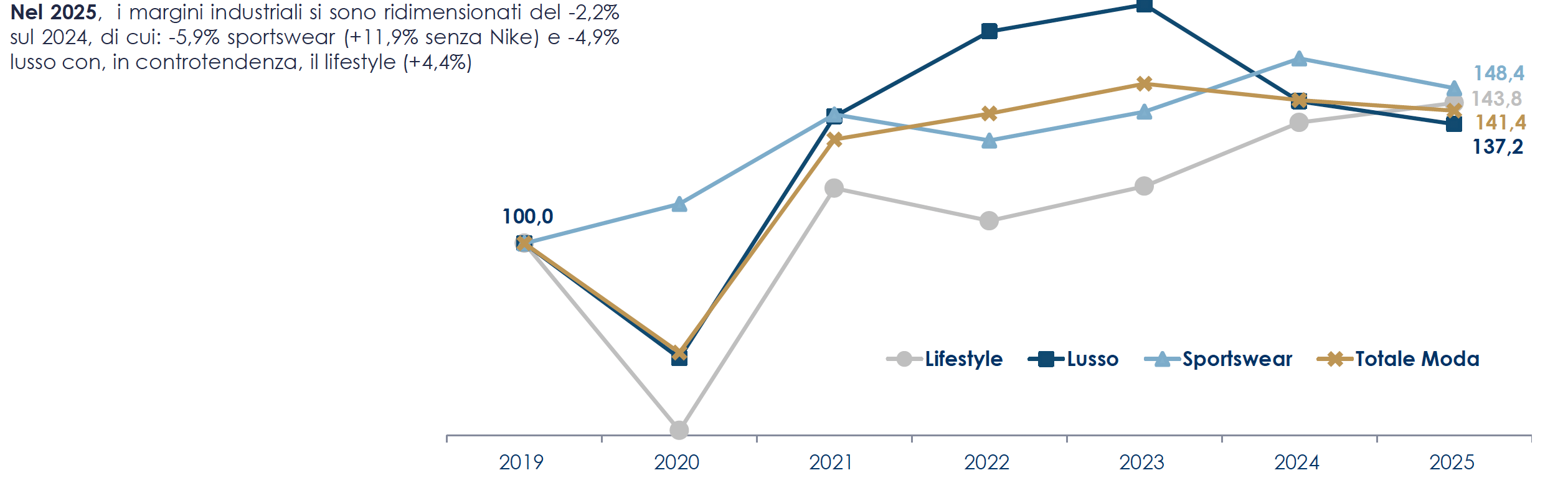
The slowdown in demand combines with rising costs. The result is margin compression marking the end of the expansion cycle. In 2025 industrial margins decrease by 2.2% compared to 2024 and by 5.6% compared to 2023.
The causes are known, but it is their combination that makes the difference. Tariffs increasingly impact, logistics costs rise due to geopolitical tensions, and the ability to pass these costs onto prices diminishes. The result is widespread pressure on operating profitability.
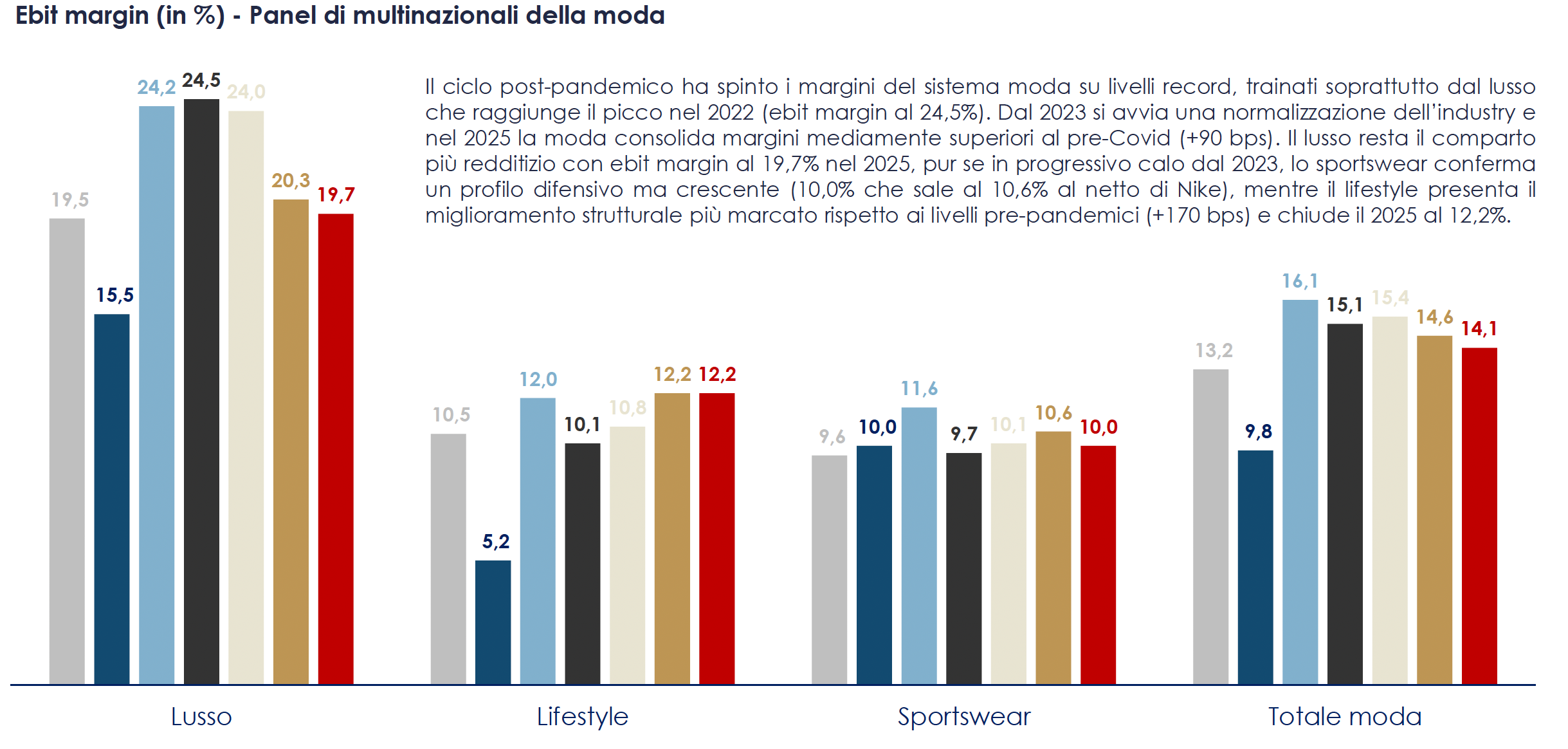
Yet, the sector remains above pre-Covid levels. The average operating margin is 14.1%, with luxury at 19.7%, lifestyle at 12.2%, and sportswear at 10%.
Industrial margins and profitability
Source: Mediobanca Research Area
WHO REALLY DRIVES THE SECTOR
If there is a clear long-term winner, it is sportswear. Between 2019 and 2025 it grew by 43.5%, confirming itself as the engine of the global fashion system. Brands like Nike and Adidas remain central: the former with 39.4 billion euros in revenues in 2025, the latter with 24.8 billion, although Nike itself has gone through a difficult phase with a 9.8% revenue drop.
But the most interesting data comes from new players. Swiss On Holding is the most emblematic case: revenues grew 11.3 times since 2019 and +30% in 2025 alone. Alongside it, Crocs (3.3 times) and Birkenstock (2.9 times) show how product innovation can create new growth trajectories.
However, the picture is less linear in the short term. Sportswear grows only 0.6% in 2025, but without Nike’s collapse (-9.8%) it would have recorded +4.6%. A sign that the sector remains solid, but not immune to cycles and difficulties.
Revenue progression by segment
Source: Mediobanca Research Area
A GLOBAL SLOWDOWN
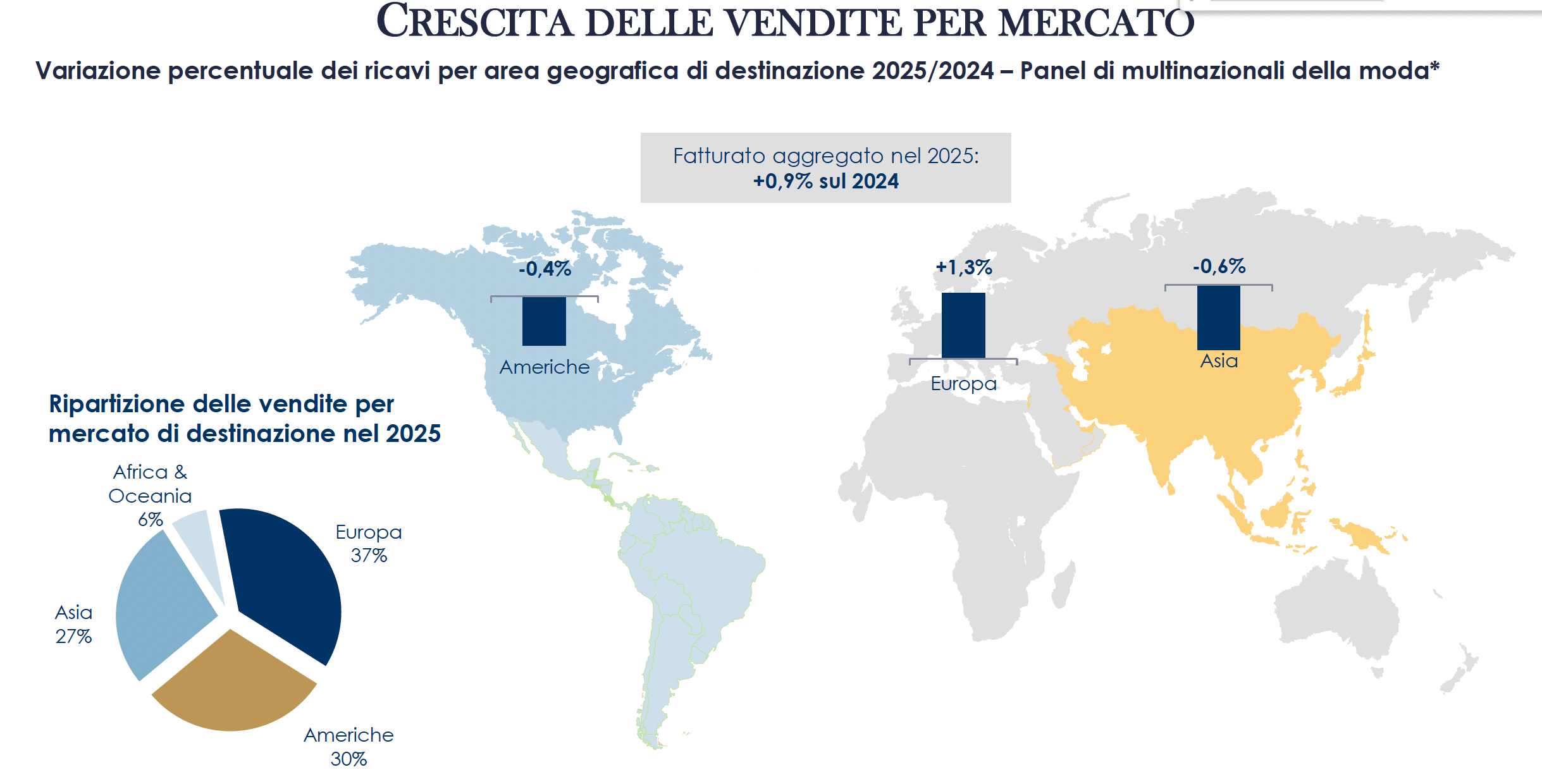
From a geographic point of view, the slowdown is widespread. Europe grows by 1.3%, while the Americas and Asia record respectively -0.4% and -0.6%. There is no longer a global locomotive.
Yet, Europe remains the center of the system. European groups generate 62% of total turnover, compared to 29% for North American ones. And within Europe, a precise geography is confirmed: Italy is the country with the most companies (14), but France dominates in turnover, with 39% of the total.
The slowdown is therefore global, but not uniform. And above all, it does not erase the hierarchies.
Sales by geographic area
Source: Mediobanca Research Area
THE GIANTS REMAIN (BUT CHANGE PACE)
The ranking of the major groups changes little, but tells a lot. LVMH remains in first place with 80.8 billion in revenues, followed by Inditex (39.9 billion), Nike (39.4), Adidas (24.8), H&M (21.1), and Fast Retailing (18.5).
These numbers show the sector’s dual nature: on one side European luxury, on the other the major global players of fast fashion and sportswear. But even these giants are changing pace.
Nike, for example, suffers from the slowdown of the direct-to-consumer model, while Inditex continues to grow thanks to more flexible supply chain management. Luxury, instead, faces the limit of the price lever.
FROM PRODUCT TO CUSTOMER
One of the deepest changes concerns the business model. Growth no longer depends only on the product, but on the relationship with the customer. The picture is clear: future growth will be driven by the ability to strengthen desirability and the relationship over time, more than by volume expansion. Not surprisingly, early 2026 data indicate revenues generally aligned with those of 2025, a sign of a sector growing less by quantity and more by value.
This implies a paradigm shift. Personalization, loyalty, and services become central, also because the customer base expands less than in the past. An indirect signal also comes from the labor market: between 2019 and 2025 employment in the sector grew by 8.3%, but with very differentiated dynamics among segments, confirming a model that is reorganizing.
Retail is also evolving: in 2025 stores grow by just 1.2%, with luxury slightly down (-0.3%) and sportswear increasing (+7.2%). Distribution remains global, but with different models: European groups maintain a more balanced presence between Europe and Asia, while North American ones remain more concentrated on the domestic market.
The store is no longer just a place of sale, but an experience space.
A SECTOR MATURES
The global fashion system enters a more mature phase. The numbers remain solid: employment growing, with over 2.2 million employees, and a stronger asset structure, with net equity equal to 1.5 times financial debts.
But the rules change. Growth is slower, margins more under pressure, competition more intense. Easy levers no longer work.
2025 therefore marks the beginning of a new cycle. Not a crisis, but a transformation. And in this new context, more than selling more, it matters to sell better.




