



As soon as attention on the Hantavirus outbreak linked to the MV Hondius ship began to fade, another already known and very dangerous virus has forcefully returned to global attention.
It is the Ebola virus, for which in mid-May African health authorities declared an ongoing epidemic with its epicenter in the Ituri province, in the northeast of the Democratic Republic of Congo (DRC).
Within less than 48 hours, the World Health Organization (WHO) declared the so-called “Public Health Emergency of International Concern (PHEIC)” — the highest level of global health alert. This is the 17th Ebola outbreak recorded in the DRC since 1976, with a crucial aggravating factor: there are no approved vaccines or treatments for this specific strain.
THE CURRENT OUTBREAK

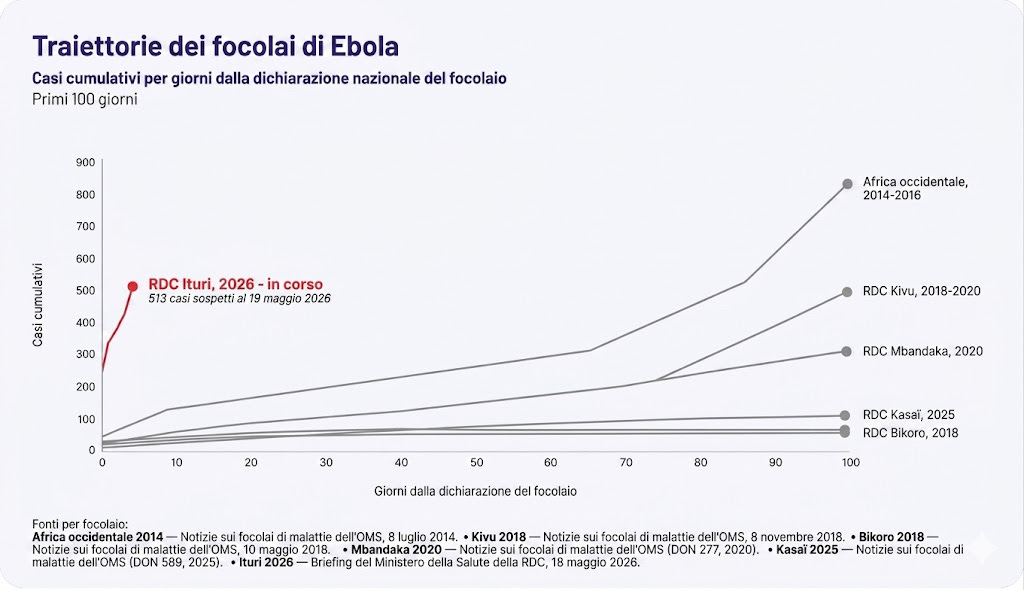
The first thing to emphasize is that this is already the third largest Ebola outbreak ever recorded — and it was so at the moment it was detected. This means the virus had been silently spreading for some time before anyone recognized what was happening.
The epidemic is centered in the Ituri province, in the remote northeast of the DRC, over 1,000 km from Kinshasa, bordering Uganda and South Sudan, in an area currently the scene of armed conflicts between rival militias with interests of various opposing world powers converging. Other affected provinces are North Kivu and South Kivu.
The first known case was a healthcare worker with symptom onset on April 24 (fever, bleeding, vomiting, and severe weakness), who died in a facility in Bunia, the capital of Ituri. The WHO was alerted on May 5 for an unknown high-mortality disease in the Mongbwalu health zone, including four deaths among healthcare workers in four days.
A crucial detail emerged in the early stages: the available rapid tests detected only the Zaire ebolavirus, not Bundibugyo, which is a different species. Species confirmation did not arrive before May 14 — almost six weeks after the onset in the index case and three weeks after the first clusters of deaths among healthcare workers.
There are speculations that the diagnostic delay may be related to recent cuts in global health programs. Certainly, the diagnostic tools used were not suitable to detect the strain involved.
As of May 27, the DRC counts 906 suspected cases and 223 deaths among the suspected; as of May 29, confirmed cases total 134 (125 in DRC, 9 in Uganda), with 18 confirmed deaths, for a fatality rate of 14 percent among confirmed cases. There is also a confirmed case in a U.S. doctor exposed during work in the DRC, currently being treated in Germany.
The virus has already crossed local borders: in Uganda, confirmed cases are 9, located in Kampala (8) and Wakiso (1), all epidemiologically linked to infections in the DRC.
The geography further worsens the situation.
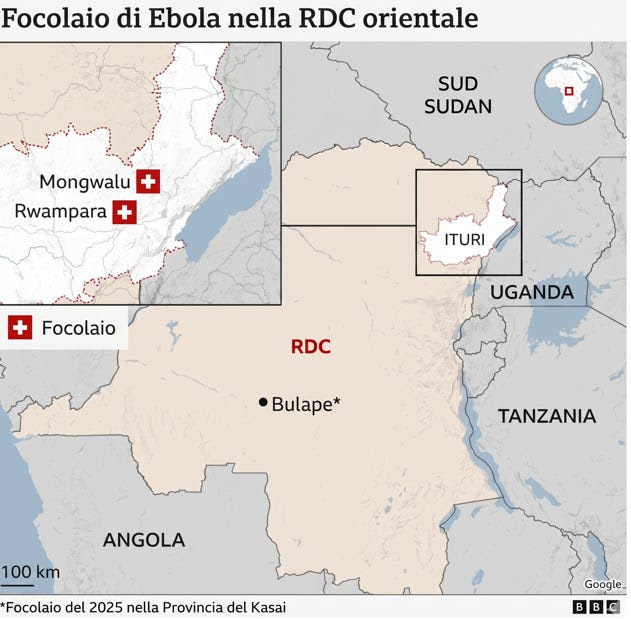
Mongbwalu is a high-traffic mining town; Ituri hosts over 270,000 internally displaced persons and 1.9 million people in humanitarian need.
The combination of high population mobility, active conflicts damaging health infrastructure, an urban epicenter, an outbreak spreading over territories controlled by different armed groups, and geographical proximity to Uganda and South Sudan creates ideal conditions for limited outbreaks to turn into large-scale epidemics.
The WHO has explicitly acknowledged that the real size of the epidemic is probably higher than official figures, based on the high positivity rate in initial sequences (8 positives out of 13 samples) and unusual clusters of community deaths reported in multiple health zones.
It is worth mentioning, in this context, the figure of Jean-Jacques Muyembe, the Congolese virologist who co-discovered Ebola in 1976 as a young doctor in Yambuku.
Today he leads the National Biomedical Research Institute of the DRC and is at the forefront of the response to this epidemic. The man who helped identify the virus fifty years ago is now leading the response in the same country: one of the most extraordinary careers in the history of modern infectiology.
WHY THIS OUTBREAK IS MORE DIFFICULT TO MANAGE
The Bundibugyo species is not covered by any approved vaccine or treatment. Global stocks of Ebola vaccines exist but were developed for the Zaire type.
The response currently relies on classic pillars: case isolation, contact tracing, safe and dignified burial, and community engagement, as well as coordinated response by national and supranational authorities.
Outbreaks are ended by breaking transmission chains. Practically, this means: rapidly identifying cases, isolating them in specialized Ebola treatment units, tracing all patient contacts, monitoring them for 21 days, and safely burying the dead — because Ebola is particularly transmissible from recent corpses. This continues until 42 days pass without new cases. This is the operational core of the response, essentially unchanged since 1976.
Since 2014, for the Zaire virus, ring vaccination has been added, an approach borrowed from smallpox eradication: contacts of confirmed cases and contacts of those contacts are vaccinated, creating a protective ring the virus cannot cross. This tool was decisive in containing the 2018–2020 outbreak.
However, its success depends on community trust. If people do not trust responders, if they do not want their loved ones taken away by strangers in protective gear, if they refuse the vaccine, the entire response collapses. Last week a crowd set fire to hospital tents near Bunia after it was announced that a body would not be returned for burial. Community sensitization must be the foundation of every response; technical interventions are built upon it.
Unfortunately, for Bundibugyo there is no vaccine availability but the lower fatality rate represents a relative advantage, although it may also partially explain why the epidemic expanded so significantly before being detected if initial cases were attributed to other causes.
Ebola’s mode of transmission — through direct contact with bodily fluids — makes sustained transmission extremely unlikely in high-income countries. Nonetheless, healthcare workers worldwide are again on alert for symptoms potentially associated with the disease in travelers returning from Central Africa.
WHAT WE KNOW
Ebola is a filovirus responsible for a devastating viral hemorrhagic fever; the Bundibugyo type is one of four human pathogens — less lethal than the Zaire virus but clinically very severe.
It was a poorly studied entity until the West African epidemic of 2014–2016 finally spurred the development of effective vaccines and treatments, which however remained specific to the Zaire virus.
The current epidemic in the DRC involves the Bundibugyo species and was identified late: it is located in a conflict-affected region with intense cross-border mobility and has already spread to Uganda. The response relies on the same public health interventions available in 1976.
Containment therefore depends, once again, on the classic pillars: early diagnosis, isolation, infection control, and coordinated international response. Science has partly solved the problem of the Zaire virus, but science alone cannot stabilize a system already collapsing.
The most critical and recurring element is the loss of community trust in health authorities. In 2026, two Ebola treatment centers in eastern DRC were burned down by residents protesting burial restrictions:
These episodes replicate dynamics already seen in 2014, such as the Womey massacre in Guinea, where eight outreach workers were killed by residents convinced that the health response was a foreign conspiracy.
When communities begin to perceive treatment centers as places from which one does not return alive, patients hide symptoms, families evade surveillance, and healthcare workers become targets rather than protectors.
The COVID-19 pandemic (not to mention the questionable decisions by Trump that greatly reduced the US commitment to safeguarding international health) worsened the baseline conditions necessary to manage Ebola: public health institutions emerged weakened and politically polarized, healthcare personnel are exhausted, vaccine skepticism has consolidated, and international coordination has deteriorated. Added to this is the chronic lack of rapid, deployable diagnostic systems in the areas where epidemics originate — a recurring gap not only with Ebola but also with COVID-19, mpox, and hantavirus.
Ebola has never been an anomaly, but an early warning signal. Biological threats increasingly overlap with national security, migration, urbanization, environmental degradation, and irregular conflicts.
Since 2014 the world has faced COVID-19, Zika, mpox, avian influenza — each crisis has reiterated the same uncomfortable truth: biological instability accelerates, while institutional resilience struggles to keep pace.
The controversial conclusion of 2014 — that the Ebola crisis required a military-scale mobilization — was actually the clearest recognition of all: modern epidemics are no longer just public health emergencies but tests of national capacity, political coordination, logistics, and social trust. The virus has changed little. The world around it has changed enormously.
The risk for Europe and North America remains very low. However, the possibility of widespread spread in the heart of Africa cannot be ruled out, with all the repercussions in terms of further social and geopolitical turmoil, in addition to the human lives that will be lost.
The main sources of this article include: Alasdair Munor — “Not now, Ebola” (The Munro Report, May 19, 2026); Steve Brozak – “Deaths, Burned Clinics — What’s Different About Ebola’s 2026 Return” (Forbes, May 25, 2026); Charles Whittaker – “How worried should you be about Ebola” (UC Berkeley Public Health, May 26, 2026); WHO – “Disease Outbreak News” May 29, 2026
Alberto Maraolo is a researcher in Infectious Diseases at the University of Naples “Federico II”; member of the technical-scientific unit of SIMIT, the Italian Society of Infectious and Tropical Diseases; fellow of ESCMID, the European Society of Clinical Microbiology and Infectious Diseases)
(Excerpt from Notes)




