


WHAT IS BEING SAID IN EUROPEAN HALLS ABOUT THE USA-IRAN WAR
Even those who have not openly criticized the United States’ war against Iran are beginning to publicly express their doubts about how the operation was conducted and its potential outcomes. The German Defense Minister, Social Democrat Boris Pistorius, used tones very different from the Christian Democratic Chancellor, Friedrich Merz. “It is illusory to think that conflicts in the region can be resolved solely through military force and unilateral actions,” said Pistorius. The minister also recalled that it is “much easier to start a war than to end it.” The High Representative, Kaja Kallas, spoke during a visit to Warsaw, implying that Ursula von der Leyen’s line on supporting the goal of regime change in Iran is risky. “The ideal scenario would be a democratic Iran that is not a threat to its neighbors. But obviously this outcome is far from certain at the moment. No one can predict which direction this war will take,” Kallas warned. The High Representative has convened a new extraordinary meeting of EU foreign ministers by videoconference for today.
WHAT IS HAPPENING BETWEEN MERZ AND MACRON
“All for one, one for all” does not seem to be part of the vocabulary of Merz “the Europeanist.” Received by Donald Trump at the White House, the German Chancellor let the American president attack the Spanish head of government Pedro Sánchez without trying to defend him. Unfortunately for him, the scene was filmed and this behavior earned Friedrich Merz a flood of criticism in Spain and also in Germany. French President Emmanuel Macron gave the Chancellor a lesson in good European manners with a statement supporting Sánchez, in which every word carries great weight. “The President of the Republic has just spoken with Mr. Pedro Sánchez, President of the Spanish Government, to express France’s European solidarity in response to the recent threats of economic coercion that Spain was subjected to yesterday,” said the Élysée. The Prime Minister António Costa also called Sánchez and stated that “the EU will always ensure that the interests of its member states are fully protected.” Pedro Sánchez indicated he had received calls from Commission President Ursula von der Leyen and from “several European allies.”
SANCHEZ’S NO TO TRUMP
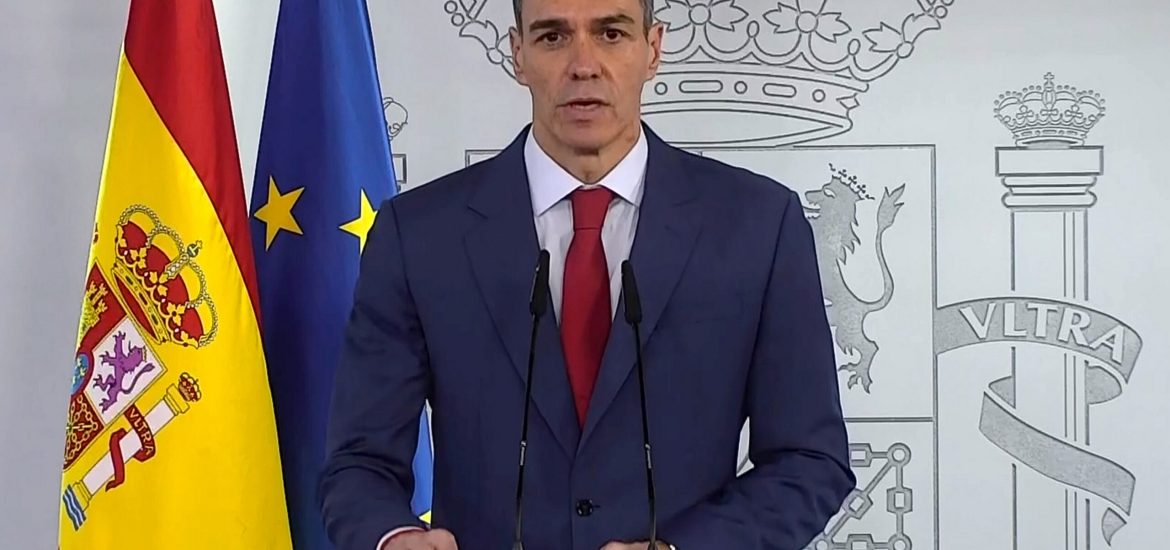
The Spanish head of government angered Trump by refusing the use of the American bases of Morón and Rota to conduct bombings in Iran. “The world, Europe and Spain have already gone through this crisis. In 2003 some irresponsible leaders dragged us into an illegal war in the Middle East, which brought only insecurity and suffering. Our response then must be our response today: no to violations of international law, no to the illusion that we can solve the world’s problems with bombs, no to repeating the mistakes of the past.” During the 2003 invasion of Iraq, France and Germany led European opposition to the war, refusing to support the American intervention without a UN mandate, while Spain, governed by conservative José María Aznar, supported the United States along with the United Kingdom, Italy, Portugal, Poland, Hungary, Denmark, and the Czech Republic, causing a fracture within the EU. “We will not be accomplices to an action harmful to the world, contrary to our values and interests, just to avoid someone’s retaliation,” Sánchez declared in response to Trump’s threats of economic sanctions.
MERZ’S ATTEMPTS
Chancellor Friedrich Merz assured he defended Sánchez during their private lunch, in an attempt to calm the anger unleashed by his passivity during Trump’s attacks on the Spaniard. “I told Trump that Spain is a member of the European Union and that you cannot conclude a separate agreement with Germany, or an agreement with Europe excluding Spain, otherwise there will be no agreement,” Merz declared in a television appearance. The Chancellor also assured he told Trump there was “no reason to treat Spain so badly” and that Spain’s refusal at the NATO summit to increase defense spending “had nothing to do with European efforts to reach a trade agreement with the United States.” Despite the efforts, some German media were harsh on his trip to the White House. “Donald Trump threatens Madrid, Friedrich Merz approves: the Chancellor’s appearance in the Oval Office was shameful. He cannot lead Europe this way,” judged Der Spiegel.
QUARRELS OVER SANCHEZ AND MORE
The conference of presidents of the European Parliament yesterday rejected a request from the Greens to put on the agenda of next week’s plenary a debate on the threat of US trade sanctions against the EU, particularly Spain, and the urgent need for a united response. The European People’s Party group, virulently critical of Socialist Prime Minister Pedro Sanchez, opposed it together with far-right groups. The proposal was supported by the Socialists, Renew liberals, and the Left. The EPP “sides with Trump instead of defending a member state,” a Parliament source told us. The preference also applies to the Turnberry tariff agreement. The EPP wanted to proceed to a vote in the International Trade Committee, but a majority opposed because the Trump administration has not yet provided clarity on its intention to respect the July agreement. On the contrary. Treasury Secretary Scott Bessent said tariffs could rise from 10 to 15 percent this week. The European Parliament’s Trade Committee decided to postpone the decision to March 17. “It is a shame that an anti-Trump narrative is promoted more strongly than a pro-European one, risking a transatlantic trade war,” said EPP MEP Jörgen Warborn.
(Excerpt from the European Mattinale)




