

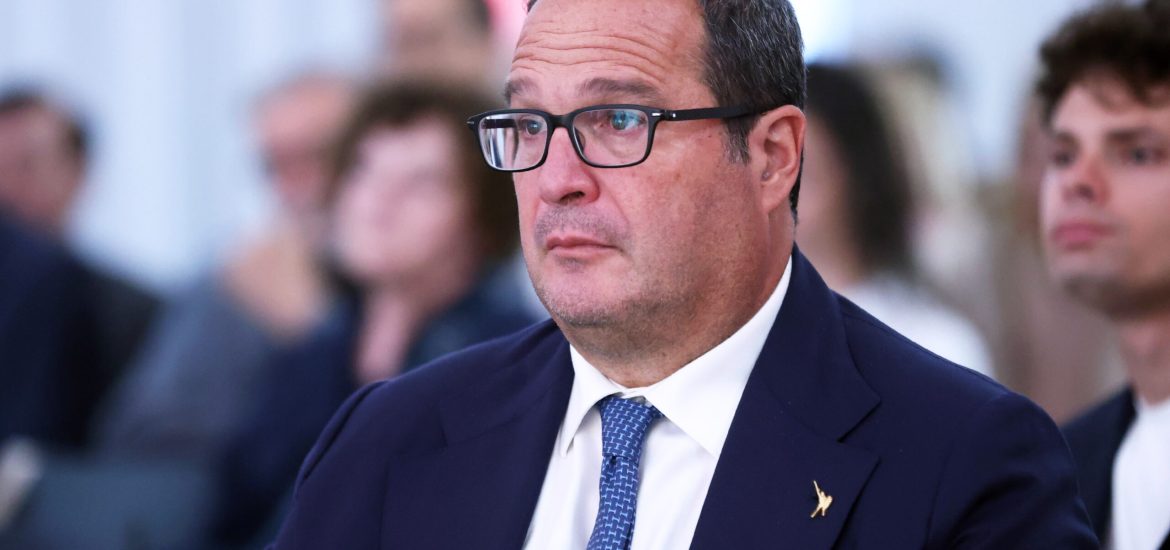

“Am I more noticed if I don’t go or if I go and don’t speak?” Even Matteo Salvini pondered Nanni Moretti’s dilemma and resolved it by staying in his office at the Ministry (at least that’s what he declared) working to prevent the transport strike on June 11. Holding the line for the League was – as always – Giancarlo Giorgetti, who also made a few customary remarks to the media. The leaders of the Broad Field coalition were also absent in the strict sense. Their conduct has become a sort of Aventine Secession. They refuse to appear publicly alongside government and majority representatives, thus expressing their opposition to weapons.
After all, it’s an old story. During the First Republic, when in the mid-1970s the PCI joined the national solidarity majority, the November 4 holiday, which celebrated Italy’s sole victory in its history, was abolished, while the June 2 anniversary was merged with the closest Sunday. It was Carlo Azeglio Ciampi who restored the Republic Day celebration on the fateful day of the institutional referendum and insisted that the parade at the Imperial Forums be held to the singing of the National Anthem, which the president considered beautiful and solemn.
One might ask a question. Could it be that because of this unnatural bipolarism we have adopted – albeit with variations at every election – and which we want to preserve with a disastrous electoral law, we have also divided the national holidays? The left keeps April 25, the right June 2, the CGIL May 1. As for Christmas, the left is ready to disown it so as not to offend Muslims, while the right is preparing to launch the annual Nativity Scene Festival with rich prizes and festivities. With the cream of the League absent from militaristic celebrations, it made its presence felt on June 2 regarding pensions, aiming to announce that, in the 2027 budget law, the relentless fight against the Fornero reform will continue with particular attention to the retirement age issue.
It was Matteo Salvini himself in an interview with Il Giornale who confirmed that at Via Bellerio they are working to identify a new form of early retirement before age 67, with the declared goal of gradually overcoming the regulatory framework of the Fornero law.
The novelty concerns the reasoning the League is developing on how pension expenditure is accounted for. “We are studying a rule that gives linearity to pension expenditure, because today it is calculated gross,” explained Claudio Durigon, the secretary’s plenipotentiary on pensions. The undersecretary wants to tackle public accounts as if it were a shell game in railway station waiting rooms. The reasoning is yet another reinvention of the wheel: pension expenditure amounts to about 326 billion euros, against contribution revenues of about 290 billion. But a significant part of the expenditure immediately returns to public coffers in the form of taxation.
“IRPEF is a revolving door that returns about 70 billion to the State,” he observes. So if we start calculating expenditure net, we can demonstrate to Europe and the markets that the budget is close to balance. It’s the same logic (also shared by the League) as those who think the sustainability problem of the system can be solved by separating pension and welfare spending. As if the Italian authorities deliberately provided incorrect data at the European level when a few subtractions would suffice to comply. However, there is a problem: statistics in Europe and beyond are made according to common, agreed, and predefined criteria. Do we want to avoid what Durigon calls “a revolving door”? But why do it only with pensions and not with public employees’ salaries, contract tenders, and all incomes and monetary flows that sooner or later fall under the taxman’s scrutiny? Moreover, when you belong to a community that has set rules, it does not seem possible to change them unilaterally. Do we want to exclude income tax on pensioners throughout Europe? The Italian net-to-GDP rate would remain higher than others also calculated net. It would be a mere propaganda operation, a cosmetic makeover for its own sake.
According to the League, thanks to the accounting trick, resources could be freed to cover “a flexibility intervention for exit with a formula at 64 years.” The statements are still too vague to understand the proposal. At first glance, it would seem to be an extension also to those governed by the mixed system of the early treatment rule provided by the contributory regime, provided they undergo this calculation. Already today, “pure contributory” workers – under the Fornero reform – can retire at 64 years of age with at least 20 years of actual contributions, provided that the accrued amount exceeds a minimum threshold equal to a multiple of the social allowance; this is to guarantee an adequacy requirement of the benefit.
It remains to be understood what the League’s intentions are regarding the biennial indexing of age and contribution requirements to life expectancy increases. The rule that was contested by the League in the 2026 budget and that, a few months later, also saw the opposition come forward to demand its abolition, without taking responsibility for its essential role in ensuring a sustainable course of pension expenditure (gross or net) relative to GDP.




