

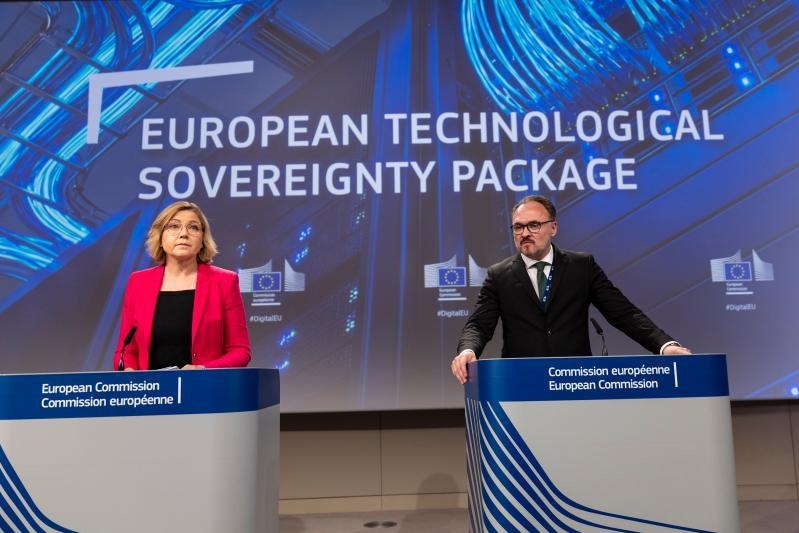

With the aim of reducing the European Union’s dependence on the United States and China and strengthening internal capabilities in semiconductors, artificial intelligence, and cloud computing, today the European Commission presented a package dedicated to “technological sovereignty” structured in four proposals: two legislative, the Chips Act 2.0 and the Cloud and AI Development Act; and two programmatic guidelines, namely the strategy for open source and the roadmap for the digitalization of the energy sector. At the same time, Brussels also paved the way for the creation of a community sovereign fund for investments in advanced technologies.
STATEMENTS
“We cannot afford to depend on others for the technologies that ensure the operation of our hospitals, the stability of our energy networks, and the security of our services,” declared the President of the European Commission, Ursula von der Leyen.
“The package presented today marks a significant turning point in Europe’s approach to technological sovereignty,” added the Vice-President for Technological Sovereignty Henna Virkkunen. “The time has come for Europe to take back control of its data, its supply chains, and its future.”
Virkkunen also explained how “over 80 percent” of the products, services, and digital infrastructures used in the European Union come from suppliers outside the bloc. “This is a serious problem for supply security in Europe, but it also has a huge impact on our economies.”
WHAT THE CHIPS ACT 2.0 PROVIDES
The first legislative proposal of the package is the Chips Act 2.0, which arrives three years after the entry into force of the previous (and homonymous) European semiconductor regulation. The goal remains to strengthen Europe’s production capacity of advanced microprocessors, which are essential for the development of artificial intelligence and for the most advanced industrial applications.
The Commission said it wants to accelerate the issuance of permits for production plants, strengthen cooperation with partner countries that share the Union’s principles (not with China, therefore), and introduce a mark of excellence for European regions specialized in semiconductors. Among the innovations is also greater support for the internal demand for European microchips, after the first Chips Act showed limits in creating an adequate market outlet for the Union’s chipmakers.
The ultimate goal, essentially, remains the one already set with the original Chips Act: to significantly increase the European Union’s share in the global semiconductor market, which to date remains dominated by the United States (particularly for the design phase) and East Asia (for manufacturing).
THE PLAN TO TRIPLE EUROPEAN DATA CENTERS
The second legislative proposal is the Cloud and AI Development Act, which promises to triple the capacity of European data centers within five to seven years. The Commission emphasized the need for artificial intelligence growth to be compatible with greenhouse gas emission reduction goals: these are two difficult aspects to reconcile, considering the high energy consumption of data centers and the difficulty in powering them with intermittent renewable sources.
The Cloud and AI Development Act, however, aims to implement advanced cooling systems, better integration of centers with energy networks, and the adoption of low power consumption technologies.
THE TURNING POINT OF THE EUROPEAN SOVEREIGN FUND
Perhaps the most innovative aspect of the package concerns financing.
In a communication attached to the two legislative proposals, the Commission openly acknowledged the existence of an “obvious weakness” of Europe in financing strategic technologies. To bridge this gap, it proposed the creation of a new venture capital investment capacity, a sort of European sovereign fund that will take equity stakes in companies operating in the energy, biotechnology, and advanced technology sectors.
According to Brussels, this new instrument could initially be funded by existing European programs and contributions from member countries. The Commission does not even exclude the use of leverage through loans, while emphasizing that the mechanism should be designed so as not to burden the public debt of member states.
HUNDREDS OF BILLIONS NEEDED
The Commission has stated it wants to consult member countries, the European Investment Bank, and other stakeholders “regarding the modalities for establishing this new mechanism.” However, it has not indicated a financial size for the future sovereign fund. Nevertheless, it is presumed that it must have an endowment of several tens of billions of euros, also because Brussels’ estimates say that just to expand the capacity of European data centers about 200 billion will be needed by 2036.




