


Italian exports to non-EU countries slow down on a monthly basis but accelerate sharply in the annual comparison. This is the snapshot of foreign trade taken today by Istat. In April, exports fell by 2.8% compared to March, while imports grew by 1.3%. But the standout figure is the annual trend: on a yearly basis, sales beyond the European Union borders recorded a leap of 11.3%, more than double the +5.1% recorded in March. The main drivers are energy, intermediate goods, and capital goods, while the slowdown towards Turkey remains heavy. On the opposite front, imports increased by 5.8% year-on-year, with an acceleration in purchases from Mercosur and OPEC countries. And the trade balance strengthens again, rising to over 3.8 billion euros, even though the energy account continues to weigh.
EXPORT STALLS ON A MONTHLY BASIS BUT RUNS ON A YEARLY BASIS
According to data released by Istat, in April 2026 Italian exports to non-EU27 markets fell by 2.8% compared to the previous month, after the strong March figure. The decline is mainly linked to capital goods, down 6.4%, intermediate goods (-2.5%), and non-durable consumer goods (-2.4%). However, sales of energy (+19.6%) and durable goods (+3.7%) increased.
However, Istat urges caution in interpreting the data. The monthly comparison is affected by the effect of exceptional sales of maritime navigation equipment recorded in March. Net of this component, the institute explains, exports would still show a monthly increase of 1.5%.
In the February-April quarter, the picture remains positive. Compared to the previous three months, exports grew by 6.4%, with widespread increases in almost all sectors. The only exception is durable consumer goods, which fell by 3.6%.
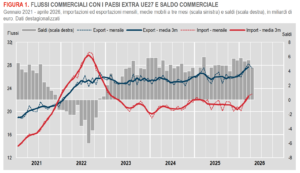
Trade flows with non-EU27 countries and trade balance
Source: Istat
The picture changes radically when looking at the year-on-year comparison. In April, Italian exports to non-EU countries grew by 11.3%, while imports rose by 5.8%. This is the best export figure in recent months and shows a much more dynamic trend compared to imports.
Italian sales are mainly supported by intermediate goods, up 22%, energy (+34.9%), and capital goods (+11.1%). Non-durable consumer goods also increased (+5.7%), while the durable goods component remains negative, losing 10.2% year-on-year.
On the import side, the increase is mainly related to energy purchases (+28.1%) and intermediate goods (+16.1%). On a monthly basis, the rise in imports is almost entirely explained by the boom in energy purchases, which grew by 25.3% in just one month.
The numbers also confirm the strong impact of the energy component on Italian trade. In April, the energy deficit rose to 5.327 billion euros, compared to 4.195 billion in the same month of 2025. But net of energy, the trade balance improves significantly: the surplus of non-energy products rises from 6.515 to 9.173 billion.
Overall, the trade balance with non-EU countries reaches 3.846 billion euros, up from 2.320 billion a year earlier. And in the first four months of 2026, the accumulated surplus reaches 17.5 billion, compared to 13.6 billion in the same period of 2025.
SWITZERLAND, CHINA, AND THE USA DRIVE ITALIAN SALES
From a geographical point of view, April shows a strong acceleration of exports to some key markets. Sales to Switzerland increased by 39.4%, those to China by 36%, and those to OPEC countries by 19.3%. The United States also grew, marking a +12.1%.
The picture is weaker for other trading partners. Exports to Turkey plummeted by 21.3%, while those to the United Kingdom fell by 3%.
The data on China stands out particularly. After months of weaker performance, Italian exports to Beijing are growing strongly again, while at the same time Chinese imports to Italy are falling, down 8.8%.
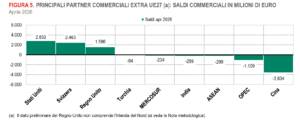
The American market also continues to support Italian exports. The United States remains the largest positive trade balance for Italy among non-EU partners, with a surplus of 2.832 billion euros in April. Switzerland and the United Kingdom follow. Conversely, the largest trade deficit remains with China, amounting to 3.634 billion.
Main extra EU27 trading partners: trade balances in millions of euros
Source: Istat
BOOM IN MERCOSUR AND ENERGY PURCHASES
On the import side, the most striking data concerns Mercosur. Italian purchases from South American countries increased by 62.7% year-on-year, the strongest rise among the main extra-European trading partners.
Imports from OPEC countries also grew strongly, up 51%. Purchases from Turkey (+12.7%), Switzerland (+10.4%), the United States (+7%), and ASEAN countries (+6.8%) also increased. In contrast, those from China (-8.8%) and the United Kingdom (-1.1%) decreased.
The increase in imports from Mercosur comes on the eve of the entry into force of the trade agreement with the South American area.
The energy dynamic continues to dominate the picture of Italian trade. In the February-April quarter, imports grew by 11% compared to the previous three months, and more than half of the increase is explained precisely by higher energy purchases, which rose by 33.7%.
Istat data thus show a still robust foreign trade, with exports growing strongly year-on-year and an improving trade surplus, but also with an energy dependence that continues to weigh heavily on the Italian trade balance.




