

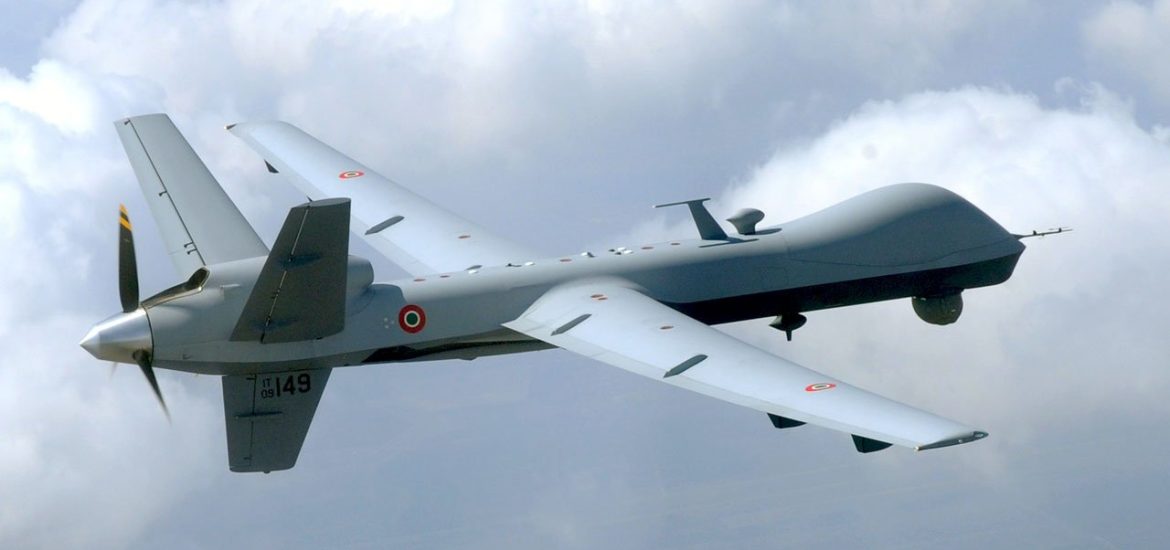

An MQ-9A Reaper drone assigned to the Italian Task Force Air was destroyed during a drone attack against the Ali al Salem air base in Kuwait.
On the morning of March 15, “the Ali Al Salem base in Kuwait, which hosts American and Italian capabilities and personnel, was the target of a drone attack that hit a shelter, inside which a remotely piloted aircraft of the Italian Task Force Air was housed, which was destroyed,” announced yesterday General Luciano Portolano, Chief of Defense Staff.
No injuries among the Italian military personnel deployed at the base since “At the time of the attack all personnel were safe,” General Portolano specifies. The Italian presence in Kuwait is part of the Italian National Contingent Command Air – Task Force Air Kuwait mission, launched in 2014 and part of Italy’s contribution to the international operation Prima Parthica/Inherent Resolve against the jihadist group Islamic State. From the Kuwaiti base, the Italian MQ-9A Predator aircraft of the Task Group “Araba Fenice” and F-2000A “Eurofighter” of the Task Group “Typhoon” conduct surveillance, reconnaissance, and data collection missions in support of operations.
Therefore, the aircraft represented one of the main assets used in the operations of the international coalition engaged against the jihadist group. Produced by the American company General Atomics, the drone is used for surveillance, reconnaissance, and intelligence gathering missions. Valued at about 30 million euros, the super-Male (Medium Altitude Long Endurance) remotely piloted aircraft can stay in flight for over 24 hours at altitudes up to about 15,000 meters.
Defense Minister Guido Crosetto also clarified that “all Italian military personnel present at the base were safe and were not involved in the attack.”
All the details.
THE ASSET HIT AT THE ITALIAN BASE IN KUWAIT
The aircraft hit at the Ali al Salem air base in Kuwait is an MQ-9A “Predator,” a medium-high altitude and long-endurance drone used for surveillance, reconnaissance, and intelligence gathering missions in support of the international coalition engaged in combating the jihadist group Islamic State.
Before this attack, our country possessed six fully operational units assigned to the 32nd Wing of the Italian Air Force.
CHARACTERISTICS AND OPERATIONAL CAPABILITIES
With a wingspan of 20 meters and a length of 11 meters, the MQ-9A Predator represents one of the main intelligence, surveillance, and reconnaissance (ISR) tools available to Italian forces in the Middle Eastern theater. The drone is designed to operate at medium-high altitude for extended periods. It boasts an endurance that can exceed 24 hours of continuous flight and an operational altitude reaching about 15,000 meters.
The aircraft is also capable of operating in adverse weather conditions, such as rain, wind, and ice. Thanks to a synthetic aperture radar (SAR), which provides radar images, the drone enables constant monitoring of the territory, target identification, and intelligence data collection. In this way, it provides real-time information to coalition commands and operational units on the ground.
DETAILS FROM THE ITALIAN AIR FORCE WEBSITE
The MQ-9A “Predator B” aircraft, built by the American company General Atomics, is a Remotely Piloted Aircraft (RPA) employed by the Air Force to carry out reconnaissance, surveillance, and target acquisition missions. The aircraft, with a wingspan of over 20 meters, a speed exceeding 400 km/h, and the ability to fly at medium and high altitudes, guarantees great flight autonomy, allowing it to achieve high performance both in conducting ISTAR (Intelligence, Surveillance, Target Acquisition, and Reconnaissance) missions and, in maritime and land contexts, in Patrol, Search, and Rescue operations.
PRODUCED BY THE AMERICAN GENERAL ATOMICS
Produced by the American company General Atomics, it has an estimated value of about 30 million dollars for the aircraft alone, a figure that can exceed 35 million including sensors, communication systems, and ground control infrastructure.
The Reaper is in service (armed) with the United States and United Kingdom forces, while it has been ordered (unarmed) by the French and Dutch forces.
THE TASKS
The Air Force’s Predator Bs are capable of fulfilling a wide range of tasks, demonstrating high flexibility, versatility, and effectiveness. For example, they can detect threats such as improvised explosive devices, which represent the most insidious and widespread danger in today’s operational theaters.
They can also carry out missions in hostile operational environments, in the presence of nuclear, biological, chemical, or radiological contamination, or acquire data and information related to small and large targets in areas potentially subject to operations. Moreover, Predator B aircraft uniquely contribute to creating and maintaining so-called “Situational Awareness,” i.e., control over the evolution of the situation by the authorities responsible for commanding activities.
The characteristics of autonomy, speed, persistence, and range, combined with low operating costs, make the system one of the best tools for border control, environmental monitoring, support to police forces, and intervention in case of natural disasters.
THE ROLE IN COALITION OPERATIONS
Precisely because of these characteristics, the drone destroyed in the attack represented an important asset for maintaining aerial surveillance in the area, which is why it remained deployed at the Ali al Salem base even after the partial reduction of the Italian deployment that took place in recent days for security reasons.
The Kuwaiti base is indeed one of the main operational hubs of the international coalition in the Gulf and hosts U.S. and allied air assets employed in regional security activities and in support of operations against jihadist networks active between Iraq and Syria.
DEFENSE MINISTER CROSETTO’S POSITION
In light of the Iranian attack on the Italian base Ali Al Salem in Kuwait, Defense Minister Crosetto explained that he immediately informed the Prime Minister, the Deputy Prime Ministers, and the leaders of political forces, “both majority and opposition, to ensure maximum transparency and sharing of the situation.” Crosetto also added that the government is closely monitoring the evolution of the security framework in the area, “in constant contact with the Chief of Defense Staff, with the Joint Operations Command (COVI), and directly with commanders on the ground.”
Finally, the Defense Minister recalled that in recent days “military personnel had been reduced, leaving only essential personnel at the base,” reiterating that “the loss of the aircraft has no impact on the safety of our troops deployed in the area.”
The March 15 attack is the second on an Italian base after a missile struck the Erbil base in Iraqi Kurdistan on March 11. On that occasion too, the attack caused no casualties among the Italian contingent, with limited damage.




