

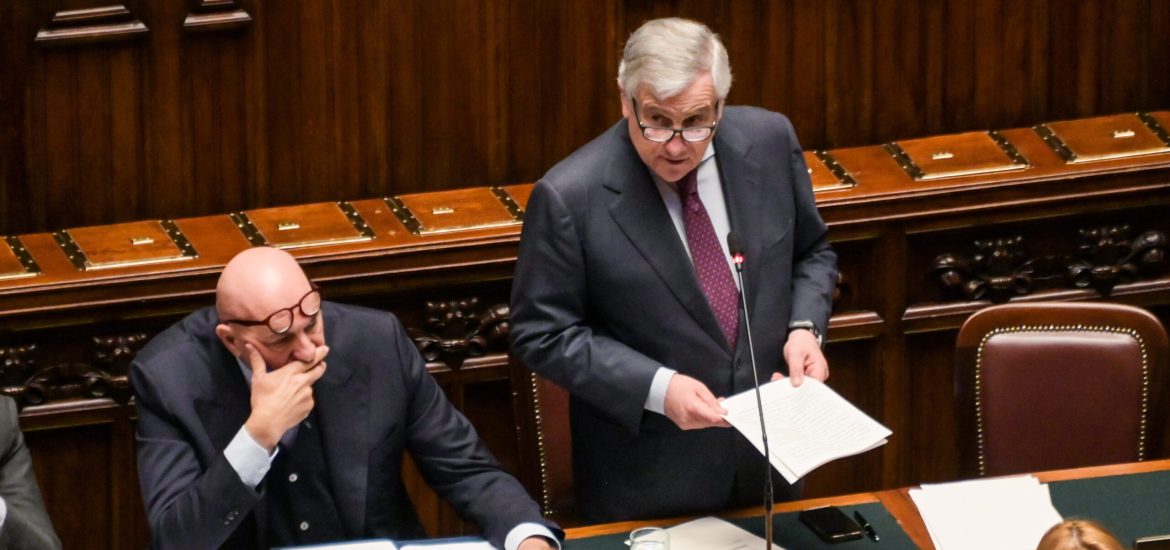

Government members’ briefings in Parliament rarely add anything to what we already know. But these are not normal times, and even such an institutional and somewhat rigid occasion can reveal much more than the mere transmitted content.
From the hearings of Foreign Minister Antonio Tajani and Defense Minister Guido Crosetto on the Middle East conflict, we have learned some important things: that the government is worried, very worried, perhaps as never before.
And that the ideological convergence with Donald Trump is much more in words than in deeds: Prime Minister Giorgia Meloni is always very careful to legitimize even the most unscrupulous actions of the U.S. president, but her ministers are instead mainly concerned about the consequences.
They try to mitigate the effects of Trump’s ruptures. And while this has always been true, it emerges with unprecedented clarity in the face of the reality of a war without clear limits.
Because this is the other important novelty of the communications to Parliament by the two ministers most involved in the dossier: the government fears this is becoming a world war.
Tajani’s main message is that Italy is not at war and never will be. And this is an apparently banal observation, but not obvious at a time when belonging to international alliances risks pushing the country toward conflict.
There was the Iranian missile against Turkey, which is a NATO country and protected by the famous Article 5 that provides for the attacked member state the option to request the intervention of the Atlantic Alliance in its support.
And there are attacks against British bases in Cyprus, which represent a double risk: because Great Britain, like Turkey, is a NATO country with Article 5 and because Cyprus, which is not in NATO, is a member of the European Union which provides in Article 42.7 a similar collective defense scheme.
In short, somewhat like on the eve of the First World War, these defensive alliances born with a deterrence purpose risk causing automatisms that lead to escalation if attacking one of the members forces all the others to intervene.
Even the countries targeted by Iranian missiles and drones are well aware of this, so for now they have avoided activating formal procedures to request help from partners, who however mobilize autonomously also to prevent NATO’s Article 5 or EU’s 42.7 from being invoked, making it impossible to contain participation in the conflict.
As Defense Minister Crosetto explains, however, Iran is working precisely on this: that is, it wants to draw as many countries as possible into the war, in order to raise the political cost for those who started it, namely Israel and the United States.
For this reason, it strikes the United Arab Emirates, which had not attacked Iran, or Oman which hosted negotiations with the United States on the nuclear issue. Indeed, Iran strikes the Emirates much more than it strikes Israel, which is farther away and better defended, and not only military targets, but also deliberately civilian objectives:
The Emirates have suffered many more attacks than Israel. Iran’s attacks have focused on countries that, in theory, do not participate in the war — today also Azerbaijan — and I wanted to give you some data to understand the dimension of this Iranian reaction.
In the Emirates, 186 ballistic missiles were detected, of which 172 were intercepted, and 812 drones, of which 755 were intercepted. In Qatar, 101 ballistic missiles, of which 98 were intercepted, and 39 drones, of which 24 were intercepted. In Bahrain, 73 Iranian missiles and 91 drones. In Kuwait, 178 ballistic missiles and 384 drones.
Iran cannot strike Israel with drones because the distance and travel time would make interception very easy. For this reason, it is striking neighboring nations.
Thus, from this perspective, the Emirates are comparable to Ukraine attacked by Russia: they are not part of the aggression by Israel and the United States, but victims of Iran’s retaliation.
And so Italy feels called to help them using the same legal basis that allows arms exports to Ukraine: the government wants to support the air defense effort of Dubai and Abu Dhabi, to resist the Iranian attack.
More from Crosetto:
Today, given what happened in Turkey and what happened in Cyprus, I have instructed the Chief of Defense Staff to raise to the highest level the protection of the national air and ballistic missile defense network, in coordination with allies and NATO.
Because when I say that in the face of a reckless reaction we can expect anything, it means that really anything can happen.
This time not even Matteo Salvini’s Lega objects, because the rightmost part of the majority enthusiastically supports the American intervention against the ayatollah regime. An enthusiasm completely missing in the much calmer and alarmed words of government representatives.
Crosetto seems to suggest that the conflict in Iran and that in Ukraine could merge. And not only because now Iran uses against its regional rivals the same drones it has provided for years to the Russian army, with Ukraine supporting the Emirates in air defense.
For the Defense Minister, the real risk seems to be that the war in Iran could push Vladimir Putin to attempt an even more extreme approach to Ukraine: the United States have changed the head of the regime in Venezuela, have together with Israel taken down the Supreme Leader of the Iranian revolution Ali Khamenei, can Putin really feel safe?
Crosetto:
One of the things we have forgotten — one of the analyses that we have never done in Italy, and that we somehow refuse to do because we are very superficial in facing it — is to understand what is happening in Russia.
Those who follow the Russian situation know that in recent months Putin has been put in the minority by nationalist hardliners, the “generals,” those of the great victories, who accuse him of having used too light a foot with Ukraine.
They have put him under very strong internal pressure, telling him: look what happened in Venezuela, look what happened in Syria, look how many years you have been attacking Ukraine.
They are therefore pushing him to increase the level of conflict, which means using other weapons in the conflict.
Crosetto claims that Putin might be tempted to use “other weapons” in Ukraine. A phrase that, in this context of maximum alarm, suggests the use of tactical nuclear weapons, to close the game, knowing that the United States and NATO in general would certainly not dare to favor a nuclear escalation.
Putin, in alternating phases, has always evoked the atomic danger, as a threat to discourage crossing certain “red lines” in the supply of arms to the Ukrainians. He has never followed through on these threats, but Crosetto’s words raise some unease.
This fear that two very different wars — the one in Ukraine supporting the attacked and the one in Iran, where the aggressors are Israel and the United States — overlap pushes the Meloni government to unexpected caution.
Tajani comes close to criticizing the attack against the ayatollah regime. Certainly, he uses tones different from those of Spanish Prime Minister Pedro Sanchez, but the message is not so distant:
“We remain convinced that the diplomatic path, however complex, is the only one capable of producing lasting results, even when it appears fragile, even when it seems distant.”
Since it is the United States and Israel who abandoned the diplomatic path of negotiations with Iran, it is clear who is the target of this veiled criticism.
Even the explanations for the need for greater Italian commitment in the Middle East offered by the ministers do not seem connected in any way with the purpose of the war.
Tajani especially emphasizes that the war threatens Italians residing in the Gulf and all those in Italy exposed to the now almost certain increase in bills due to the shock on raw material prices:
The government is ready to intervene also on the economic front to mitigate the impact of this crisis, which unfortunately is already visible. The blockade of the Strait of Hormuz, a vital passage point for global energy supplies, is worrying.
Oil and gas prices have already recorded significant increases. Insurance premiums on maritime routes have risen. Increases in consumer prices are recorded, sometimes even unjustified.
The political message that emerges is that the government intervenes only to contain the damage of the war, not because it shares its origin and purpose.
From the total absence of enthusiasm for the military option follows the line on the use of American bases in Italy.
As Crosetto clarifies, the issue does not arise today: based on bilateral treaties of 1951 and 1954, secret, and a public memorandum of 1995, the United States can use bases in Italy for some NATO activities, including exercises, but not to launch war operations. For different activities, such as launching raids on Iran, Italy’s consent is required:
It is indeed necessary to have further presences in the area for our contingents, for our compatriots, and to help counter an emerging financial and energy crisis.
In particular, the agreement establishes that, for 70 years, activities related to NATO operations and training, support, and non-kinetic operational activities have been authorized. We are therefore talking about logistical support activities, training, technical-operational cooperation, and aircraft not intended for combat.
To date, no request has been received regarding scenarios different and outside this perimeter. There has been no anticipation in this regard, so there is no issue of bases to be granted.
Crosetto explains that currently there is no request and he does not think there will ever be one. But even if there were, Prime Minister Meloni has already expressly communicated to him that Parliament should decide.
If the war, fought so far only from above, were to become a ground war — with possible U.S. support to the Kurds or with the direct sending of American troops — it is quite clear that Italy would not do as with Iraq in 2003 and would refuse any direct involvement.
In this war context, Giorgia Meloni suddenly seems to see no benefit in aligning with Donald Trump’s line.
(Excerpt from Appunti)




