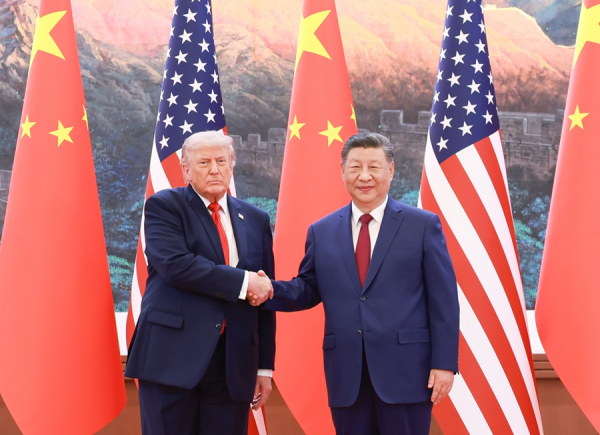

The summit between Donald Trump and Xi Jinping ended with tangible results for the US on the trade front – from massive purchases of American agricultural products to Boeing orders – and with the establishment of a new bilateral mechanism to manage exchanges, the so-called “Board of Trade.” However, divergences remain on Taiwan, on which both interlocutors maintained a firm stance.
It was, in short, a meeting full of symbolism and pragmatism that consolidates the trade truce without resolving the strategic fractures between the two major world powers.
The summit – the first by an American president in China in nearly ten years – was rich in ceremonies and emblematic gestures, from lunch at Zhongnanhai to a stroll through the gardens. Trump invited Xi to the White House in September, while Beijing speaks of a “constructive strategic stability” for the next three years.
As noted by the BBC, although there were no agreements that can be called epochal, there were targeted advances that consolidate the truce reached in October in South Korea. Structural challenges – from the trade deficit to technological control to the Taiwan issue – remain on the table.
THE ECONOMIC DOSSIERS DISCUSSED IN BEIJING BY TRUMP AND XI
As reported by CNBC, Xi assured the US CEOs visiting with Trump that China will “open its markets even more” to American products.
“We have concluded some fantastic trade deals, truly beneficial for both countries,” emphasized the White House chief, according to words reported by Reuters.
As highlighted by Bloomberg, US Trade Representative Jamieson Greer announced that Beijing will commit to purchasing tens of billions of dollars worth of American agricultural products annually over the next three years, in addition to renewing the existing agreement that provides for 25 million tons of soybeans per year.
Trump, interviewed by Fox News, highlighted this aspect with satisfaction: “They will buy a lot of agricultural products, especially soybeans. With all those consumers, they need it.”
Beijing also renewed licenses for the import of US beef and showed interest in American energy, including oil and LNG.
The US president stated to Fox News that Dragon ships will arrive at the ports of Texas, Louisiana, and Alaska to load American crude, a concrete step to reduce Chinese dependence on the Middle East.
BOEING CELEBRATES IN CHINA
One of the most visible results of the summit is the Chinese order of 200 Boeing aircraft, as confirmed by Trump himself and reported by CNBC.
This is the first major purchase of American jets in almost a decade: more than the 150 units initially expected by Boeing, but below market expectations that spoke of 500 aircraft. The stock market unsurprisingly reacted negatively to the news.
The presence of the company’s CEO in the American delegation made this agreement even more concrete, seen as an immediate win for industry and employment in the United States.
WHAT THE BOARD OF TRADE WILL DO
An important new element is the creation of a bilateral “Board of Trade,” tasked with overseeing the reduction of tariffs on about 30 billion dollars’ worth of non-sensitive goods.
Greer explained this in several interviews, including with Bloomberg and the New York Times, clarifying that the goal is to promote trade in sectors such as aeronautics, soybeans, medical devices, and energy.
There is also a “common willingness” to extend the rare minerals agreement beyond the October deadline. However, Greer expressed concern about new Chinese regulations that risk penalizing foreign companies that move supply chains out of China.
THE TAIWAN AND IRAN ISSUES
Despite the cordial tones and handshakes at Zhongnanhai, Xi Jinping drew a clear line on the Taiwan issue.
As highlighted by the New York Times citing the Chinese state news agency Xinhua, Xi warned that mishandling the island could lead to “clashes or even conflicts,” calling it the most delicate issue in bilateral relations.
The Trump administration, through Secretary of State Marco Rubio, reiterated that American policy does not change.
On the Iranian front, The Donald reported that the Chinese president expressed willingness to contribute to a solution and that both agree on the need to reopen the Strait of Hormuz without tolls.
China, the main buyer of Iranian oil, has called for a lasting ceasefire in the region. An agreement on this point would have immediate repercussions on global energy prices. But on this point, the US accuses Beijing of maintaining an ambiguous line and at least partial support for the Islamic Republic.
NVIDIA CHIPS AND MORE
On the technology front, Reuters revealed that the United States have already authorized about ten major Chinese companies – including Alibaba, Tencent, ByteDance, and JD.com – to purchase Nvidia’s H200 chip, the second most powerful for AI.
The last-minute presence of Jensen Huang, CEO of the leading semiconductor company, in the American delegation was precisely aimed at unlocking this stalemate.
At the same time, the two leaders discussed AI. Treasury Secretary Scott Bessent previewed that the United States and China will work on a common protocol to prevent advanced AI models from falling into non-state hands.