

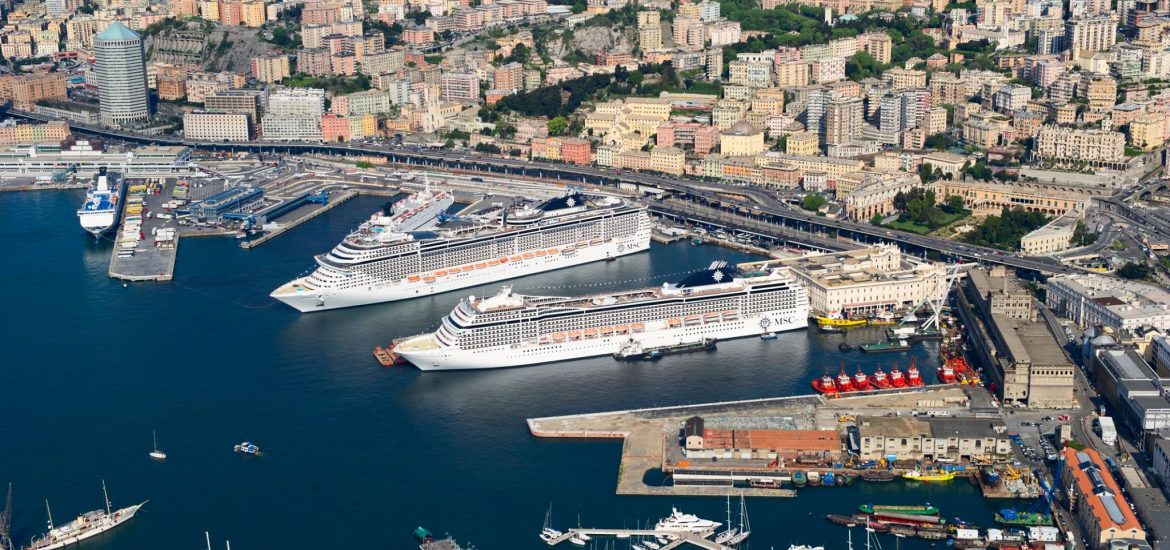

The world is witnessing a real race for strategic ports, a phenomenon that mixes commercial interests, geopolitical ambitions, and concerns about the security of supply chains.
The latest issue of The Economist dedicates an in-depth report to this reality, starting from the example of Greece: a country where Americans, Chinese, and Russians compete for key infrastructure. But the picture is much broader, and it takes shape as an international competition to dominate maritime routes, involving tens of billions of dollars.
On one hand, the British weekly emphasizes, this fragmentation promises greater resilience and competition; on the other, it risks generating colossal inefficiencies, overinvestment, and a polarization between Western and Chinese port networks.
Greece at the center of the new port war
Located about 1,200 km north of the Suez Canal, Piraeus represents one of the clearest cases of this competition. The port, majority-controlled by the Chinese state giant COSCO, is among the busiest in Europe with over 4 million containers per year.
But just 30 km away, the United States supports the development of a new commercial terminal in Elefsina, while in Alexandroupolis American and NATO forces have established a logistics hub.
Further north, Russian and Chinese investors have taken positions in Thessaloniki.
These parallel moves in a single country demonstrate how Greece has become a paradigm of the broader struggle for control of maritime infrastructure.
A global competition
The phenomenon is not limited to Greece: it stretches from Argentina to Thailand, passing through the Panama Canal, where the rivalry between the United States and China has taken particularly sharp tones.
According to PwC, investments in port infrastructure will grow by over one-third, reaching 90 billion dollars annually by 2035.
This fierce battle is justified by the fact that 80% of world trade travels by sea, and recent crises, from the pandemic to the closure of the Strait of Hormuz, have shown how fragile the system is.
Governments seek to reduce dependence on single bottlenecks for both economic and strategic reasons. In the long term, more competition could lower transportation costs, but in the short term, a landscape of waste and overcapacity is looming.
The Chinese advance
China is the main protagonist of this expansion: its companies control or hold stakes in at least 129 ports outside national borders, with investments exceeding 80 billion dollars.
Many of these terminals are located near strategic points such as the Strait of Malacca, Hormuz, and Suez.
According to a MERICS study, when a Chinese company obtains management of a terminal, the trade with China of the host country increases by over 20%, while exports to the rest of the world can drop by 19%.
Control allows prioritizing Chinese ships and goods, speeding up customs and logistics. It is therefore no surprise that Western governments are alarmed.
Responses from Western companies
Recent rerouting has caused congestion, delays, and soaring freight rates. Non-Chinese companies have reacted strongly: since 2021 they have announced acquisitions worth about 140 billion dollars along the entire maritime supply chain.
Recent examples include Hapag-Lloyd’s purchase of stakes in Brazil and India, American joint ventures with CMA-CGM, and expansion plans by Maersk and Eurogate in the North Sea.
Governments are also moving: India plans ports through 2047, Singapore is investing 20 billion in a mega-automated hub, and Dubai’s DP World is expanding its presence in Africa and Latin America.
The Panama Canal case
Tensions have reached high levels in the Panama Canal. After Trump’s election, the United States challenged the management of two terminals by CK Hutchison, a Hong Kong group. A mega-deal worth 23 billion dollars between BlackRock and MSC allowed the Americans to take over, triggering a Chinese reaction.
Beijing blocked dozens of Panamanian ships and ordered Maersk and MSC to suspend operations. The legal dispute is still open and shows how commercial competition has turned into an open geopolitical clash.
Meanwhile, the American Federal Maritime Commission is strictly monitoring possible anti-competitive behaviors.
Beyond the docks
Chinese presence is not limited to port ownership. Shanghai Zhenhua produces over 70% of ship-to-shore cranes, Beijing companies manufacture 95% of the world’s containers, and the LOGINK software, managed by the Chinese government, is used in 86 ports across 24 countries, providing data on nearly 90% of the world’s container ships.
Faced with this, a progressive bifurcation is emerging between port networks controlled by Western groups and those managed by the Chinese.
COSCO and China Merchants Port continue to expand, acquiring operators in Brazil and investing in industrial parks connected to their terminals.
The pros and cons
This fragmentation has positive aspects: increased competition forces ports to improve services and rates, reducing monopolistic power. An operator will always have a nearby alternative.
As one executive notes, “every port and every country aspires to become a logistics hub, but they cannot all be.”
Ports’ high operating margins are inevitably destined to fall. This creates indebted infrastructure, inefficient routes, and, in times of crisis, delays and higher prices for consumers despite greater overall capacity.


