Xi Jinping evokes for the second time in a decade the risk of the trap in which the declining power and the rising power find themselves, risking going to war.
The news is not that Xi Jinping cites the “Thucydides Trap,” but that he admits its existence. That is, he contemplates the possibility of a war between the United States and China due to the possible reaction of the declining hegemonic power to the rising power.
In 2015, during a visit to the United States in Seattle, Xi had cited the same concept, widely used and abused in international relations theory, but to argue that no contemporary Thucydides Trap existed.
A risk of conflict between the two superpowers that for Xi was very remote a decade ago now seems almost an imminent danger to avoid.
It is useless to look for any strategic depth in Donald Trump’s speeches during this summit in Beijing that he so much wanted and awaited. The American president, as is well known, is incapable of articulating any concept and when he tries, he should not be taken literally anyway.
So far, he has limited himself to saying that China is beautiful and that he invites Chinese President Xi Jinping and his wife Peng Liyuan to the White House on September 24.
Better then to focus on Xi and the “Thucydides Trap,” which we now explain in detail. But first, Xi’s words:
The whole world is watching our meeting. An unprecedented transformation over the course of a century is accelerating worldwide, and the international situation is fluid and turbulent.
The world has reached a new crossroads.
Can China and the United States avoid the Thucydides Trap and create a new paradigm in international relations? Can we face global challenges together and offer greater stability to the world? Can we build a brighter future together, for the well-being of our two peoples and for the future of humanity?
Ten years ago in Seattle, with Barack Obama as President of the United States and China’s economy still that of a developing country, Xi’s tone about the risk of a direct confrontation between superpowers was very different:
Building with the United States a new model of relations between great powers, based on absence of conflict, absence of confrontation, mutual respect, and mutually beneficial cooperation, is the priority of Chinese foreign policy.
We want to deepen with the United States mutual understanding of each other’s strategic orientation and development path. We want to see more understanding and trust, less distance and suspicion, so as to prevent misunderstandings and miscalculations.
We should strictly base our judgment on facts, to avoid becoming victims of hearsay, paranoia, or self-imposed prejudices.
There is nothing in the world like the so-called “Thucydides Trap.” But if great powers continue, one after another, to make strategic miscalculations, they could end up creating these traps themselves.
So, in 2015 Xi Jinping warned that superpowers could coexist peacefully or create traps that would lead to war.
Today, he seems to take for granted that it has happened, that the traps exist, so the United States and China must try to “avoid” the Thucydides Trap which is a concrete and present risk.
A Slippery Concept
What matters is the message, more than the philological correctness of applying to the current dynamic of confrontation between China and the United States the logic of the Peloponnesian War.
More than 2,500 years have passed, yet the war between Athens and Sparta that took place between 431 and 404 BC remains an unavoidable analytical paradigm in international relations theory.
In brief: Sparta was the city-state with the strongest traditional land army, but Athens was at the forefront with the cutting-edge technology of the time, that for building fast and light warships. Sparta led the military alliance of the Peloponnesian League, Athens the Delian League. Military alliances that required the leading power to defend smaller members if attacked by enemies.
Thucydides, historian, politician, aristocratic skeptic about the effectiveness of democracy, dedicates eight books to reconstruct almost in real time events of which he is witness and protagonist. Without attributing blame and responsibility to capricious gods or heroes with superhuman qualities.
His eight books are the first example of almost scientific historical and political analysis, with the analysis of facts and the proposal of an interpretative key.
In the first book, he summarizes his thesis on the origin of the conflict between Sparta and Athens:
“I am convinced that the most authentic motivation, the one however least apparent from official speeches, was the formidable power attained by Athens and the apprehension that caused Sparta: and the war was inevitable.”
Then there are another 500 pages to discuss formal and substantial causes. But it is that initial summary that Harvard political scientist Graham Allison looks at when he writes in the Financial Times in 2012 that “the Thucydides Trap has been triggered in the Pacific.”
For Allison, the two fundamental ingredients are the rise of a new power and the fear it inspires in the hegemon.
In 2017 Graham Allison transformed that article and his subsequent analyses into a book, published in Italian by Fazi with the title “Destined for War – Can America and China Escape the Thucydides Trap?”
With that mix of apparent rigor and intellectual ease that often characterizes successful syntheses in international politics, Allison lists situations in which two powers found themselves in the Thucydides Trap in recent history.
Of 16 cases listed, only in four did the challenger’s rise not trigger a war. The most recent cases in Allison’s list are Japan’s rise in the 1970s-80s threatening Soviet hegemony in Asia, the rise of the Soviet Union threatening the United States between the 1940s and 1980s, the rise of Germany in Europe from the 1990s challenging Britain and France.
Like all historical analogies, it is obvious that the “Thucydides Trap” is open to criticism, because much if not all today is different from the times of Sparta and Athens, just as every choice of subsequent “traps” is debatable.
But what matters in these powerful syntheses is that if the protagonists of international politics adopt them, they then behave accordingly.
Graham Allison has enjoyed great success especially in China, the leadership of the Chinese Communist Party takes him very seriously, and the renewed citation by Xi Jinping shows that this way of reading the competition between the two superpowers has permeated China’s official position.
If we read what Graham Allison wrote in The Atlantic in 2015, right after Xi Jinping’s visit to the United States, the feared danger was a war between the United States and China “in the next decade.”
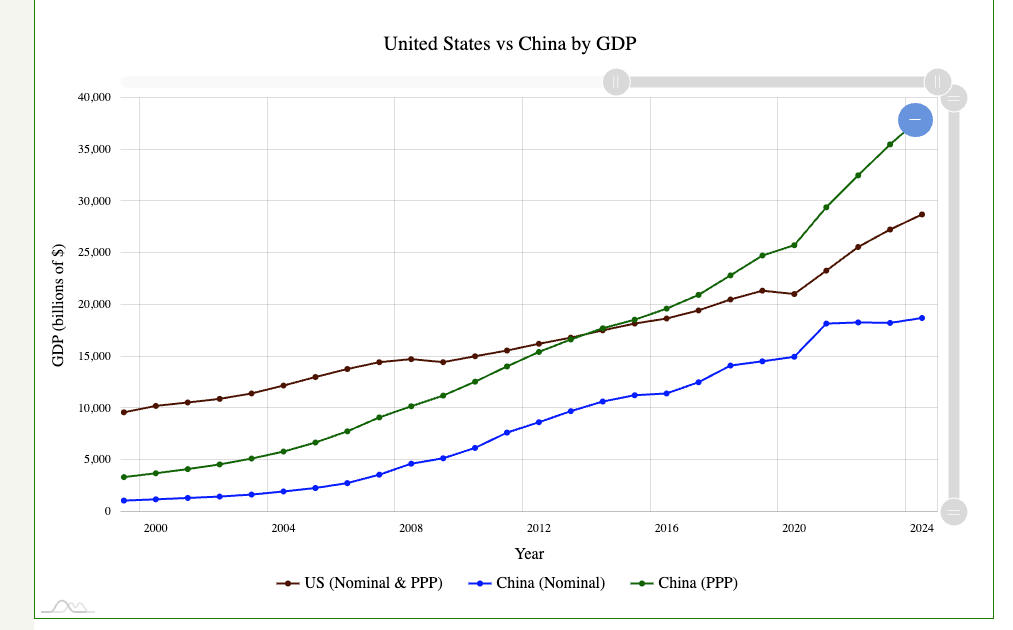
That decade has passed and the war has not happened. Meanwhile, China has changed its nature, from the world’s factory to a competitor with the United States in frontier technologies, from an open economy that needed globalization to a global power that defends its borders and builds a closed ecosystem inside with strong government influence.
In 2015, the United States was led by the candidate of hope, Barack Obama, who had won in 2008 with the slogan “Yes we can,” while in 2026 there is – again – the candidate who has American decline in the slogan that brought him to the White House: Donald Trump wants to make America “great again,” because evidently it is no longer great.
Trump the Athenian
Donald Trump also refers to Thucydides, obviously unconsciously because it is legitimate to think he has no idea who the Greek historian is. In the sense that he applies to international relations a logic of force that does not consider the constraints of international law.
To the inhabitants of the neutral island in Spartan orbit of Melos who invoke law and justice to refuse to submit to Athens’ brutal demand, the Athenians respond with words made famous by Thucydides:
“You are as aware as we are that the concepts of justice emerge and take shape in human language when the scale of necessity is balanced between two equal forces. Otherwise, the powerful act, the weak submit.”
Trump also tried to replace the force of law with the law of force. The problem is that, in doing so, he exposed the fragilities of a declining superpower, as demonstrated by the substantial failure of the war in Iran.
After more than two months, the ayatollah regime is still standing, the nuclear program is not destroyed, and Iran has turned the Strait of Hormuz into a geopolitical weapon apparently invincible.
Trump certainly did not make America stronger, he only made it more aggressive and unpredictable. And he underestimated one aspect, which China instead grasped: America is, or was, a hegemon that institutionalized its power, as Vittorio Emanuele Parsi explains well in his latest book Against Empires (Bompiani).
The United States built an international order based on rules that served to reduce the costs of exercising its power because it made the outcomes of conflicts between different interests more predictable. It was an effective but also efficient system.
Trump mistook the symptom for the disease, he began weakening institutions like the UN or the World Trade Organization that had been tools of American hegemony. The reduced effectiveness of those tools was the consequence of new American weakness, not the cause.
China seems to have chosen to use that international order to accompany its rise, instead of facilitating Trump’s destructive moves, because it still finds it functional.
The analogy with the “Thucydides Trap,” which sees competition as entirely centered on the military plane and the use of force, is therefore imperfect, like all historical analogies.
(Excerpt from Appunti)