

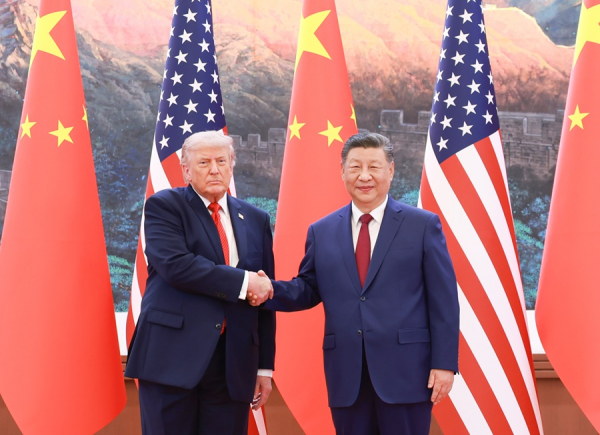

For a moment, it seemed that Taiwan had escaped danger. During the formalities of Donald Trump’s two-day visit to Beijing, which ended on May 15, the American president avoided publicly speaking about Taiwan. This temporarily eased the fears of the Taiwanese that he might yield to Chinese pressure to curb arms sales or even change America’s public stance by opposing the island’s independence – writes The Economist.
Then things began to get complicated. In an interview with Fox News recorded shortly before leaving Beijing, and while speaking to journalists on Air Force One after takeoff, Trump made a series of comments about Taiwan that deeply unsettled the island. Not only did he suggest that America’s forty-year commitment not to negotiate with China on arms sales to Taiwan is now outdated, but he stated that he had discussed “in great detail” with Xi Jinping a $13 billion arms package destined for Taiwan, seeing it as a useful bargaining chip. He also portrayed Taiwan’s president, Lai Ching-te, as someone seeking independence who risks dragging America into a war.
At the same time, he surprised many by suggesting he would speak directly with “the person who leads Taiwan” regarding the arms package. There have been no direct contacts between sitting American and Taiwanese leaders since 1979 […]. To further confuse the picture, Trump repeated the accusation that Taiwan had “stolen” the semiconductor industry from America and should move all chip production onto U.S. soil. He has said similar things in the past, but rarely since Taiwan promised to invest $250 billion in America as part of a trade deal signed in February.
Trump insisted that American policy has not changed. However, his remarks suggest that Chinese leader Xi Jinping has managed to influence his thinking. At the start of the first day of meetings in Beijing, Xi warned that mishandling the Taiwan issue could trigger a conflict between China and the United States. The Chinese leader then spent much of that evening talking about the island, and Trump commented: “I listened to him.” Trump’s comments suggest a much more transactional view of American relations with Taiwan compared to his predecessors, and less commitment to its defense.
Taiwan’s immediate concern is the new arms package. Trump had approved a record $11 billion package in December. Before the summit, it emerged that he had frozen a second package, worth about $13 billion, already approved by Congress. America has previously delayed arms shipments before meetings with Chinese leaders, but Taiwanese officials will be deeply worried if this new freeze lasts more than a few weeks. “I might do it, or I might not,” Trump told Fox News. “I’m holding it up, and it depends on China. Frankly, it’s a great bargaining chip for us.”
In the past, America has always maintained that arms sales to Taiwan should not be part of broader negotiations with China, partly because Washington is legally obliged since 1979 (by domestic law) to help the island defend itself. Even President Ronald Reagan committed, in 1982, not to negotiate with China on this issue. Asked about this, Trump replied to journalists: “Well, I think the 1980s are a long time ago.”
This was a severe blow to the Taiwanese government which, after months of clashes with the opposition, had just managed to get parliament to approve a supplementary defense budget of about $25 billion precisely to finance both U.S. arms packages. […]
Equally worrying for the Taiwanese government is Trump’s suggestion that arms supplies might encourage President Lai to declare independence. “Now they have someone there who wants independence,” Trump said. “If things stayed as they are, I think China would be fine with that. But we don’t want someone saying ‘let’s declare independence’ just because the United States has our backs.” In response, Lai reiterated his position: Taiwan is already, *de facto*, a sovereign and independent nation. The island, he concluded, “will never be sacrificed or used as a bargaining chip.” It remains to be seen whether Trump agrees.
(Excerpt from the foreign press review curated by Epr Comunicazione)


