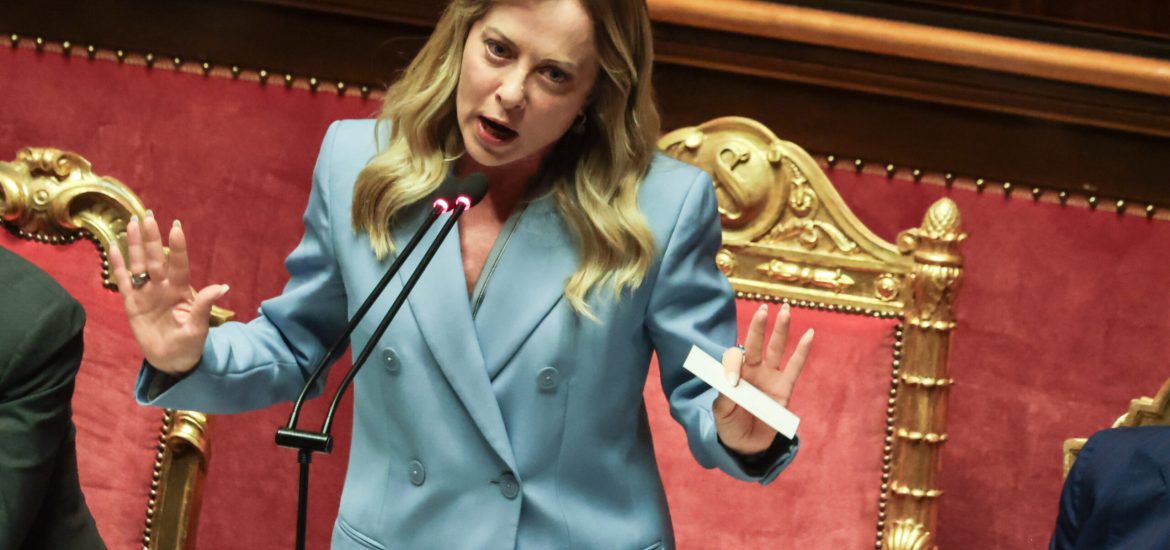

The anger and pride of Giorgia Meloni against the vulgar and sexist insults from a Five Star Movement parliamentarian, Francesco Silvestri, for which at least until the evening, with the exception of Pina Picierno, Vice-President of the European Parliament (former member of the PD), no solidarity comes from the camp that was thought to be at least broadly feminist, further highlight the state of disarray of an opposition that once again split into as many as 6 resolutions.
In the communications in parliament, ahead of the European Council on June 18 and 19, the premier harshly replies to the Five Star deputy that the truth is that the opponents have never accepted that it was the right wing to express the first female premier, who moved forward “without help and kneepads (which Silvestri accused her of wearing with Trump and Netanyahu editor’s note)”
“These are insults to all women,” Meloni denounces. The premier pokes at Laura Boldrini, the former President of the Chamber, PD parliamentarian, who instead criticizes a colleague for addressing Meloni as “Mr. President.” Meloni basically tells Boldrini that her feminism is about formal issues, while “the point of respect” must be about serious and substantial issues such as the sexist insults received yesterday under the silence of the left.
But beyond a left that in fact remained silent even when the CGIL secretary, Maurizio Landini, insulted Meloni with the term “courtesan,” beyond the alternating feminism of the broad camp, which reaches the serious institutional discourtesy towards a premier, the first woman at the helm of Palazzo Chigi, Meloni easily captures the state of crisis and disarray of oppositions divided into as many as six resolutions. And paradoxically, with Piero Fassino, for example, one of the most prepared Democrats on foreign policy, accusing Meloni of “ambiguity” on Ukraine and its entry into the EU.
The premier has no difficulty letting the facts speak for themselves, confirming support for Ukraine: the center-right has always found consensus and voted united in support of Kyiv, while the center-left once again splits into six resolutions. Attempts are made, as Matteo Renzi does for example, to use the small group of Roberto Vannacci defectors to talk about “splits in the center-right.”
But the difference is enormous with the broad camp born structurally divided from the start, beginning with the crucial issue for those running to govern, namely foreign policy. Meloni attacks the Vannacci group frontally for the first time anyway, recalling that they voted no confidence in the government six times. To warn: “Those elected within the center-right who are functional to the left are not the true right.” She emphasizes: “The true right is never functional to the left.”