

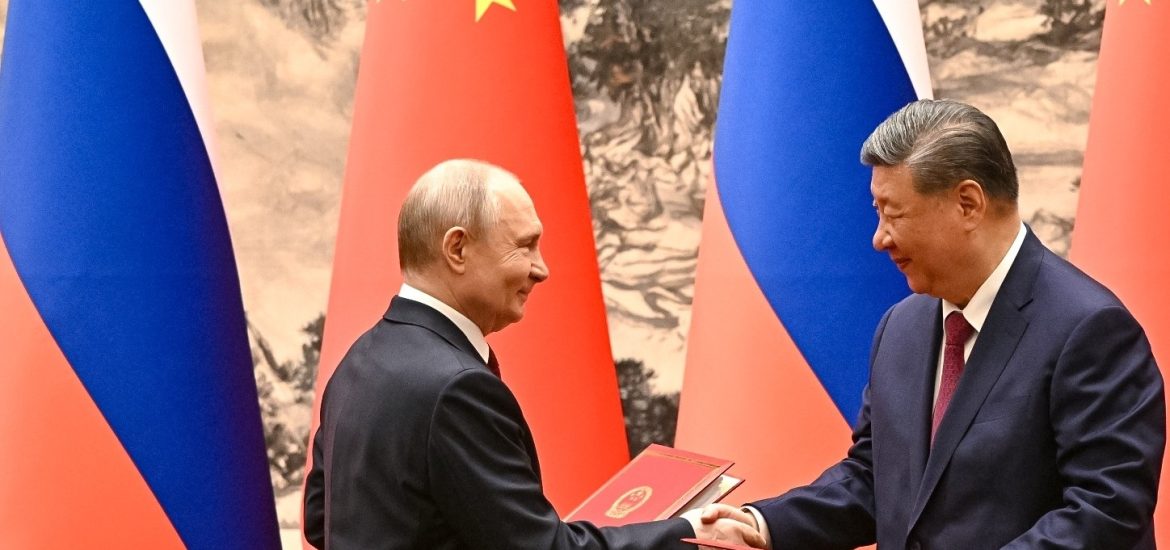

Beijing welcomed Vladimir Putin with the same honors reserved just days earlier for Donald Trump, but with a warmer and more consolidated understanding.
The summit between the Russian leader and Xi Jinping reiterated the “unprecedented level” of bilateral relations and projected the image of two powers positioning themselves as pillars of a multipolar world order, in opposition to what they call “unilateral hegemony,” with a clear reference to Washington.
As reported by Reuters, the two leaders signed over twenty documents and a joint declaration, though without announcing the long-awaited breakthrough on the Power of Siberia 2 pipeline.
HOW PUTIN WAS WELCOMED BY XI
Putin’s arrival, notes the BBC, was marked by a red carpet, honor guard, 21-gun salute, and cheering children waving Russian and Chinese flags shouting “Welcome!”.
Unlike the American president, who was greeted at the airport by Vice President Han Zheng, Putin was received by Foreign Minister Wang Yi, in line with protocol for a regular visitor – this being his twenty-fifth visit to China.
The ceremony outside the Great Hall of the People was almost identical to that given to Trump the previous week, notes Bloomberg, complete with military band and national anthems.
However, the atmosphere appeared more relaxed and personal compared to the meeting with Trump, as noted by several observers cited by the Financial Times and CNBC.
WHAT XI AND PUTIN SAID
The summit was marked by deep cordiality. Putin greeted Xi calling him “my dear friend” and opened his speech with a Chinese proverb: “A day apart seems like three autumns,” to express how much he had awaited the meeting. Xi reciprocated by calling him “my longtime old friend.”
As reported by the New York Times, Xi spoke of a “new phase of more active engagement and faster development” between the two countries.
Putin emphasized that ties have reached “an unprecedented level” despite international difficulties, citing bilateral trade that has reached 240 billion dollars and increasingly close energy cooperation.
STRATEGIC COORDINATION
Both leaders stressed the depth of the partnership.
Xi highlighted that Sino-Russian relations have reached this level “despite countless trials and tribulations,” thanks to mutual political trust and strategic coordination, as reported by the Chinese news agency Xinhua and picked up by the Financial Times.
Putin spoke of a relationship that continues to develop steadily and represents one of the main factors of stability on the international stage.
THE AGREEMENTS AND THE CASE OF THE NEW PIPELINE
The two heads of state renewed and extended the 2001 Treaty of Good-Neighborliness and Friendly Cooperation and, as reported by al Jazeera, signed a joint declaration on the “formation of a multipolar world and a new type of international relations.”
Energy cooperation was one of the pillars of the summit. Putin, accompanied by eight ministers and executives from Russian energy giants Rosneft and Gazprom, reiterated that “amid the crisis in the Middle East, Russia remains a reliable supplier of resources, while China is a responsible consumer.” Xi acknowledged Moscow’s role in ensuring China’s energy stability.
As emphasized by the Associated Press, about twenty agreements were signed in commercial, technological, and scientific fields, but – as confirmed by Kremlin spokesman Dmitry Peskov and reported by Reuters – the final agreement on the Power of Siberia 2 pipeline was not signed. A “principle agreement” was reached on the route and parameters, but prices, volumes, and details remain to be defined. Beijing continues to fear excessive dependence on a single supplier.
ANTI-USA BARBS
On the international front, Xi warned that “the tide of unilateral hegemony is raging” and that the world risks returning to the “law of the jungle,” highlights the Guardian, in a clear reference to the United States and their adventurism.
The Chinese president called for a “complete cessation of hostilities” in the Middle East, describing the situation as a “critical crossroads” and emphasizing the impact on oil imports through the Strait of Hormuz for Beijing.
The two leaders, notes the CNN, also criticized the American missile shield project “Golden Dome,” considering it a threat to strategic stability.
XI’S BALANCING ACT
Ultimately, the Beijing summit confirmed that the Sino-Russian axis not only withstands international turbulence but explicitly positions itself as a stable alternative to a world order dominated by the United States.
Xi Jinping and Vladimir Putin transformed a routine meeting into a demonstration of strategic unity, celebrating a partnership defined as “at the highest level in history.”
However, as the New York Times points out, “beneath the show of solidarity lies an unequal relationship,” with Russia increasingly dependent on China both economically and for dual-use technologies.
Yet, precisely at this moment of difficulty for Moscow, Beijing appears as an indispensable partner, while for Xi the alliance with Putin represents a fundamental pillar for building that “multipolar world” repeatedly invoked.
The summit thus leaves Beijing in a position of strength: capable of welcoming Trump and Putin just days apart with almost identical ceremonies, confirming its role as a privileged interlocutor for all major global players.
As observed by Bloomberg, Xi is conducting a delicate diplomatic balancing act, strengthening ties with Moscow without closing the door to Washington. It remains to be seen whether this ambition for mediation and multipolar leadership will translate into concrete influence or remain primarily an effective narrative.




