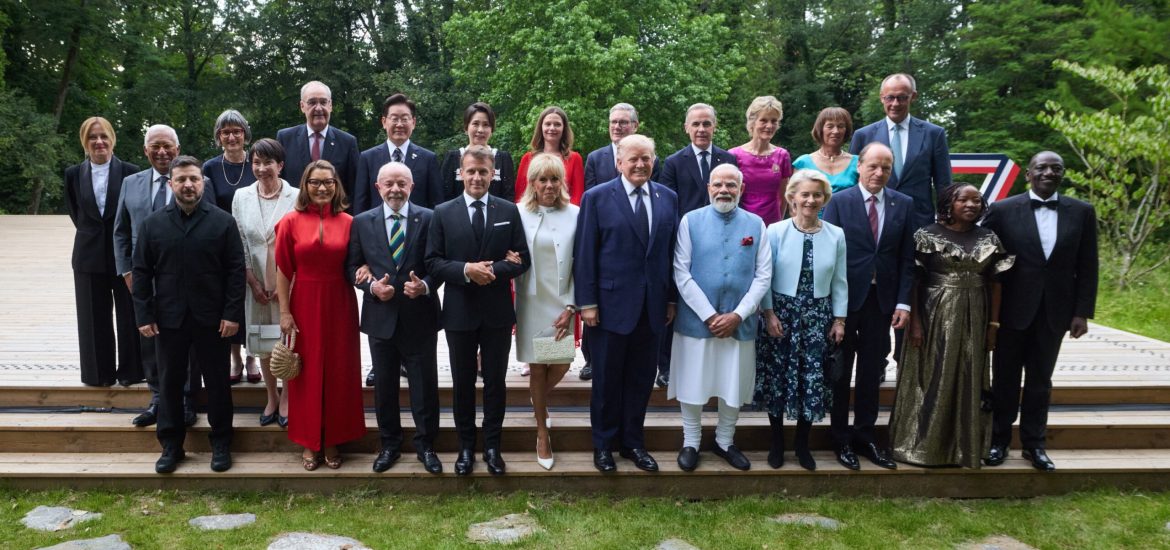

The G7 summit hosted by Emmanuel Macron in Évian-les-Bains, on the shores of Lake Geneva, ended with a mixed but overall more positive outcome than many observers expected.
After months marked by deep divisions over the war in Iran, American tariffs, and an apparent disengagement of Washington from Ukraine, the leaders seem to have found a sense of unity again.
Trump was praised for the preliminary agreement with Tehran, described by himself as “magnificent,” while the Europeans managed to decisively bring the Ukrainian conflict back to the center of the Western agenda.
As the New York Times writes, the summit saw Trump stay until the end – a far from obvious fact – and sign a joint document on Ukraine that just a few months ago seemed out of reach.
Who was there
At the main table sat the seven greats: Donald Trump for the United States, host Emmanuel Macron, Friedrich Merz for Germany, Giorgia Meloni for Italy, Keir Starmer for the United Kingdom, Mark Carney for Canada, and Japanese Prime Minister Sanae Takaichi. With them Ursula von der Leyen for the European Commission and António Costa for the European Council.
Macron expanded the audience with targeted invitations: Volodymyr Zelenskyy, Indian Prime Minister Narendra Modi, Egyptian President Abdel Fattah el-Sisi, the Emir of Qatar al-Thani, and the leaders of Australia, Brazil, Kenya, and South Korea.
Particular attention was drawn by the lunch with the AI giants – from Sam Altman of OpenAI to Dario Amodei of Anthropic, Demis Hassabis of Google DeepMind, and Arthur Mensch of Mistral – a sign that AI geopolitics has now fully entered international summits.
The agenda
The program was ambitious. At the top of the priorities, of course, were the two wars: the agreement with Iran and the conflict in Ukraine. Following that, global macroeconomic imbalances – with France describing the triangle “China produces too much, the US consumes too much, Europe invests too little” – and highlighting dependence on Beijing for critical minerals.
There were also topics on the debt of developing countries and, above all, AI, with sessions dedicated to risks, cybersecurity, and the protection of minors online, as noted by CNBC.
Trump and the agreement with Iran
Trump arrived in Évian energized by the memorandum with Tehran, released just in the final hours of the summit and which the White House chief called a “turning point for the entire Middle East.”
His colleagues applauded him, including in the final declaration the recognition of his “strong leadership,” as highlighted by the Associated Press.
However, as the New York Times reports in detail, on the last day Trump threw stones into the pond: “If I don’t like it, I’ll tear it up and we’ll go back to bombing.”
The president also joked about blaming any failures on Vice President JD Vance, recalling that “my life is made of deals” and that “crazy things happen with deals.”
Ukraine returns to the center
The real European achievement was refocusing attention on Kyiv. After the bilateral Trump-Zelenskyy meeting, judged “very good” by the Ukrainian leader, the United States agreed to sign a final declaration that speaks of “unwavering” support for Ukraine’s territorial integrity, promising more air defense systems, interceptors, and long-range capabilities, as well as willingness for local military production licenses.
As the ISPI writes, Macron clearly summarized the European position: the Old Continent’s allies are providing almost 100% of the aid and ask that other partners, starting with the US, do not weaken the common line. Von der Leyen recalled the already formalized 90 billion euro loan and called to close the remaining gap.
Trump announced the reinstatement of sanctions on Russian oil, suspended during the Iranian crisis, and declared that “the time has come for Moscow to make a deal,” committing to do “everything in his power.”
Merz, Starmer, and Carney also announced new measures against the Russian shadow fleet.
Interactions among the leaders
Macron skillfully played the French soft power card: an exclusive dinner at Versailles, marking 250 years of Franco-American friendship, convinced Trump to stay until the end.
“We are friends again,” was the phrase caught by microphones among Costa, Meloni, and Trump. The Italian Prime Minister smiled: “We have always been friends.”
Merz gave the American president a German national soccer team jersey with the number 47, then stating “we are on the same team.”
Trump showed mixed behavior: cooperative on major issues, but unpredictable in tone. He publicly thanked Xi Jinping and Putin for neutrality in the Iranian conflict and joked about his delay to one of the sessions, saying he is “the boss.”
The final declaration and other dossiers
The joint communiqué represents an important political signal. Full commitment of all attendees towards Kyiv: “We G7 leaders – it reads – are united in unwavering support for Ukraine in defending its freedom, sovereignty, and territorial integrity.”
Nine declarations were produced, from geopolitics to the fight against drug traffickers, from AI to migrants, and unanimity was reached on each.
The leaders committed to reducing dependence on a single supplier for rare earths and magnets, as highlighted by Bloomberg. For other critical minerals, specific targets will arrive by the end of the year, with emphasis on recycling and new mining projects.
Assessment
As highlighted by the analysis made by ISPI, the Évian summit worked like a well-orchestrated courtship: the Europeans exploited the relief over Iran to bring Trump back to the Ukraine dossier.
Macron spoke of a “strategic awakening” and a deep “re-synchronization” of positions. Former Ukrainian Prime Minister Arseniy Yatsenyuk admitted that “the image given by the G7 is much better than expected” and that Moscow failed to exploit divisions among the leaders.
Yet, the assessment remains provisional. The true value of the summit will be measured in the coming weeks: when sanctions on Russian oil will be fully reinstated, when it will be clear if licenses for missiles for Ukraine will really arrive, and when it will be seen if the agreement with Iran will hold.