

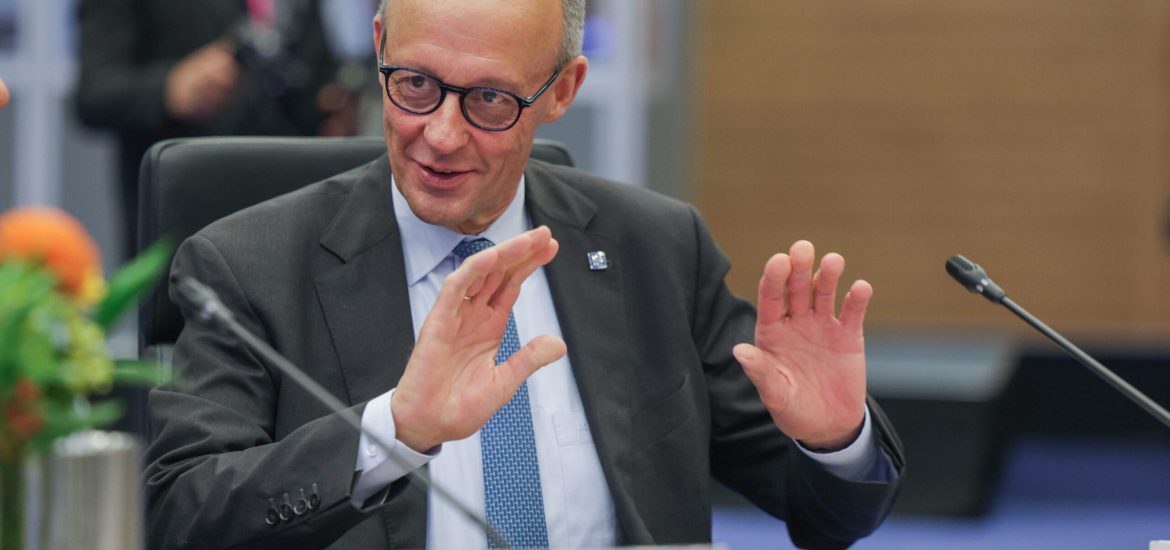

Friedrich Merz is set to play a central role in shaping the trajectory of the European Union next year. With Emmanuel Macron exiting the political scene in France, and no obvious successor able to match his influence in Europe, expectations of Paris are limited. However, Berlin is also struggling. The German chancellor is struggling to assert his authority. Impulsive, clumsy, and unpopular, Merz has yet to establish himself. Germany faces a complex political and economic climate: a deadlocked coalition, troubled Franco-German relations, and a chancellor reluctant to exercise European leadership.
On May 6, Merz celebrates the first anniversary of his election – although there is little to celebrate. His approval ratings have fallen to 19 percent, with 71 percent of respondents dissatisfied, according to a recent INSA poll published by Bild am Sonntag. Discontent also extends among supporters of the CDU/CSU-SPD coalition. By comparison, his predecessor Olaf Scholz recorded 32 percent approval after one year in office. “Compared to Olaf Scholz, Merz is doing significantly worse after twelve months,” the newspaper noted. His difficulties are compounded by a weak mandate. On May 6, 2025, he failed to be elected chancellor in the first round of voting in the Bundestag – an unprecedented outcome in the Federal Republic – necessitating a second ballot to secure 325 votes out of the 328 members of his coalition.
Critics highlight his impulsiveness and lack of sophistication. In Germany, detractors accuse him of provoking Donald Trump and being responsible for Washington’s decision to withdraw 5,000 of the 36,000 American troops stationed in Germany, as well as the 25 percent tariffs on European car imports in violation of the Turnberry agreements.
“Troop withdrawal, car tariffs: the German chancellor has severely damaged relations with the United States with his statements,” says analyst Ulrich Speck. “If Merz had deliberately sought confrontation with Trump – like Sánchez or Macron – one could debate the merits of such a strategy. But that was not the case. He simply made rash comments in a spontaneous exchange with students. There was no strategy, nor intention. There is a word for this: lack of professionalism,” explains Speck.
Others disagree. Julian Röpcke calls it “absurd” to hold Merz responsible for the recent pro-Russian statements and actions of the American president. “Merz expressed a realistic assessment of a failed American strategy regarding the Strait of Hormuz. Was it wise to do so publicly? Perhaps not. But it is hard to blame an adult politician for not modulating his communication to avoid childish reactions from another head of state – such as the impulsive troop withdrawal from Germany,” Röpcke explains.
“Friedrich Merz must pound the table to assert himself as a leader, especially at a time when he is deeply unpopular and his party is behind the far-right AfD,” says Paul Maurice of the French Institute of International Relations (IFRI).
Merz’s criticisms of Donald Trump have unsettled European partners. Merz had presented himself as Washington’s most willing ally within NATO, particularly through the announced rearmament strategy. He also urged Europeans to avoid a direct confrontation with Trump over tariffs. The chancellor supports the United States’ refusal to admit Ukraine to NATO, slows Kyiv’s path to EU membership, and refuses to provide German weapons for deep strikes against targets in Russia. In June 2025, he thanked Israel and the United States for “doing the dirty work” against Iranian nuclear facilities, refusing to “judge an ally.” He also abstained from condemning the US operation aimed at capturing Venezuelan president Nicolás Maduro. During a visit to the White House, he remained silent while Trump publicly reprimanded Spanish Prime Minister Pedro Sánchez – an episode widely interpreted as a sign of deference, if not weakness, on the part of the leader of Europe’s largest economy.
However, Merz has also shown the ability to make abrupt U-turns. “The Americans clearly have no strategy. And that is the problem in these conflicts: you must not only be able to enter them, but also to exit them,” Merz said in a sharp critique of the American president. “An entire nation – the United States – is humiliated by the leaders of the Iranian regime.” Trump responded sharply: “He doesn’t know what he’s talking about… No wonder Germany is in such precarious economic and other conditions.”
Stung by the rebuke, Merz moved to calm tensions, reaffirming that “the transatlantic relationship is essential for us.” Privately, Emmanuel Macron noted that without US support, the German chancellor is reluctant to act. Although personal relations between the two leaders remain cordial, Paris struggles to change Berlin’s position.
This caution marks a shift from the more assertive European rhetoric Merz adopted early in his mandate, when he declared that it was time for Europe to become more autonomous and insisted that “the United States are not NATO’s debt collector.” Germany’s rearmament is underway, albeit gradually and in line with other European military powers.
Nonetheless, Merz has yet to convince partners of his European commitment. “We have a problem with Germany” regarding the next multiannual financial framework, a negotiator confided to us. Berlin opposes increasing its national contribution, remains ambiguous about new own resources, and supports broad horizontal cuts of about 400 billion euros to the Commission’s proposal. Supporters of the common agricultural policy and cohesion funds oppose this. The risk, experts warn, is that deep cuts will compromise competitiveness. “Everyone is puzzled,” a participant at the informal summit in Cyprus told us: “Is this clumsiness or deliberate obstructionism by Germany?”




