
Honda, like Ford, Stellantis, Porsche and other car manufacturers, joins the ever-growing list of brands ready to reverse course on full electric, since the Japanese automaker is convinced that pursuing this path has already cost it enough.
HONDA’S ANNUS HORRIBILIS
As anticipated a few weeks ago on these pages, 2025 will go down in Honda’s history as its worst year, the first closed in the red since 1957. In the twelve months ending in March, the second largest Japanese automaker by volume, after Toyota, announced at a conference losses of 424 billion yen, equal to 2.29 billion euros, compared to a profit of 836 billion yen the previous year.
Operating loss stood at 414 billion yen, a result far worse than analysts had estimated. Revenue, however, shows a slight increase of 0.5%, reaching 21.8 trillion yen (about 118 billion euros).
THE BATTERY IS DEAD…
Weighing down the results are activities related to electric vehicles, which generated total losses of 1.45 trillion yen. The group also expects additional charges of about 500 billion yen in the coming months related to restructuring the sector.
RESTARTING BY FOCUSING ON HYBRIDS AND POSTPONING FULL ELECTRIC
To restart, Honda presented a more pragmatic plan to its shareholders: it will abandon the full electric path (which was not particularly ambitious anyway, having been set for 2040) and will proceed by investing in hybrid solutions.
GAME OVER FOR AFEELA ELECTRIC CAR JV WITH SONY
A very abrupt reversal that also hit an exceptional partner: fellow Japanese Sony. With the home entertainment giant, famous especially for PlayStation consoles, Honda was supposed to produce several electric cars, known as Afeela, which were even supposed to redesign the very concept of mobility, linking it to the pleasure of travel (the technology part would have been handled by Sony).
For many observers, Afeela could have been the only Japanese brand capable of competing, on the hi-tech front, with American Tesla and Chinese Xiaomi, another Big Tech lending itself to the automotive world. It is unclear what will remain of the JV, which will in any case have its budget cut.
Apple had already wisely withdrawn from the competition, thus avoiding losing billions given the sector crisis, and according to consistent press rumors had been working for several years on Project Titan, an electric car likely equipped with autopilot.
PUBLIC APOLOGIES FROM THE LEADERSHIP
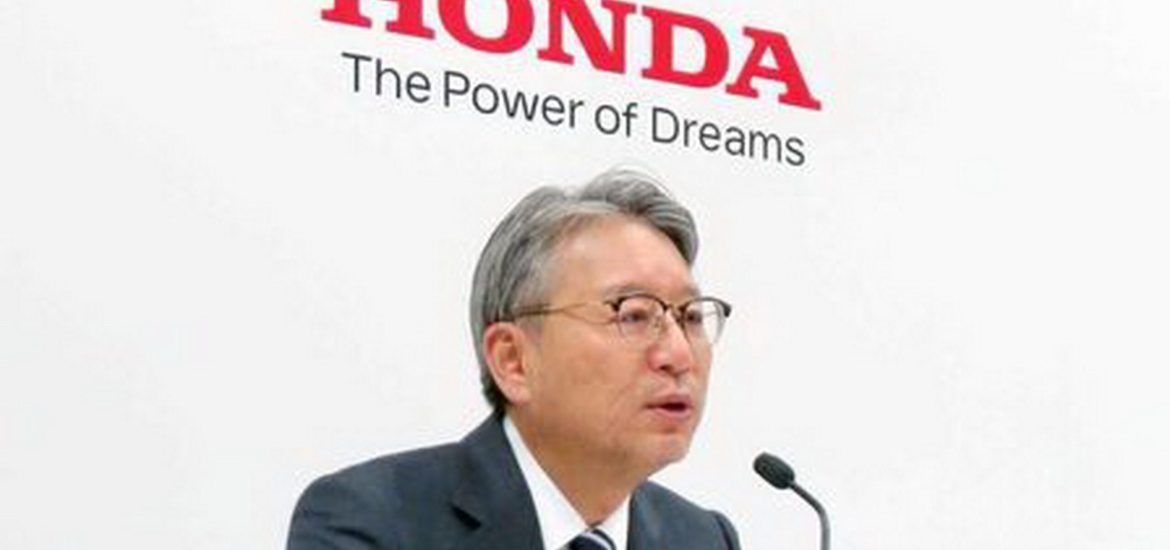
CEO Toshihiro Mibe (in the photo) publicly makes hansei, bowing deeply, responsible for having outlined the electrification plans for the lineup wanting to distinguish the brand from other Japanese manufacturers – starting with Toyota – who have always been very skeptical about the idea of locking themselves into a single technology for the development of future powertrains.
The samurai era ended long ago, no seppuku for company executives, but there is still a gesture certainly unusual to Western eyes: President Mibe and Vice President Noriya Kaihara will give up 30% of their monthly salary for three months and all bonuses related to the performance of the difficult year just closed.
The relaunch will therefore pass through the need to shred the old strategy (full electric has been postponed to 2050, which in industrial terms effectively means an indefinite postponement) and the introduction in the medium-term pipeline of as many as 15 hybrid models.
HONDA’S EXPECTATIONS FOR THE NEAR FUTURE
Despite the negative picture of the just-concluded fiscal year, Honda estimates a return to profit of 260 billion yen for the current fiscal year, supported by cost containment and the resilience of the motorcycle division, traditionally one of the pillars of the company’s profitability.
However, the impact of the 25% U.S. tariffs remains unclear since the group makes about 40% of its sales in North America. American President Donald Trump has already shown he could raise them at any time, making forecasts difficult.