

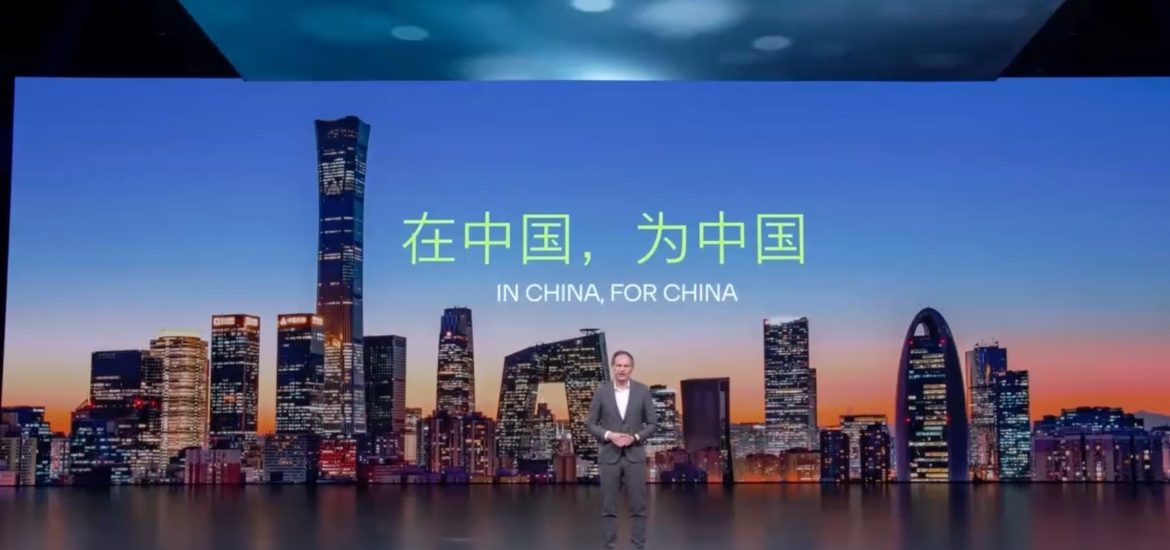

Any doubt that China has become the heart of the global automotive industry is quickly dispelled by a visit to the country’s main auto show. This year’s Beijing event, noisy and crowded, was twice as large as in 2024 and featured about 180 new cars on display. The show, which ended on May 3, once again demonstrated that foreign car makers are lagging behind their Chinese rivals in the race to the future of the industry – writes The Economist.
[…]
THE GROWTH OF THE CHINESE MARKET
Slowing down China’s meteoric rise is vital. The market share of foreign companies in China has nearly halved in five years, standing at about 30% in 2025. Moreover, in 2023 China surpassed Japan to become the world’s largest car exporter. In 2025, over 8 million vehicles were exported abroad, a third more than the previous year. In Europe, over the past five years, Chinese brands have gone from almost nothing to nearly 8% of all sales.
INNOVATION AND TECHNOLOGY
Chinese cars are affordable and packed with cutting-edge technology. Often in collaboration with local tech giants, the country’s automakers have developed software that represents an increasingly important source of differentiation.
The pace of innovation is staggering. The “Chinese speed” has become the industry’s tempo, as Ola Kallenius, head of Mercedes, states. Traditional industry product development cycles, which take 40 to 80 months, now seem painfully slow. Production processes designed around electric vehicles (EVs), combined with deep vertical integration and a greater willingness to improve vehicles after launch through software updates, allow everything to be completed in a maximum of 24 months in China.
PARTNERSHIPS
To catch up in the electric vehicle sector, foreign car manufacturers have sought help from Chinese companies. Volkswagen, which is launching 20 new models in China this year, has partnered with XPeng and Horizon Robotics. Toyota, which will produce electric versions of its Lexus brand near Shanghai starting in 2027, is working with Huawei and Tencent, as well as Momenta and Xiaomi. BMW and Nissan have done the same with local companies.
[…]
FUTURE CHALLENGES
Will efforts to become more Chinese succeed? Pedro Pacheco of Gartner warns that Chinese speed is not a “magic formula,” but a mindset very difficult to match. It is the result of a work culture with long hours and an industry built from the start around electric vehicles and software. Converting historic car manufacturers, which for decades have relied on gasoline engines and mechanical engineering, will be a tough task.
Furthermore, relying too much on partnerships risks creating a dependency that is hard to break. Philippe Houchois of Jefferies believes that foreign carmakers may intend to move away from Chinese partnerships in the future, but this could prove difficult unless traditional companies manage to transform into successful software enterprises.
Therein lies the challenge. To avoid being irreversibly left behind by Chinese competitors in the electric vehicle sector, traditional manufacturers may have no choice but to form partnerships. But by doing so, they risk ceding expertise in the areas that will define the future of the automotive industry, leaving themselves at the mercy of the competitors they fear most.
(Excerpt from the foreign press review curated by eprcomunicazione)




