


The first industrial plan of Antonio Filosa does exactly what was announced: it refocuses on the US, marginalized under former CEO Tavares to the point of upsetting not only the Uaw, the powerful American metalworkers’ union, but even then-President Joe Biden. The numbers are impressive: globally, 60 billion in investments and 60 new models are planned, but if you look beneath the surface, you realize that most of that money will land in the United States, since Stellantis intends to prioritize two American brands, Jeep and Ram, while Europe will have to share what remains with emerging markets (where the group is increasingly present not only as a distributor but also as a manufacturer, from North Africa to South America).
THE AUTOMOTIVE CENCELLI MANUAL
For now, contrary to the advice of multiple analysts, Stellantis is not selling any brand in its portfolio, not even DS, which has never performed well for a single day. But it is reorganizing them forcefully. Four pillars on which it intends to globally base its business: two American (Jeep, Ram), one French, Peugeot, and one Italian (Fiat). It looks like the Cencelli manual applied to the automotive industry and it is clear that it is the result of Neapolitan balancing acts and Savoyard cunning.
In this way, the group tries to respond both to the criticisms coming from France, which for some time have been grumbling about being sidelined and having to digest the recent decision by management to stop production at Poissy, a hub on the outskirts of Paris, to transform it into a reconditioning plant, as well as to the – much more modest and docile – criticisms coming from Italy, reminding that multiple plants remain in a disheartening state of perpetual layoffs.
STELLANTIS’ BRAKE IN EUROPE
But the reality is that in Europe capacity will be reduced by over 800 thousand units. To mask the problem, reliance will be placed mainly on partnerships (Madrid, Zaragoza, Rennes) with Chinese players eager to enter the Old Continent bypassing Brussels’ tariff shield on electric cars made in China. Hence the recent accelerations with Leapmotor and Dongfeng.
The hope is to bring plant utilization from 60% to 80% by 2030. But scratching the European brand reveals precisely the Asian one, implementing a strategy that many observers fear is dangerous and short-sighted, like letting the fox into the henhouse hoping it will eat the mice and leave the hens unharmed.
THE DOWNGRADE OF ALFA ROMEO
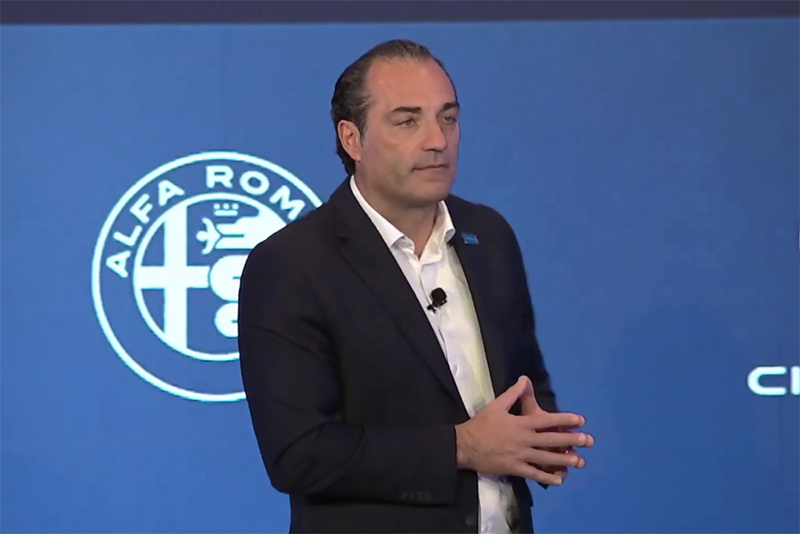
Two American brands – Chrysler and Dodge – and three important European brands (Citroën, Opel, and Alfa Romeo) will be downgraded to regional and “will share the same global assets.” Whatever that means, it does not seem like good news at all for the Biscione, a historic stable long in identity crisis and with few models.
Let’s be clear, Alfa only has appeal in the Old Continent, that is known. The desire to regionalize it follows a logic. However, there are fears it will become marginal, as noted by industry journalist Andrea Malan on the pages of Il Domani: “there is no talk of heirs to Giulia and Stelvio, and the only new product by 2030 will be the heir to the Tonale SUV.”
A BLUNT LANCIA
But the news that probably hurts car enthusiasts the most is the decision to place Lancia under Fiat, exactly as DS will end up under Citroën. The two most limping brands of the Group are thus “placed under administration.” Forgetting that the Piedmontese company has always supplied its flagships to the Quirinale while now it is the shadow of what it once was, as demonstrated by the numbers: in 2025 sales stopped at 11,754 units while not even 10 years earlier, in 2016, they stood at 67,225.
And Maserati? Here too answers were expected, given the unsustainable working and economic conditions in which a stable too long forgotten by management finds itself (weighed down by a 2025 loss of 840 million and a terrible start to 2026: sales collapsed by 41% in the first quarter), while only half confirmations arrived on the alleged plan shared with the Chinese partners Jac and Huawei. The two Asian partners are not mentioned but two models in the pipeline are talked about for the Trident as per rumors released in recent days.
Aware that on this point Stellantis management must provide an answer (which it has been postponing since the time its chairman, John Elkann, was summoned to Parliament), the Group tries to calm the waters by talking about a presentation to be held in Modena in December this year. Everything still postponed, in short.
AND THE ITALIAN PLANTS?
Just as there is still no certainty about the future of the Italian plants, from the historic Mirafiori plant, which “celebrated” 18 years of layoffs last year, to Cassino, which even seemed to be at the center of interest from Byd with a visit that took place very recently but categorically denied by the Chinese.
In the disinterest of unions and the political world, in the last five years Stellantis has already cut over 12,000 jobs in Italy: today it has just over 30,000 workers and more than half (56 percent) are either on layoffs or benefiting from solidarity contracts. All this, it is sadly known, while the company increasingly looks to North Africa, where it intends to rebuild the same supply chain established here in Italy around its factories, scouting among Piedmontese third parties.




