

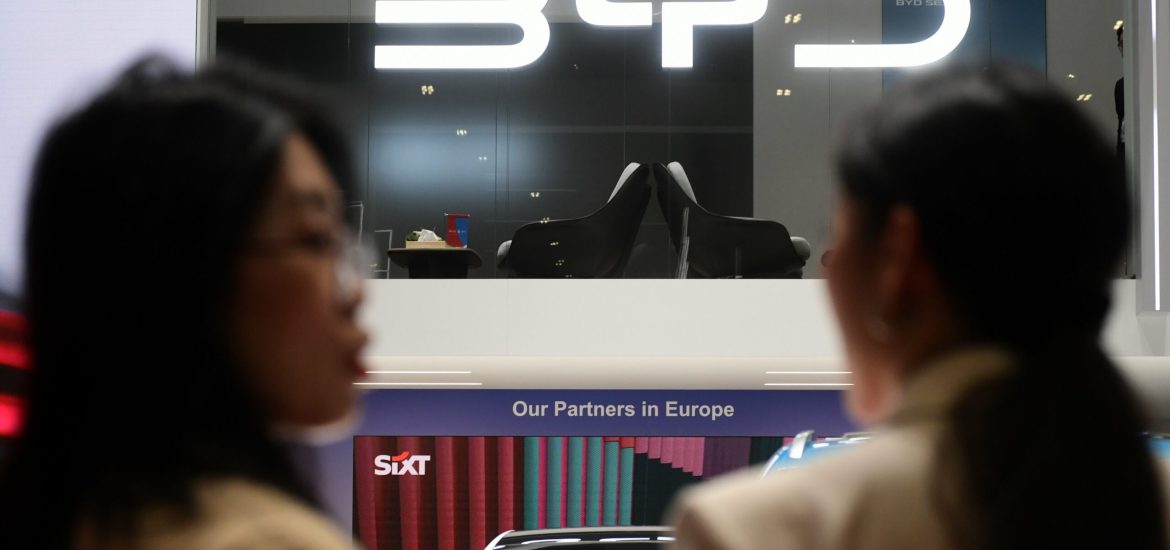

Byd is undoubtedly the most aggressive and feared Chinese brand by local manufacturers, but it is not the only one and, above all, it is not doing very well as its accounts show.
THE AUTOMOTIVE GIANT STALLS
The Shenzhen brand had to admit a decline in net profit for the fourth consecutive quarter and this time the drop was 55%. Translated into figures, the Asian giant, the only one so far to have managed to surpass Tesla in electric car production, stopped at 4.08 billion yuan, the lowest in the last three years. To be clear, 4.08 billion yuan, equal to 511.3 million euros, remains a remarkable result especially at these latitudes, but it also certifies the existence of problems. Also because in the same period revenues fell by 12% to 150.2 billion yuan, which in our currency corresponds to 18.82 billion euros.
WHAT IS SLOWING DOWN BYD
Not surprisingly, since the phenomenon, far from being underground, has been closely followed here on Start Magazine, what has hit Byd’s financial results first and foremost is the price war erupted in China when the government ended almost all blanket incentives through which it had funded its local manufacturers with the intent of turning them into international champions, but which distorted the domestic market and created a multitude of competing companies.
THE COMPANIES THAT ARE HOLDING BACK THE CHINESE NATIONAL CHAMPION
These four consecutive quarters of decline must be examined keeping in the background the rapid growth of the outsider Xiaomi, probably one of the few Big Tech companies to have kept its intention to debut in the car market (on the opposite side of the Pacific Cupertino has backtracked on the Apple Car project) and the competition from more experienced players such as Geely Automobile Holdings.
GEELY ALSO HAS SOME ISSUES
But the internal struggle, which Beijing has tried to avoid at all costs, has also cost Geely dearly, which recorded a profit attributable to the parent company’s shareholders of 4.17 billion yuan, with a slowdown of 27 percentage points. Dragging down the Hangzhou manufacturer’s accounts in this case was also the European Volvo. Geely’s Swedish subsidiary announced a 26% drop in net profit in the first quarter, equal to 67 million euros – due to US tariffs and a hostile American market – and a revenue decrease of 12% to 6.7 billion euros.
A SITUATION THAT SHOULD NOT MAKE WESTERN RIVALS FEEL AT EASE
With a domestic market now unable to absorb the immense production of the many local players, it is clear that the attention of Chinese brands will increasingly turn to new lands to colonize. And since the US has already entrenched itself behind high trade walls, the eyes of manufacturers from Beijing and surroundings are set on Europe. Byd’s foreign sales have not coincidentally jumped by over 50% in the first quarter, driven by the surge in oil prices which has stimulated demand for electric cars. Exports accounted for about 45% of Byd’s deliveries in the first quarter, putting the company on track to reach its goal of selling 1.5 million cars outside China this year.
Europe is also timidly trying to entrench itself behind protectionist-style policies to protect its industrial heritage: after the stealth adjustment of tariffs on electric cars made in China, the Industrial Accelerator Act should mainly favor supply chains established in the 27 member states. For this reason, Beijing has already stated that “China will closely follow the legislative process and is ready for dialogue,” but “If the EU ignores the suggestions and insists on adopting this text” as it currently stands, “damaging the interests of Chinese companies,” the Dragon Country “will have no choice but to adopt countermeasures.” In short, even in the automotive field Brussels finds itself caught in the trade vise of Washington and Beijing.




