

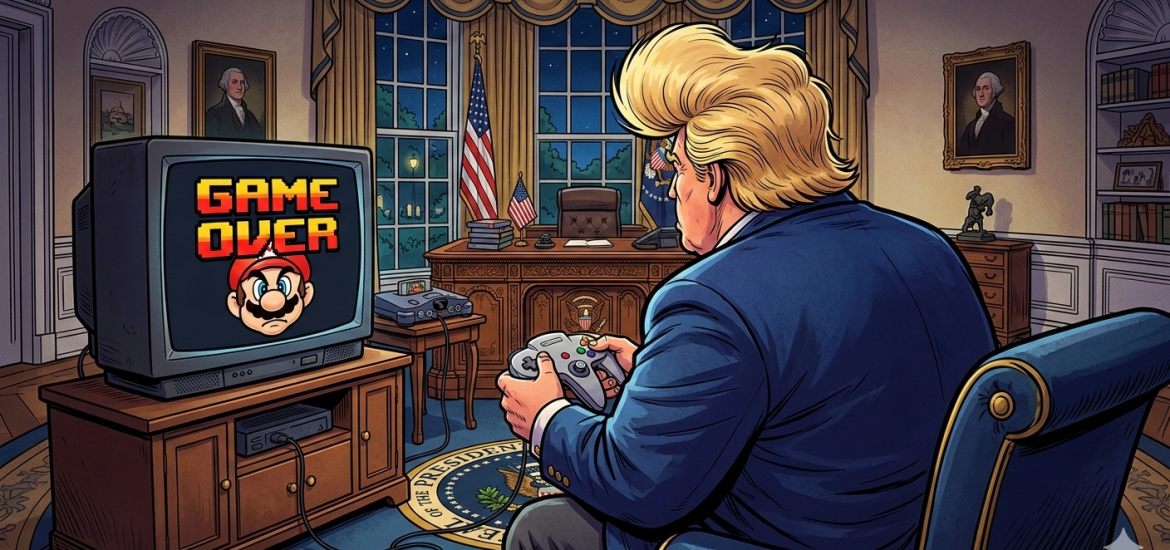

According to the Japanese video game giant Nintendo, the Supreme Court ruling last Friday, February 20, which rejected the tariff measure under the IEEPA (International Emergency Economic Powers Act, the federal law that grants the president broad powers to regulate trade and financial transactions in response to “unusual and extraordinary” threats to national security), means not only the halt of collection – although, in the meantime, the Trump administration has taken action and enacted new tariffs, whose legal basis is Section 122 – but above all having the right to request back the sums paid without the current White House occupant having the authority to impose them.
NINTENDO SUES THE TRUMP ADMINISTRATION
Already last year, Nintendo had declared that customs tariffs had damaged its business in the North American country, causing the suspension of pre-orders for its new Switch 2 console, released in June 2025 and produced in Vietnam and other Asian countries to which Donald Trump had raised high walls of protectionism at customs.
A DAMAGE OF TWO HUNDRED BILLION DOLLARS
The Kyoto-based company, which in the document seen by some U.S. media identifies among those responsible the U.S. Trade Representative, Jamieson Greer, the Secretary of Commerce, Howard Lutnick, the Secretary of the Treasury, Scott Bessent, and Kristi Noem (the former U.S. Secretary of Homeland Security recently fired by Trump), does not detail, at least according to what has been reported, the exact amount of the damage suffered, limiting itself to recalling that in total something like 200 billion dollars not owed would have entered the American treasury.
An estimate far exceeding the range between 130 and 170 billion previously estimated related precisely to the sums collected by the U.S. and which companies worldwide could now demand back. The high-tech company argues that the court must intervene regarding the refund request “within two years from the cause of the first action.”
WHO IS MOVING AGAINST THE TARIFFS
The risk for the North American treasury is that the tariff war now gives way to a legal battle that leads to exorbitant compensation claims. Two dozen U.S. states have already filed lawsuits against the new tariffs that the American president imposed after the Supreme Court’s intervention, this time using Section 122 as the legal basis. Even now, governors and Attorneys General argue not only that he had no authority but that his actions are jeopardizing the solidity of the U.S. economy.
At the same time, over 1,000 companies intend to drag the Trump administration into the United States Court of International Trade because, with the stroke of the pen by the judge of U.S. laws, every legal basis supporting the tariffs paid so far would have disappeared: in addition to Nintendo, the French beauty giant L’Oréal, the U.S. hypermarket chain Costco, the British vacuum cleaner manufacturer Dyson, the contact lens maker Bausch + Lomb, the tire manufacturer Goodyear, and the American shipper FedEx have moved.
NINTENDO AGAINST TRUMP ALSO FOR POKéMON
But tariffs are not the only reason why Nintendo and the Trump administration could face off in court. The Kyoto-based company did not appreciate the “institutional” communication that, by taking wholesale images, graphics, and logos from a freshly released Pokémon-themed video game, Pokopia, rolls out on the White House’s social media the usual slogan “make America great again”.
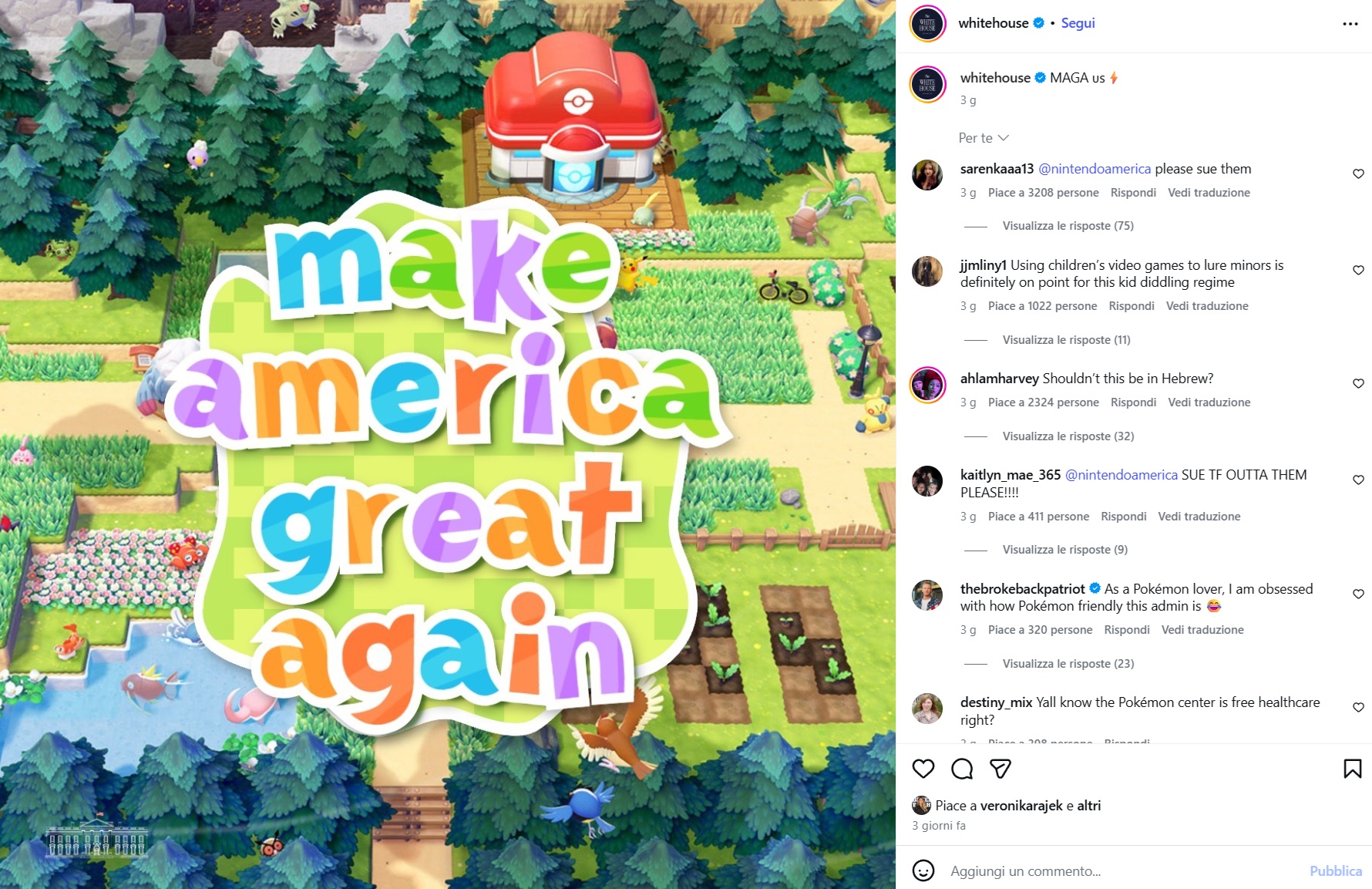
“We were not involved in its creation or distribution, and no authorization was granted to us for the use of our intellectual property,” declared The Pokémon Company spokesperson, Sravanthi Dev. “Our mission is to unite the world, and this mission is not affiliated with any political vision or program.”

What Pokémon clearly visible in the background have to do with the Maga communication is hard to say, also because it is an entirely Japanese intellectual property, but despite the name of the video game the Trump social strategists referred to, Pokopia, it is obvious who copied whom…




