

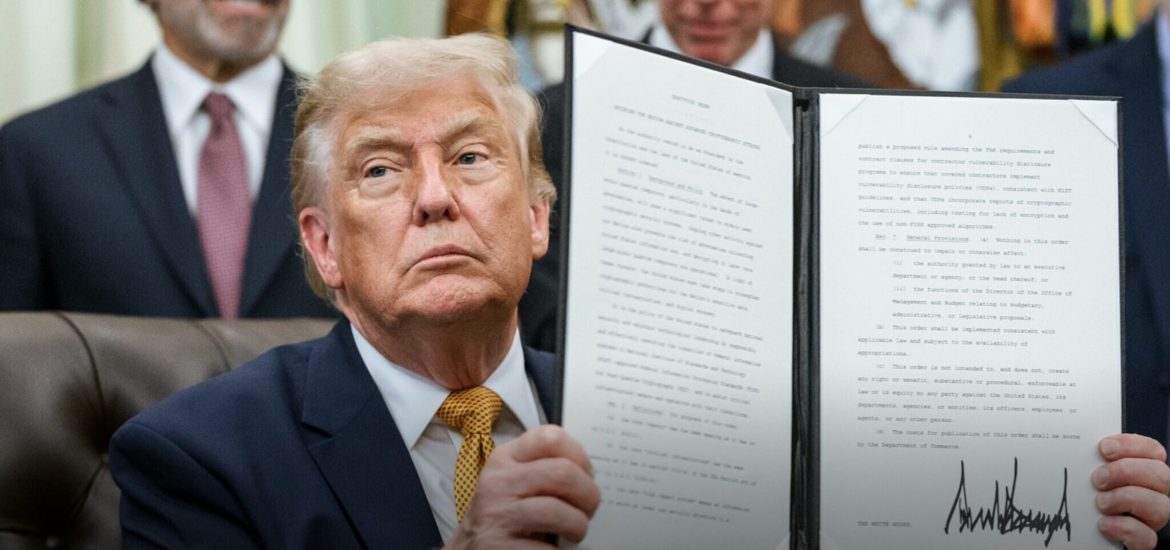

U.S. President Donald Trump signed two executive orders on Monday to stimulate the development of quantum computing and to ensure the defense of government computer systems from attacks based on this technology.
WHAT IS QUANTUM COMPUTING
Simply put, quantum computing applies the principles of quantum mechanics – from which the name derives – to achieve extremely high computing capabilities.
Quantum computers, unlike traditional ones, do not “work” on bits, which are either 0 or 1, but on qubits, subatomic particles that can represent various possible combinations between the two values: this ability is called “quantum superposition” and allows qubits to “exist” in multiple states at the same time.
Another peculiarity of quantum computers is that they work on problems in parallel, rather than sequentially: essentially, they can simultaneously calculate many potential results and solve problems impossible for traditional processors, or reach results much faster.
At the moment, however, these devices are mainly used in research fields and commercial applications still seem distant.
IMPLICATIONS FOR NATIONAL SECURITY
Besides being revolutionary for the economy, quantum computing technology could represent a formidable weapon in the hands of governments.
For example, quantum computers could be used to break current encryption systems, those protecting infrastructures and sensitive data: these systems are designed to withstand currently available computers, which would take too long to crack the alphanumeric combinations set, but quantum computers could “break” such protections with relative ease.
THE COMPETITION WITH CHINA…
As demonstrated, in a way, by the drafting of the two executive orders, the Trump administration wants to ensure that the United States maintains technological primacy in quantum computing and does not fall behind in the competition with China, its main political and economic rival. Moreover, Washington has for years acted to prevent Beijing, through export controls, from developing quantum computing technologies.
The major companies focused on quantum computing are all North American: for example, Rigetti, D-Wave, Infleqtion, and IonQ. But also the Big Tech companies, like Microsoft and Google, are active in this field. In China, instead, two of the main names are QuantumCTek and Accelink.
… AND GOVERNMENT INVESTMENTS
In May, the U.S. Department of Commerce announced a $2 billion investment to acquire stakes in some quantum computing companies: the aforementioned D-Wave, Rigetti, and Infleqtion will each receive $100 million, the same applies to Atom Computing, PsiQuantum, and Quantinuum; Diraq will receive up to $38 million; while Andreon – a subsidiary of the IBM computing group dedicated to quantum chips – will get 1 billion.
This further direct intervention in “critical” companies for national security seems to confirm the United States’ move away from the traditional model based on external constraints on companies – such as export controls – and a shift towards the so-called European “state capitalism,” where state presence in company capital is much more frequent.
WHAT TRUMP’S EXECUTIVE ORDERS PROVIDE
One of the executive orders signed yesterday by Trump aims, as mentioned, to ensure the security of government computer systems from cyberattacks based on quantum technologies: the White House set a date – between 2030 and 2031 – by which these systems must complete migration to post-quantum cryptography.
Furthermore, the Department of Defense – also known as the Pentagon – must equip itself with quantum sensors by 2028. These could prove useful, for example, for navigation in war zones where traditional positioning systems are not accessible. Or they could be installed on satellites to facilitate the detection of underground activities on Earth, such as tunnel construction or missile launch facilities.
Besides the Pentagon, other government agencies must also develop plans to acquire quantum sensors within the next five years. Finally, the executive orders aim to strengthen international cooperation on intellectual property protection and the security of quantum supply chains.




