The software house of Sam Altman continues to rack up spectacular farewells, like those seen in the turbulent period when the CEO managed to get back in the saddle after being unseated by his own Board of Directors.
WHO IS LEAVING OPENAI AND QUESTIONS ABOUT SORA
In recent hours, the resignations of Bill Peebles – the man who led the development of Sora – and Kevin Weil, vice president of the scientific section, have made particular noise. The first farewell revives many questions left unanswered after OpenAi’s sudden decision to shut down the Sora project, the “branch” of the smart algorithm dedicated to creating very realistic videos.
At the time, the explanation for the abrupt halt of work was sought both in the computational effort required for the “serial” generation of such content and in the uncertainty regarding revenues. Certainly, the latter theory was the least convincing, since Disney had already signed a partnership worth about a billion dollars and the software’s applications seemed endless, especially in advertising.
However, since during its lifetime the app generated between 1.4 and 2.1 million dollars in revenue against the 1.9 billion produced by ChatGpt in the same period, many continue to see an economic motivation, although one should also consider the fact that, by doing so, Sam Altman’s software house has decided not to maintain a field that has now become hunting ground for rivals, starting with the Chinese ones. The computational effort theory also did not satisfy everyone: TechCrunch observes, for example, that after the peak of over 3.3 million monthly downloads, installations had dropped significantly in the following months.
INTERNAL CONVULSIONS AT OPENAI?
In short, the impression is more that this is the temporary emergence of those hidden conflicts within the company that have been talked about for a long time and that have currently taken shape in the decision, far from shared by all, to pivot to projects and processes still unknown to the general public but firmly pursued by management (some even bring the Pentagon into the picture, but the risk is falling into crude conspiracy theories).
Weil’s departure was also reportedly made reluctantly, with newspapers reporting rumors that the entire scientific division responsible for the Prism project (a digital workspace designed specifically for researchers) will be downsized and the work done so far put on ice, except for channeling some specifics into the Codex app. A decision that the unit’s vice president must not have welcomed favorably.
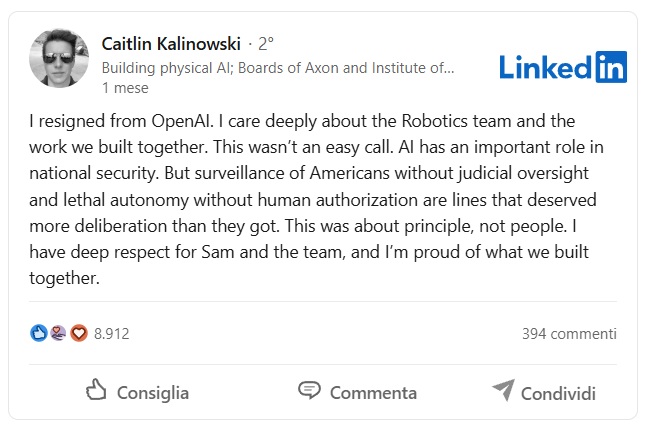
As mentioned, OpenAi’s life has been marked by important departures, starting with those of Helen Toner, Tasha McCauley, Jan Leike and Ilya Sutskever who left immediately after Altman’s return to the CEO chair. Then Peter Deng, Greg Brockman and John Schulman left, but the list would be much longer. The latest case dates back just to last March when Caitlin Kalinowski, recruited in the robotics division, chose to slam the software house’s doors behind her. Doors that had been opened for the first time only 16 months earlier. The reason? As in many previous cases, this time also ethical: the agreement signed between OpenAI and the Pentagon.