



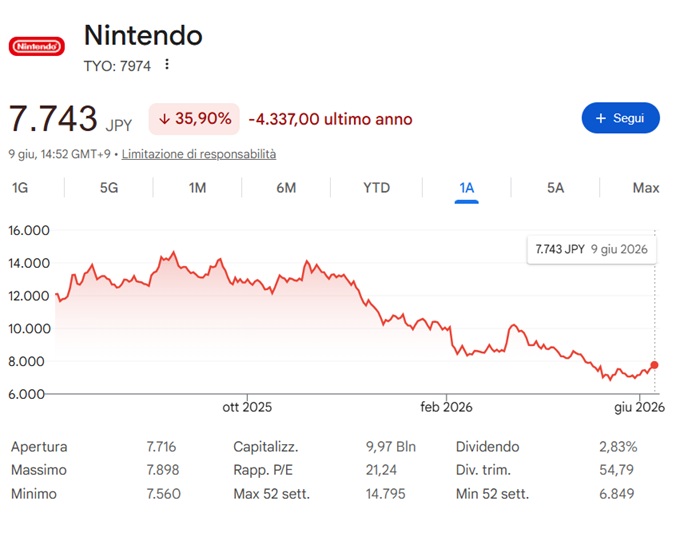
The generation that saw the release of PlayStation 5, Xbox Series X|S, and Nintendo Switch 2 will be universally remembered as the first with prices continuously adjusted upwards. Until today, in the hi-tech environment, the opposite had always happened, given the rapid aging of onboard technologies. International crises, tariffs, and shortages of chips and RAM have instead pushed the three major market producers, the Japanese Sony and Nintendo and the American Microsoft, to raise prices. Nintendo Switch 2 was the last to follow the rivals, foregoing more aggressive pricing policies so as not to erode too much those margins that have led its shares to a steady decline recently.
DID BLOOMBERG SEE IT RIGHT?
Already last March Bloomberg revealed that the Kyoto-based company had opted for a drastic cut in Nintendo Switch 2 production. However, costs did not weigh on that decision. Or rather, the Japanese company decided to reduce stock accepting the risk that producing later could cost more. Why? To avoid another risk that scares manufacturers when things go wrong: that of full warehouses.
HOW MUCH HAS NINTENDO SWITCH 2 SOLD?
The question, therefore, is how the new Nintendo console performed in its first year of life. According to official data, it would have sold about 20 million units worldwide while on the software side it would approach 50 million video games (precisely, 48 million, but it should be noted that this number also includes digital titles sold for a few euros). A satisfactory start considering that in the 12 months since its debut, the rival PlayStation 5 sold about 13.4 million units globally.
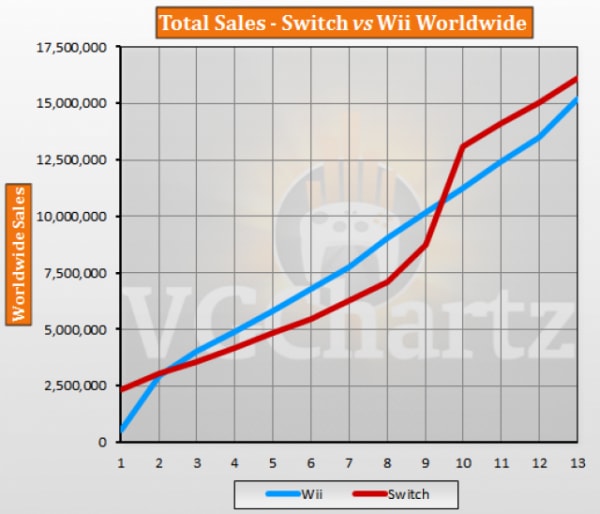
But above all, despite difficulties, Switch 2 has proven more performant than its burdensome predecessors. Indeed, by retrieving old VgChartz reports, it is discovered that 13 months after launch Nintendo Switch sold 16,108,373 units while going even further back, the Wii sold 15,192,774 copies. Obviously, given the commercial flop, it is useless to take the Wii U as a point of comparison.
It remains to be seen whether the price increase announced worldwide by Nintendo (in the US and Europe after summer, while in Japan it has already taken effect) will affect sales.
WHAT IS RIVAL SONY DOING?
What is certain is that at the moment Nintendo has only one price increase, compared to PlayStation 5’s four. The latest in April 2026 brought prices to $649 in the US for the edition with optical drive and $599 for the one capable of reading only digital games.
The penultimate increase took place on August 21, 2025 and made news for being the third in just four years and is probably indicative of the unique historical moment experienced by the global economy: the first, in 2022, was due to the chip war, the subsequent ones were caused by pressures on international supply chains and Trump’s tariffs which focused especially on Southeast Asia where consoles are assembled. Xbox itself, despite being American, had to raise prices again in December 2025 being hit by decisions made by the White House occupant.
Matthew Ball says Xbox shed “millions of subscribers” when the Gamepass price increased 50 percent in Fall 2025. pic.twitter.com/ESCr1iOEV8
— Geoff Keighley (@geoffkeighley) June 8, 2026
Also at the end of the year, Microsoft increased its online subscriptions known as Xbox Game Pass. Matthew Ball, new Chief Strategy Officer of the Xbox division, confirmed during the Summer Game Fest that this decision caused Redmond to lose “millions” of subscribers globally who evidently did not appreciate that the Ultimate subscription went from $19.99 to $29.99 per month.
GAMING IS GETTING MORE EXPENSIVE
Compared to the competition, in short, Nintendo users can consider themselves the luckiest. The only (so far) price increase of Switch 2 also brought the stock price up, but it is creating some turmoil in the markets. In September 2026, even in the Old Continent, the Japanese hybrid will go from €469.99 to €499.99 while the Japanese market has been the pioneer.
According to the industry magazine Famitsu, after the increase from 49,980 to 59,980 yen in the price of the cheapest Switch 2 model, total sales in the home country stopped at just 32,000 units. In the week of June 2, 2025, right after launch, for example, 947,000 Switch 2 units were sold. But without going that far back, in the week immediately before the price increase, the Nintendo console had totaled 247,880 units sold in Japan.
It is still too early to draw conclusions: part of this seesaw effect, most likely, was due to a mini-boom linked precisely to the announcement of the price increase, which pushed undecided buyers into a frantic buying spree, thus “boosting” the averages of the period. Instead, the recent announcement of a Nintendo Direct through which the software house will present upcoming titles for the next season and perhaps even the winter period might not be coincidental: a move useful to entice gamers and make them forget that gaming is becoming an increasingly expensive hobby.




