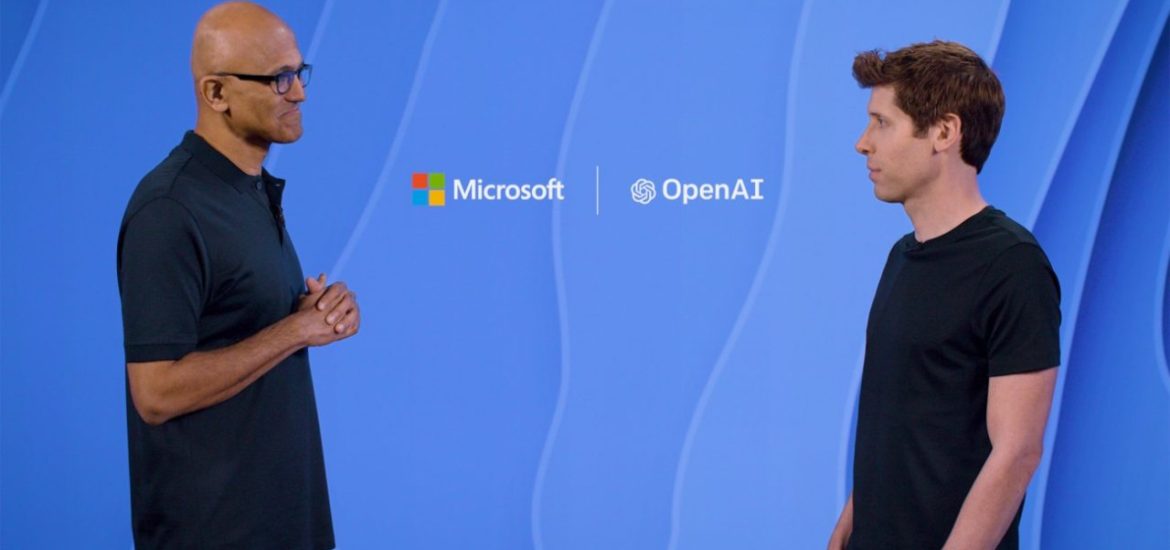

OpenAI, the startup of Sam Altman responsible for ChatGPT, the quintessential artificial intelligence algorithm, owes a lot to Microsoft. Redmond has indeed funded that entity with over 13 billion dollars. But their relationship has been anything but idyllic.
TENSIONS BETWEEN MICROSOFT AND OPENAI
Just last February, Mustafa Suleyman, head of Microsoft’s AI division (he is also among the co-founders of Google DeepMind), in an interview with the Financial Times finally admitted what the press had been whispering about for quite some time, namely that the company created by Bill Gates was pursuing the need to develop cutting-edge internal models, trained with large-scale infrastructures and highly specialized teams, essentially ceasing to be tied to third-party ones.
The partnership had been questioned on multiple occasions due to Altman’s “reckless” corporate leadership, who hinted at not appreciating the constraints imposed by Microsoft. The most critical point was reached when OpenAI and Amazon signed an agreement worth about 50 billion dollars that challenged a fundamental element of the contract with Microsoft, namely the exclusivity of the Azure cloud. The FT had also reported the rumor that Microsoft had long considered whether or not to take legal action against the giant founded by Jeff Bezos as well as its former “protégé,” OpenAI.
WHAT THE CONTRACT RENEWAL PROVIDES
The aforementioned incidents were only the latest skirmishes in chronological order; in reality, the disputes between Altman’s and Satya Nadella’s entities have long held a fixed place in the chronicles of tech-specialized outlets. But they may be destined to end as they reportedly led to the redefinition of the original contractual terms to satisfy OpenAI’s demands for greater freedom.
Microsoft will remain OpenAI’s primary cloud partner, and the products churned out by ChatGPT’s parent company will continue to be launched on Azure as a priority, unless Redmond decides otherwise. However, OpenAI will gain the freedom to distribute its products on any cloud provider, while Microsoft will retain the license on the models and products until 2032. A license that is no longer exclusive and, above all, with a clearly defined expiration date.
At the same time, the new agreements signed between the parties provide that Microsoft will stop paying a share of its revenues to Sam Altman’s now ex-startup on the way to IPO, while revenue share payments from OpenAI to Microsoft will continue until 2030, at the same percentage but with an overall cap, regardless of the technological progress achieved by OpenAI in the meantime.
In short, it is undeniable that the agreement, as it was likely amended for peaceful coexistence between the two parties, marks a strong loosening of the constraints that tied OpenAI exclusively, or almost exclusively, to Microsoft’s infrastructure, the first company to believe in Altman’s genius allowing it to reach where it is today. Microsoft, moreover, emphasizes that it will remain an investor in this rapidly rising entity.