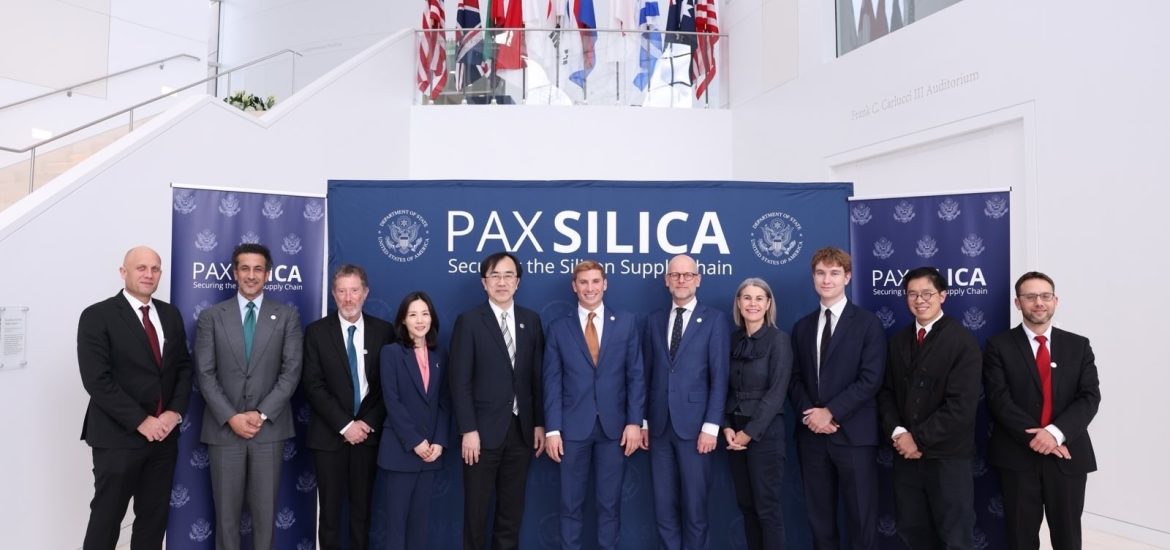

The European Union has formally joined Pax Silica, the US-led initiative to build secure and “trusted” supply chains in the field of AI.
The accession, which took place Tuesday in Washington during a dedicated summit, represents a significant step in the Western attempt to reduce dependence on China in strategic sectors such as semiconductors, critical minerals, energy, and digital infrastructure.
We are not talking about a binding treaty, but a declaration of intent that brings together allies and economic partners from different regions of the world.
Italy, after a few days of uncertainty linked to recent diplomatic tensions, has confirmed its participation with conviction.
What is Pax Silica
Pax Silica is defined by the US State Department as “the flagship effort on AI and supply chain security.”
The central goal is to promote a shared technological ecosystem among allies, capable of supporting innovation without excessive dependence on unreliable suppliers.
As stated in the official declaration from the State Department itself, the signatories “recognize that a reliable supply chain is indispensable for our mutual economic security” and that AI represents “a transformative force for our long-term prosperity.”
The text emphasizes the need to collaborate across the entire technological “value chain”: from foundational models to semiconductors, from critical minerals to energy, up to information networks, data centers, software applications, and transport and logistics infrastructure.
The aim is to “mobilize the creative and financial power of the private industry” and to reduce “excessive dependencies” through fair market practices, coordination on investment security, and countering non-market distortions such as overcapacity and dumping.
Jacob Helberg, Under Secretary of State for Economic Affairs and the main architect of the initiative, explained to the Financial Times that Pax Silica was born from the awareness that forums like the G7 or G20 are not suited to managing the AI economy.
“There is no grouping specifically built to manage the AI economy at a time when it is revolutionizing the shape of the global economy,” Helberg said.
The initiative promotes the concept of “innovation sovereignty” as opposed to “digital sovereignty” pushed by some multilateral forums such as the UN Global Digital Compact, which Helberg believes risks leading to “synchronized mediocrity.”
Participating countries
At the opening of the Washington summit, Pax Silica counted on a broad and geographically diverse group of participants.
Among the main signatories are: Australia, United Arab Emirates, Finland, Germany, Greece, India, Israel, Japan, Netherlands, Norway, Qatar, South Korea, Singapore, Sweden, Philippines, United Arab Emirates, United Kingdom, and the European Union as a whole.
Taiwan has embraced the principles of the declaration through a separate joint statement, although it is not a formal signatory.
This week new members joined: Argentina, Chile, Costa Rica, Kazakhstan, and Panama bring the total to 24 countries.
The EU’s collective membership represents a strong signal of European unity, alongside individual bilateral signatures from various member states. Sweden and Finland had already joined earlier, while the Netherlands, Germany, and Greece signed during Tuesday’s summit.
This coalition thus unites traditional transatlantic allies, key Indo-Pacific partners, and some emerging countries in Latin America and Central Asia, creating a network that covers much of the technological capabilities and mineral resources necessary for AI.
The role of the EU
The EU’s accession came after months of internal negotiations. As reported by Euractiv, the Council’s green light came only after American reassurances and requests, especially from Eastern countries, for guarantees on AI chip flows.
In addition to the EU’s collective signature, as we have seen, various member states also joined bilaterally. This dual membership – collective and national – underlines the strategic importance Europe attaches to its relationship with Washington in this field.
The Old Continent needs Nvidia chips for its AI computing infrastructures, while the United States depends on key European technologies such as Dutch ASML lithography machines and solutions from Ericsson (Sweden) and Nokia (Finland) for 5G and future 6G networks.
Italian participation
In Italy, the accession had a path not without obstacles. As recounted by the Corriere della Sera, after the public clash between Donald Trump and Giorgia Meloni, Rome’s accession seemed uncertain. However, a meeting at Palazzo Chigi unlocked the situation: “Nothing has changed: we will join with conviction,” the Prime Minister announced.
Italy considers Pax Silica not only a bilateral dossier with the US but a strategic project for the digital sovereignty of the West and for the development of industrial supply chains enabling AI.
Deputy Prime Minister and Foreign Minister Antonio Tajani played a leading role, being the only European representative to speak at the Washington ministerial on critical minerals in February.
The confrontation with China and geopolitical prospects
As highlighted by the Financial Times, Helberg presented Pax Silica as an alternative to the Chinese Belt and Road Initiative, criticized for lack of transparency, inefficiency, and “debt traps.”
The American initiative instead focuses on collaboration with the private sector and the creation of economic security zones, such as the one announced with Kazakhstan for minerals or the ongoing one in the Philippines.
Analysts cited by The Diplomat see Pax Silica as an evolution of the industrial policy started with Biden through the CHIPS Act and the Mineral Security Partnership, but with a more transactional approach typical of Trump.
Its effectiveness will depend on concrete support from the private industry and the ability to offer real commercial advantages, not just geopolitical ones. Dependence on potentially unstable regions and the risk of being used purely as an anti-China tool are however uncertainties.
Nevertheless, for many Indo-Pacific and European countries, participating means diversifying risks, attracting investments, and maintaining strategic flexibility in a bipolar technological world dominated by Washington and Beijing.