



Energy security and economic costs
Starting from the early 2000s, renewable energy production began to increase in most major economies, including Europe, the United States, and China, thanks to the rise in solar and wind capacity fed into the grid (Figure 1). Although clean energy production in these key markets continues to grow at an impressive rate, electrification rates – a measure of the share of electricity in final energy consumption – have suffered a significant setback in the EU and the United States, in stark contrast to China, where they continue to rise (Figure 2).
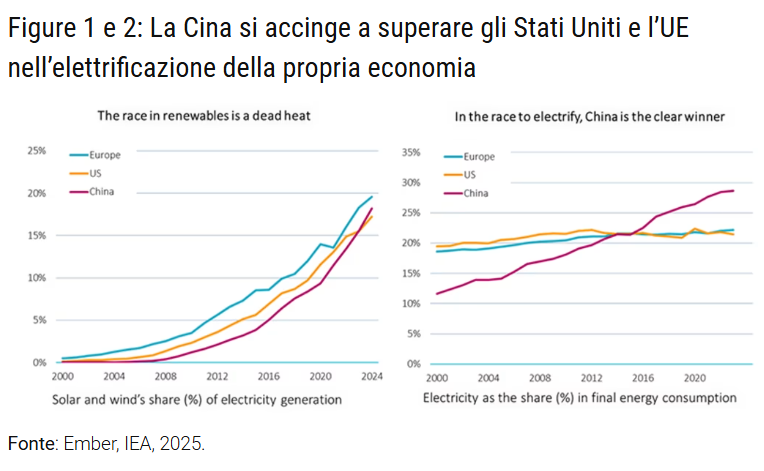
China’s rise in the clean technology sector was not initially driven by climate change, but rather by economic survival. Strategic assessments in the 1990s and early 2000s pushed China to expand high-end manufacturing capacity, including renewables, electric vehicles, and batteries. Energy security was also part of China’s motivation mix. As a net importer of oil and gas, the country is vulnerable to external supply shocks from dominant petro-states. An electrified economy powered by renewable sources offers a pathway to reduce exposure to external shocks and strengthen long-term economic competitiveness.
China’s dominance in numbers
China clearly confirms itself as the global leader in investments for the energy transition, having spent $800 billion in 2025 (about 35% of the total global spending of $2.3 trillion). Moreover, these investments are rapidly accumulating, with clean technology sectors nearly doubling their real value between 2022 and 2025. If these sectors were a nation, they would today be the world’s eighth-largest economy.
In the first half of 2025, China accounted for 67% of global photovoltaic plant installations. Nationally, wind and solar are on track to represent half of installed generation capacity by the end of 2026. Furthermore, no country comes close to China in terms of installed battery storage capacity and battery usage. Given its mastery of battery technologies, it is no surprise that in 2024, nearly half of all new cars sold in China were fully electric, making it the largest domestic market for electric vehicles. The country also boasts the largest charging network in the world, with nearly 66% of global public charging stations.
China’s dominance is not limited to the domestic market: the country is also a major global supplier of clean technologies. Estimates indicate that China currently produces between 70% and 80% of battery cells for electric vehicles worldwide and produced about 12.4 million electric cars in 2024, accounting for over 70% of total global production. The country also holds a dominant position in the battery storage supply chain, as 90% of applications in this area depend on Chinese-made components. China is also the world’s leading producer of heat pumps: it accounts for 40% of all units produced and controls 95% of the heat pump compressor market.
Not only cleaner, but also cheaper and more productive
Thanks to the scale and vertical integration of its national supply chains, China has managed to significantly reduce the cost of clean energy technologies. Solar panel prices have dropped by nearly 75% since 2022; wind turbine prices fell by 50% between 2022 and early 2024; and battery pack prices decreased by about 30% in 2024 alone. Finally, heat pump prices have also fallen in China, another critical technology for end uses, so that these devices now cost 40-60% less than in the EU and the United States.
Electrification beats fossil fuels not only in economic costs but also in sheer energy productivity. Renewables avoid the huge thermal losses inherent in fuel combustion, being two to three times more efficient in electricity production. Electric motors regularly achieve efficiencies of 80-90%, compared to about 20-30% for combustion engines and fossil fuel power plants. Heat pumps provide two to four units of useful heat per unit of electricity, thanks to their ability to transfer rather than generate heat, making them three to four times more efficient than gas boilers.
The United States continue to leverage their petrostate power
Under the Trump administration, energy and geopolitical policies shifted towards securing fossil fuel resources and protecting combustion-based consumption. Trump expanded oil and gas leases, relaxed methane and power plant emission standards, and repealed vehicle efficiency regulations. In addition, he issued a series of executive orders prioritizing fossil fuel production and the US export capacity.
Despite all Trump’s efforts to hinder clean energy growth, the US continues to benefit from the forward-looking energy policies of previous administrations, particularly Biden’s Inflation Reduction Act (IRA), which triggered a wave of investments in renewables and electrification. These investments are proving crucial to achieving Trump’s own advocated goal of US leadership in AI and data center infrastructure, sectors that require huge amounts of electricity. The fastest and cheapest way to meet this demand is large-scale solar energy, battery storage, and modern grid connections, which is why, according to the US EIA, 93% of all new generation capacity added to the grid in 2026 will come from wind, solar, and batteries.


