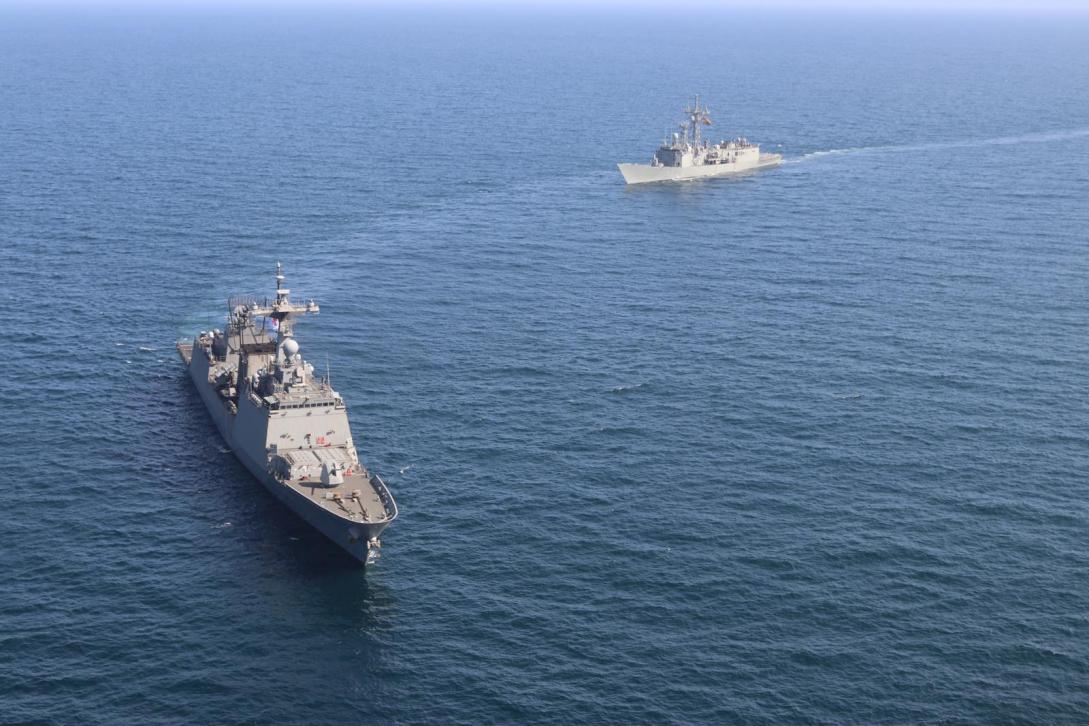
Iran has said it is willing to accommodate “any request” from Spain regarding the Strait of Hormuz, the most important waterway in the world for energy trade that the Iranian regime has effectively blocked, causing a sharp rise in oil and natural gas prices. At the moment, only ships flying the flags of a few countries – such as China, India, Thailand, and Malaysia – can pass through the strait without risking being attacked by Tehran.
WHY SPAIN?
Iran, through its embassy in Spain, has implied that it would also allow Spanish vessels to pass because it considers Spain “a country that respects international law.” This is the first concession Tehran has offered so far to a European Union country, and not just any: the Spanish government was the only European government to condemn the United States and Israel’s attack against Iran. Prime Minister Pedro Sánchez, of the Spanish Socialist Workers’ Party, also banned the Americans from using the naval base at Rota and the air base at Morón.
THE SPANISH RESPONSE
Spanish Foreign Minister José Manuel Albares said he did not understand the meaning of the Iranian embassy’s statement and recalled how Madrid had voted in favor of both sanctions against Tehran and the designation of the Revolutionary Guards as a terrorist organization. He also declared that Iran must cease its “unjustified attacks” against the countries of the Persian Gulf.
THE SPANISH MERCHANT FLEET
Although Spain, unlike Italy, is not very exposed to the crisis in the Strait of Hormuz – most of its gas supplies come from Algeria and the United States – it still feels the impact of rising fossil fuel prices.
And even if it wanted to accept Iran’s offer for passage through the Strait of Hormuz, the Spanish merchant fleet is small and would not be able to make a significant contribution to easing energy markets. According to the latest available data, the Spanish merchant fleet consists of ninety-one vessels, including six oil tankers and thirteen LNG carriers. Meanwhile, most of the ships controlled by Spanish shipowners fly foreign flags.
Reuters reported that currently no Spanish oil or LNG tankers are in the Persian Gulf.
SPAIN GETS GAS FROM ALGERIA
Minister Albares also announced that Algeria – also courted by Italy – will increase gas supplies to Spain. Algeria is already Spain’s main fuel supplier through the Medgaz pipeline in the Mediterranean Sea, 51 percent owned by the Algerian state company Sonatrach.
Medgaz has a capacity of 32 million cubic meters per day; in January and February, flows averaged 28 million, so there is room to increase supplies.
Relations between Spain and Algeria have improved compared to 2022, when Sonatrach said it wanted to raise the price of gas sent to Spain. The decision, officially motivated by economic reasons, was actually a political retaliation for Madrid’s support of Morocco’s plan – a regional rival of Algeria – on the autonomy of Western Sahara, a vast desert region located between Morocco (to the north), Mauritania (to the east and south), and Algeria (to the east, in a small part).