


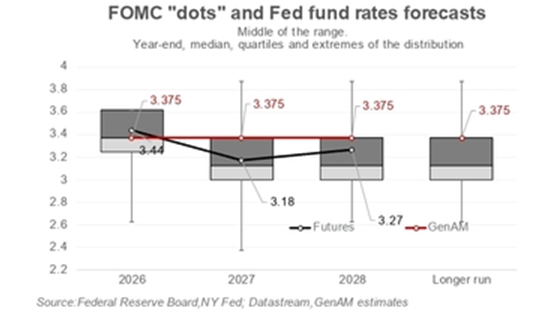
The Fed meeting, held in a context of high uncertainty linked to the war with Iran, ended with rates kept unchanged. The institution signaled a structural increase in the growth rate thanks to an improvement in productivity, which, however, should have little impact on inflation and unemployment. The expected increase in productivity also leads to an upward revision of the neutral rate.
The Fed also acknowledged the effects of high energy prices and tariffs, which push up short-term forecasts for core inflation and overall inflation. While leaving the median projection of the rate path unchanged, the risk balance now appears tilted toward higher inflation and weaker growth and employment.
The Q&A session focused on the impact of rising oil prices and possible economic repercussions. Powell explained that it is too early for an assessment, as the extent of the crisis is still uncertain. The FOMC will have more complete information by the next meeting, in six weeks. He also recalled that the US economy has shown resilience in recent years, despite several supply-side shocks and the sharp rise in interest rates.
Economic activity continues to grow at a solid pace, while the real estate sector remains the main weak point. The increase in productivity supports expansion and is attributed to investments that reduce labor demand and changes introduced in the way of working after the pandemic. However, it is too early to assess the impact of generative Artificial Intelligence, and Powell warns that prolonged phases of high productivity are rare and often revised downward. Despite growth prospects, job creation has stalled. The slowdown in immigration has almost halted labor force growth, leaving unemployment essentially stable since September. The labor market appears balanced, but it is a fragile balance, with significant downside risks.
Despite downside risks to the economy, these are not greater than those related to inflation. Core PCE inflation is expected to have risen to 3% year-on-year in February, mainly due to the effect of tariffs on goods prices. Once goods inflation returns to around 0%, disinflation should resume, although the FOMC is uncertain how long it will take for the higher price level to stop affecting inflation statistics.
The impact of tariffs on inflation remains the Fed’s main focus, and the possibility of ignoring the oil shock will depend on this and on the fact that inflation has exceeded the target for five consecutive years, with the risk that expectations become unanchored.
Monetary policy remains halfway between neutral and restrictive, with the official rate placed in the upper part of neutrality estimates. The FOMC believes it is at the right point to balance pressures between inflation and unemployment. Powell reiterated that any further rate cuts will require clear evidence of disinflation. However, he stated that talking about stagflation is exaggerated.
Powell will continue as interim chair of the FOMC until his successor, Kevin Warsh, is confirmed by the Senate. He will remain on the board until the conclusion of the Department of Justice investigation, which recently appealed against a federal judge’s decision to dismiss the case. Powell has not yet decided whether to remain on the board after the end of his term as chair, valid until May 2028.
Our forecast remains for an additional rate cut, not before September. The uncertainty linked to the oil shock hinders the necessary visibility, and the new chair, even if quickly confirmed, will hardly convince the FOMC to proceed with rapid cuts soon.
The meeting was overall not very significant, also due to the lack of important news from data and especially the uncertainty arising from the Gulf war. The two-year yield rose slightly (+3 bps) and the S&P 500 hit the day’s low upon the release of the news.




